Playground Extraordinaire

Yesterday we tried something new: we packed a picnic lunch and drove to Meinig Memorial Park in Sandy, a drive of about 45 minutes by the roundabout backroads route we took (because at least half the fun is the pretty drive). If you’re ever in that area with kids, I highly recommend that park. It has a huge playground with an enormous, castle-like, maze of a climbing structure. It’s kid heaven. The structure has myriad crawl spaces (which Niko called attics), hidey-holes, and towers. Bridges and passageways connect sections. I counted three slides of different styles and two swingsets, one with baby swings. Tire swings and hanging rings (a swinging version of monkey bars) dot the area. All around the perimeter are benches and seats, making it easy to keep an eye on the kids while resting.

And that’s just the playground. There’s also a huge gazebo, with gigantic tree trunks for supports and smaller ones forming roof supports. Then there’s a little outdoor amphitheater with a half-circle stage and stone seats, all set apart from the rest of the park by a low, wide stone wall that’s perfect for an adventurous boy to run daringly on shrieking “I’M A SUPERHERO!” A creek runs along one side, with a little bridge next to the amphitheater. Away from the busy playground, it was a perfect spot to sit in the sun and eat sandwiches in the fresh air.

The only drawback? The restroom building is kept locked. I presume it’s only unlocked for events or rentals, because we’ve visited twice and the bathrooms have been locked both times. Of course Niko, being a small boy, was delighted to have the opportunity to use the woods instead of a bathroom, but I wasn’t so lucky.

Bathrooms aside, it’s an amazing park. Niko had so much fun, and it made a relaxing family afternoon. What a perfect way to spend the day.


Baby Jesus, Elmo, and Bad Guys in Water at the Promised Land

We tried a new church a couple of Sundays ago. It wasn’t a great fit, but I did appreciate that the Sunday School and Children’s Church (yes, both — it was a long service) actually did some teaching about the Bible. Other times when we’ve dropped Niko in the Sunday School room at whatever church we’re trying out, he’s seemed not to register any lesson. This could be simply because he wasn’t participating. He’s gotten better at this, so maybe his time in preschool, rather than a superior presentation at this church, was what made a difference. Whatever the case, it was obvious that there was some Bible teaching happening this particular time.

What wasn’t so obvious was what Bible story was that week’s focus.

“What did you learn in Sunday School?” we inquired as we drove away.

“Weellll,” Niko replied thoughtfully, “there was an Elmo story. And Jesus was in the water with bad guys. And his Mommy and Daddy stayed safe from the bad guys.”

“Elmo?” we asked, confused. “The story was about Jesus and…Elmo?”

“Well, not Elmo. Not really Elmo. They were Elmo guys. Like on Elmo’s World.”

It took some intense detective work, but about halfway through the drive home we’d established that Niko had seen a puppet show, with characters that bore a resemblance to some of the characters on Sesame Street, with “pinkish brownish skin like ours, not red skin like Elmo’s. And the puppet Jesus had teeny tiny little hands!” However, we still couldn’t figure out what the story had been.

“So Jesus was in the water?” I asked. “Was it the story about when he was baptized?” This opened an entire new conversation in which I found myself trying to explain to my four-year-old the concepts of baptism, sin, and spiritual cleansing. Aaron smirked from the driver’s seat: not having been the one to broach the subject, he was perfectly content to let me do the clumsy explaining. It quickly became clear that it wasn’t the baptism story, anyway, so I cravenly abandoned theology and returned to the original question: “Why was Jesus in the water?”

“Was he in a boat?” Aaron suggested. “There are a few stories about Jesus in a boat.” No, no boat.

It wasn’t until after Niko’s nap that the story became clear. He stumbled out of his room, not really awake, and curled up next to me in the floor. “Why did Jesus’s sister put him into the water?” he mumbled, resting his head sleepily on my lap.

Sister.  Bingo.  “Was the story about a baby?” I asked. He nodded. A Bible story about a sister putting a baby into the water to keep him safe. “Are you sure the baby’s name was Jesus?” I probed. “Could it have been, maybe, Moses?”

And there it was. It had taken approximately five hours for us to figure out that the story that day had actually been the story of Moses’s sister Miriam keeping him safe from the Egyptians by hiding him in the river in a little cradle woven from reeds. It’s always been one of my favorite stories, but filtered through the mind of a four-year-old, it was almost unrecognizable.

I wonder what the next Sunday School lesson will be?

Junco Jamboree

Well, that was exciting.

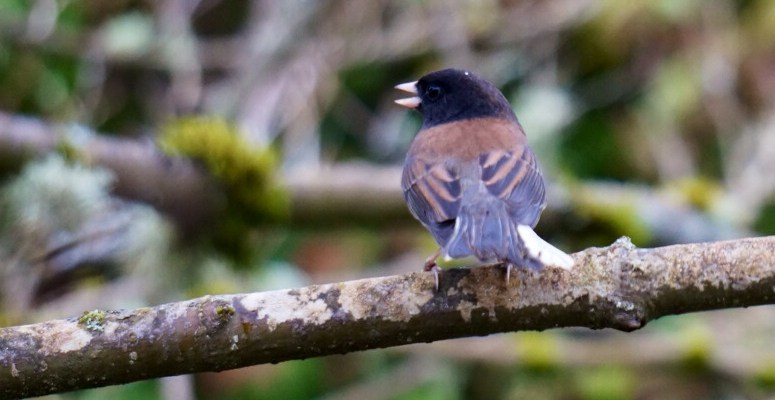
A sudden flurry of wings as I walked toward Sofia’s room caught my eyes. I looked up just in time to see the dark grey bird frantically rushing down the hallway. Aaron and I followed it into Sofia’s room, where it fluttered wildly about. Aaron went after it with his hat while I tried to take a picture, only to discover that my phone had no more room.

The bird dashed into Niko’s room, where it took refuge in the closet. As Aaron stalked it, it froze, and then made a run for the hallway, got confused, and headed back to Sofie’s room. This time I got ahead of Aaron, found it crouching behind the rocking chair, and then realized I had no camera. “Waitwaitwaitwait…” I called, rushing for the camera. But Aaron, singleminded, had already gathered it into his hat and was headed for the door. “Wait wait!” I begged. He paused briefly — just long enough for me to realize I was too close to focus with my long lens, which I’d been using earlier. I retreated down the porch, but the bird had already beaten a retreat to the vine maple. It perched there, beak gaping, where I finally managed to snap a couple of shots.

And that’s it. All that excitement, and all I have to show for it is one picture of Aaron lunging for the bird, and a couple of the bird sitting innocently outside on a branch.

IMG_2110-0.JPG

IMG_1934.JPG

Camels and Traplines

Niko has a highly unsettling habit of reading my mind. You may believe it or not, but I’m perfectly serious. It happens most often when I’m engrossed in a book, fully immersed. He’ll come up to me and say something or ask a question directly related to what I’m reading — maybe ask me to tell him the meaning of an unusual word I’ve just read. Other times, he’ll chime in mid-verse on the song that’s bouncing around my head. It’s inexplicable, but it’s happened too frequently to discount.

Example 1: A few months ago, I was reading a novel that referred to a tavern called the Three Pigs. Niko interrupted my absorption of a vivid description of the disreputable tavern to ask, “Why were the three pigs so dirty?” (Yes, the tavern was described as being a bit of a pigsty.)

Example 2: I’m reading Carl Hiaason’s book Trapline. It’s set in the Florida Keys, which threw me a bit because I was halfway expecting a northern setting, with that title (in the north, a trapline is the area a trapper sets his traps to catch furbearing mammals, on land). I had just gotten to the part where the main character’s trapline got cut, his shrimp traps destroyed and buoys stolen, when I had to stop to make dinner. Niko called to me in the midst of my reflection on the differences between traplines in British Columbia and in Florida: “Look, Mommy, a trapline!” He had stretched a tape measure across the entrance to the kitchen, grinning proudly.

Then there was the night not long ago when I asked Niko at bedtime what happy thing he was going to think about while he fell asleep (our magic no-nightmares trick). “Riding a camel,” he said promptly. “Could we ride a camel after we wake up?” I explained that we weren’t likely to find a camel nearby. “Then could we go to a place where there are camels?” I laughed and said, “Who knows, maybe someday we will.” But it didn’t seem likely.

Having kissed my strange little son goodnight, I went out to the kitchen and picked up my phone. There I found a text from Aaron, off on a business trip. The text read: “Want to go to Abu Dhabi?” He wasn’t completely joking. His company was looking for consultants who might be willing to travel there for three months.

Abu Dhabi. Known for palm trees, beautiful skyscrapers, white sand… and…CAMELS. They have a camel beauty contest there. And I’m willing to bet that Aaron was doing a quick bout of Google searching on Abu Dhabi right about the time Niko, who has never before expressed the faintest interest in camels, asked, “Can I ride a camel?”

Unsettling, that child is.

[Just to clarify: We have no actual current plans to travel to Abu Dhabi. Aaron’s company is at the “seeing who’s interested” stage, and my guess is they’ll send over some single analyst with no family ties so they don’t have to pay for housing for an entire family. But it’s fun to fantasize, right?]

Paczki

Yum. These look like a great Saturday breakfast!

JuJuwe's avatarmeraki

x-1X3bv97ZJiTA5LDdL0-X2OuqEM389vJE9U65Qvgn0

Bread is one kind of food that ever since I learnt to make it, I’ve never failed. I am not saying that I have mastered making it, just that the result is always good. Also, I found out that  homemade bread lasts longer in room temperature than the store bought bread. That’s why homemade cooking is always healthier than eating out, I believe this.

This is the first time I baked Paczki and I just love their taste. Paczki are Polish doughnuts . They are actually fried doughnuts but they can be oven baked as well. I did the oven baked ones. Traditionally they are filled with strawberry jam but again, you may fill them with any fillings you like. I went with vanilla custard and strawberry jam.

Every country may have this kind of doughnuts with their unique names .  In Indonesia we call it Donut Goreng . But according to…

View original post 367 more words

Build An Inexpensive Table Top Seed Starting Stand

I bet we could modify the existing countertops in our shed to do something like this. We’d just have to add a heater and we’d be good to go.

oldworldgarden's avatarOld World Garden Farms

One of the most rewarding experiences for a home gardener is to grow their own vegetable or flowering annual plants from seed.

There is nothing more promising for spring than to see the first sprout of a seedling! There is nothing more exciting to a gardener than to see the first sprout of a seedling!

It also can be a huge savings in place of buying plants at your local nursery or garden store each Spring! Not only is it expensive – you are also limited to whatever mainstream varieties they selected to sell – and to whatever chemicals, bug sprays and fertilizers they use in growing and maintaining the plants.

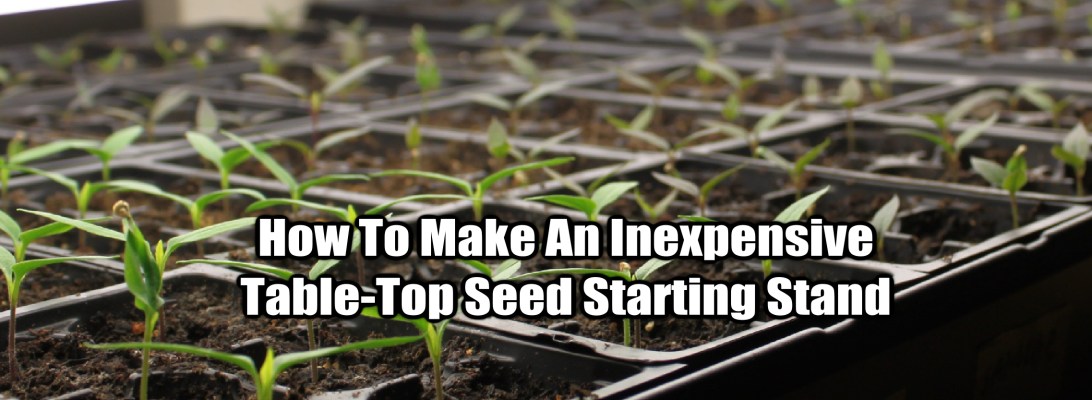
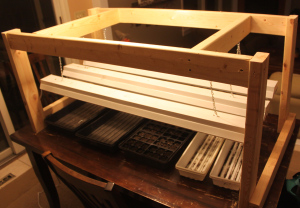
With this inexpensive and simple to build table-top seed stand – you can easily grow up to 4 flats of your favorite plants, ( 288 plants when using the 72-cell flats) – and have more than enough to fill your garden and flowerbeds!

The simple table top stand can hold grow up to four full flats of plants indoors - and can be used on top of an old table or any flat surface The simple table top stand can be used to start and grow up to four full flats…

View original post 866 more words

Elusive Hummingbird

Hummingbirds, I thought, hibernated. Or migrated. Or something. I’ve never put much thought into what I thought they did, but I’ve certainly never seen them in winter. When my family lived in northern British Columbia, we had the beautiful Rufous hummingbirds at our feeder, zipping around like little red and green living jewels on a perpetual caffeine high. They stayed all summer and then disappeared. [NOTE: If anyone read this when it posted itself yesterday after I explicitly instructed it to publish itself this morning, you’ll notice that I have now corrected my mistake regarding which hummingbird is common in British Columbia. Thank you to my mother for noticing.]

The hummingbirds we have here in Oregon are not as brilliant in plumage as the Rufous, but they’re still charming. My best guess, looking through sites like Beauty of Birds AvianWeb, is that either ours are the Broad-Tailed hummingbird, or I’ve been seeing female or immature Rufous hummingbirds. Anyway, since they are also tiny, high-energy birds, I’ve assumed they must have similar behavior. Gobble nectar all summer, vanish mysteriously once the weather turns cold. When our feeder froze solid in November, I figured the cold plus the lack of food would prompt our own hummingbirds to hibernate. Or migrate. Or whatever.

I kept thinking that until I read a blog post by Garden Fairy Farm, “Feeding Hummingbirds During the Winter.” Wait. What? We have to feed them in the winter? Turns out, hummingbirds are migratory birds. They don’t hibernate. But some of them inexplicably hang around their favorite spots instead of migrating. Oh dear… this could explain why my feeder has been looking emptier and emptier, until there’s now only a tiny bit of red liquid in the very bottom. The hummingbirds are still here! Or maybe just one, or… Who knows? The point is, with few insects for food this time of year (yes, they’re carnivorous — another surprise fact I turned up in a flurry of research after reading Garden Fairy Farm’s post), they actually need the food I’m providing. Apparently they can survive, if necessary, on the wells of sap that sapsuckers store up (another fascinating fact), but their chances of survival will increase if they’re given an additional food source like a hanging feeder.

My poor hummingbird! I feel like a terrible bird parent. Time to fill the feeder. Maybe they’ll reward me by letting me witness their presence this time around.

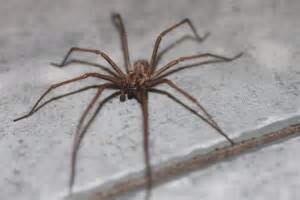
Ode To a Bathtub Spider

Your lovely, fragile legs
Your round, defenseless body
Zing a shot of terror
Through my jelly spine.

I shiver,
You scuttle.
I gasp,
You freeze.
Then scuttle
Again.

Who knows why
You descended
From your soft cobwebby pillows
Safe above my broom’s reach?

Why do you lurk
So ominously
So inscrutably
So terrifyingly
In my tub?

You are excluded
From my sacred assortment
Of things I may kill.

You pose no danger:
Neither to my body,
Nor my home,
Nor my food.
Upon death, your body will provide
No healing,
No shelter,
No nourishment.

But. The jelly
In my spine
Takes over.

Water on.
A brief swirl.
A pang of guilt,
Darkness passes through in my soul.
You are gone.
I bathe in peace.

Wintergreen

This last summer and fall, Aaron started experimenting with home brewing. He created a cherry wheat Hefeweizen that’s better than anything similar I’ve had yet, using cherries from our tree. He made an apple and a pear ale that both turned out to be very high in alcohol and low in carbonation, more like a wine than an ale, but are delicious despite being not what we expected. And he’s made three batches of root beer.

I didn’t know this before Aaron got interested in brewing, but the distinctive flavor in root beer is wintergreen leaf. When we learned this, we went out and got a couple of different traditionally-brewed root beers and sipped slowly, exploring the flavors — and yes, you really can taste it. However, when Aaron collected ingredients for his first batch of root beer, the brewing supply store didn’t have wintergreen leaf. They did have spearmint. He couldn’t remember for sure which leaf he was supposed to get, saw the spearmint, and decided it must be the right thing. The result was oddly delicious. Not really root beer, but an earthy, slightly herbal, dark-colored brew. It was REALLY GOOD. The brewing supply store still didn’t have wintergreen the second or third times he wanted to make root beer, so he just used spearmint again, knowing it would turn out to be good (though not exactly what one might expect from something called root beer).

Meanwhile, I was learning about wintergreen, trying to find a reliable source so we could try a batch of more traditionally flavored root beer. You can order dried leaves through Amazon, as well as seeds. I thought planting our own might be a good idea. They’re pretty plants, with shiny evergreen leaves and pretty white flowers in spring. The flowers give way to white berries later in summer, and then the berries ripen to bright red in the winter. Planting the seeds can be a bit tricky, as wintergreen is a cool-weather plant. You have to refrigerate the seeds before germinating them, and then you have to sprout them in a wet paper towel before planting. (I got my information at Heirloom Organics and Mother Earth Living.) It sounded a bit daunting, but I was prepared to try.

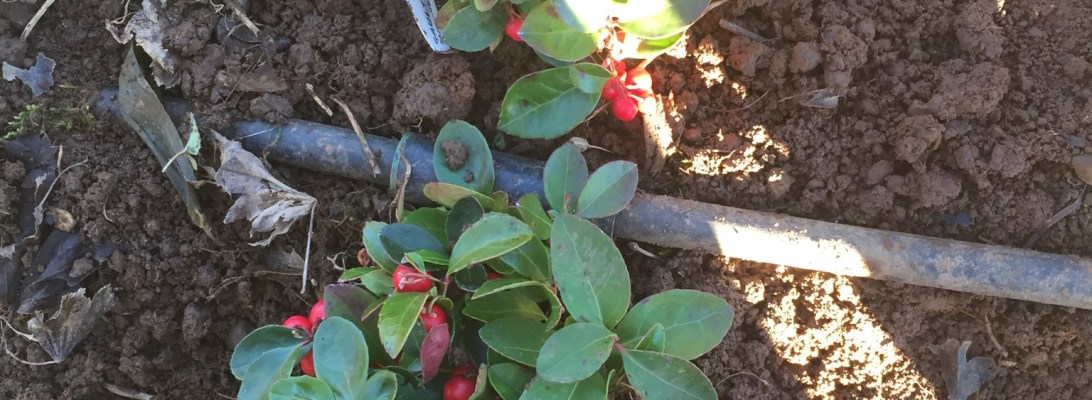
And then, sometime before Christmas, we were strolling through the little floral and garden section of a nearby New Season’s Market (a charming grocery store chain that originated in the Portland area), and saw… wintergreen! They were attractive little plants in terra cotta pots, and the plant marker confirmed what I’d read: they’re good ground cover, prefer acidic soil, like to be in partly shaded places. Aha! So much easier than planting from seed!

So we’ve had two little wintergreen plants sitting on our porch for a month and a half, waiting for me to decide where to put them. Finally, yesterday, I decided I needed to take care of them before they became hopelessly root bound. I did one more spurt of research and discovered the key: they need sun in morning and shade in the afternoon, and they need to be kept moist when they’re young. Right away I knew where they needed to go.

There’s a vine maple at the end of our larger pond that is perfectly positioned so the rising sun shines at its base. That spot gets light all morning until the sun is high, when the dense leaves of the little maple provide shade. The garden is set up with a sprinkler system, so it’s easy to keep the ground moist, and that area also gets watered when I water the vegetable garden. Perfect.

Yesterday afternoon, I went out with kids and puppy in tow and did some preliminary weed-pulling, then plopped the plants into the ground. With any luck, within a year or two they’ll spread and multiply to the point that we’ll be able to harvest some leaves now and then. Meanwhile, they’ll become more and more decorative as they grow, which is a nice side benefit.