Deirdre Fulton: ‘Everything is Awesome’? Not So Much for Middle Class, Says Warren

Something to think about.

Vox Populi's avatarVox Populi

Despite positive economic indicators, ‘America’s middle class is in deep trouble,’ says the progressive senator…

.
“For more than thirty years, too many politicians in Washington have made deliberate choices that favored those with money and power,” Sen. Elizabeth Warren (D-Mass.) said at the AFL-CIO’s first National Summit on Raising Wages, held Wednesday in Washington, D.C.

But by raising the minimum wage, supporting organized labor, breaking up big banks, and rejecting corporate-friendly trade deals and tax codes, it is possible to “un-rig the system,” she said.

Pivoting off a recent Politico article titled “Everything is Awesome,” in which journalist Michael Grunwald outlined several ways in which the U.S. economy appears to be on the upswing, Warren declared that “despite these cheery numbers, America’s middle class is in deep trouble.”

“A lot of broad national economic statistics say our economy is getting better, and it is true that the economy overall…

View original post 597 more words

Garden Planning

On Friday, Aaron said to me, “We should start planning what we want to plant this year.” And I said, “Oh, right, I meant to make something for that!” Because, as I so often do, I had had a brilliant idea for garden planning, but then I’d forgotten my brilliant idea. (Have I mentioned that a common characteristic of people with ADHD is forgetfulness?) Aaron’s comment jogged my memory just in time.

My brilliant plan had originally been to create a spreadsheet that listed the plants we already have, plus those we want to plant, with their key data: when to plant, what type of soil, best light, when to expect blossoms or fruit. I even thought of adding more details for flowers: average plant height, flower color, foliage color, and so on, for visual planning. In a spreadsheet, I thought, I could then easily organize by, for example, planting time, and voila! My spreadsheet would become a planting calendar. Or I could choose to order it by soil type to help me decide where to plant, and so on.

As I so often do when considering my brilliant ideas, I quickly realized that this one might be a tiny bit beyond my reach, at least this year, because a) I’m not really that great at creating spreadsheets, and b) this would be incredibly time-consuming. However, several years of teaching has made me REALLY great at designing charts and worksheets, and it occurred to me that if I made a printable chart with space for the same data, I could use it as a planning worksheet right now, and save the filled-in sheet for later…just in case I someday want to create a more complex data entry system for keeping track of plants in our garden.

I ended up making three sheets: one each for flowers, herbs, and vegetables. I may later make one for fruit too, but since we’re not planning on putting in any new fruit this year, that can wait. Each sheet starts with a place to jot down the following climate data: Sunset Climate ZoneUSDA Hardiness Zones (I found that link and information at The National Gardening Association); and the average time of the first and last frosts as well as last year’s first frost and this year’s last frost (you can find this information at Old Farmer’s Almanac and Dave’s Garden, among other places). I included a spot for both the Sunset Climate Zone and the USDA Hardiness Zone because they both provide advantages when planning what to plant. The USDA Hardiness Zone is used most often on plant labels and seed packages, but  it’s not nearly as useful in Western North America as it is in the East. That’s because it only accounts for average winter temperature, not for rainfall or snow. In the western half of the continent, both of those factors heavily impact what types of plants grow best, and both are highly variable over here even when winter temperature averages are similar. The Sunset Climate Zone system does take this into account… but since most plant distributors use USDA data, you have to do a bit more work to discover what plants grow best in each Sunset zone.

Then I added a table with the following headings: When to Plant, Best Soil, Light, Plant With…, Avoid Planting With…, Germination, and Bloom (or Harvest) Time. I’m pretty happy with the way it turned out. I’m leaving it out on the desk so I can quickly jot down plants that I think of, and later I can research to find information about planting, which I can then record as I have time. This is making me so excited! I can hardly wait to get started with planting!

If you click on the title above each chart image, you should get a PDF that opens in a new screen. That way, you can print these charts for your own use. Happy gardening!

Vegetable Planning                                  Flower Planning                               Herb Planning

Primroses

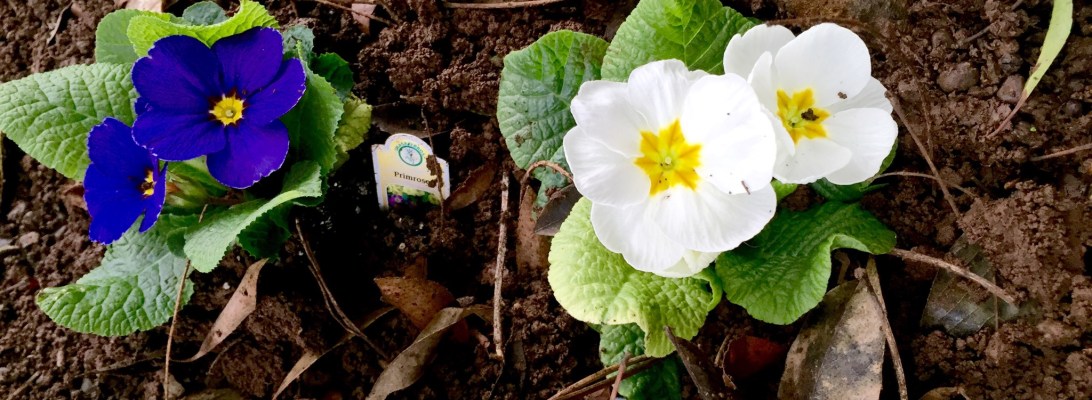
Today I stopped at Fred Meyer on the way home from dropping off Niko at preschool, and on the way in I passed by a big display of spring flowers: pansies and primroses for $1.50 each, and cyclamens for about $3. I’m planning to start pansies from seed this year, and I want to do more research before trying a cyclamen, but I couldn’t resist the primroses. Since the display was outside, they should be hardy enough to do fine transplanted outside…I hope…and the ground is just a bit damp, with a light misty rain off and on today, so it seemed like perfect timing.

We already have a few primroses in some shady parts of our garden, but they have tiny flowers nestled deep into leaves and aren’t very showy, though they’re pretty up close. The ones I got today were English primroses, with large, bright flowers on longer stems.

I let Niko come outside after lunch, before his nap (because it would be getting too dark after his nap), and he was so excited to help me plant. He found a miniature trowel and dug holes enthusiastically. He was very serious, too, about his job of choosing which flowers to put where. And now we have six primroses distributed strategically around the garden in spots that are sunny now, but will be shaded in hotter weather by leafy shrubs. They add an attractive, bright pop of color against the rich browns and greens of the winter garden.


Spidacheos and Fuuuuks

When Niko was first born, a tiny, sleepy bundle, I remember Aaron saying, “This is the best stage, isn’t it? We can just hold him all the time. I love holding him when he’s sleeping.” And I agreed. It was definitely the best stage.

Sleeping in Daddy's arms
Sleeping in Daddy’s arms

Then Niko started holding his head up, making eye contact, smiling. And one of us said, “This is definitely the best stage. Look at that smile!” And so on. Each stage was the best stage ever. Each time he changed, had a developmental leap, learned a new thing, it was the best thing ever. Every time. But to me, there was one stage that really, really was the best: learning to talk. I loved hearing his tiny voice saying new words, completely unaware and uncaring that his pronunciation was imperfect. It was absolutely amazing.

Niko, three months old

With Sofie, it was a little different. She hit her developmental milestones appropriately, no concerns. But it wasn’t until she was about four months, nearly five months, old that she really became enjoyable. The one thing that united all her stages up to that point was the constant crying, the nightly screaming, the continual need to be held. So we didn’t talk as much about how each stage was better than the last. Until, as I said, around four and a half months. Suddenly, she was smiling, making happy noises, trying to sit.

That smile: pure miracle.

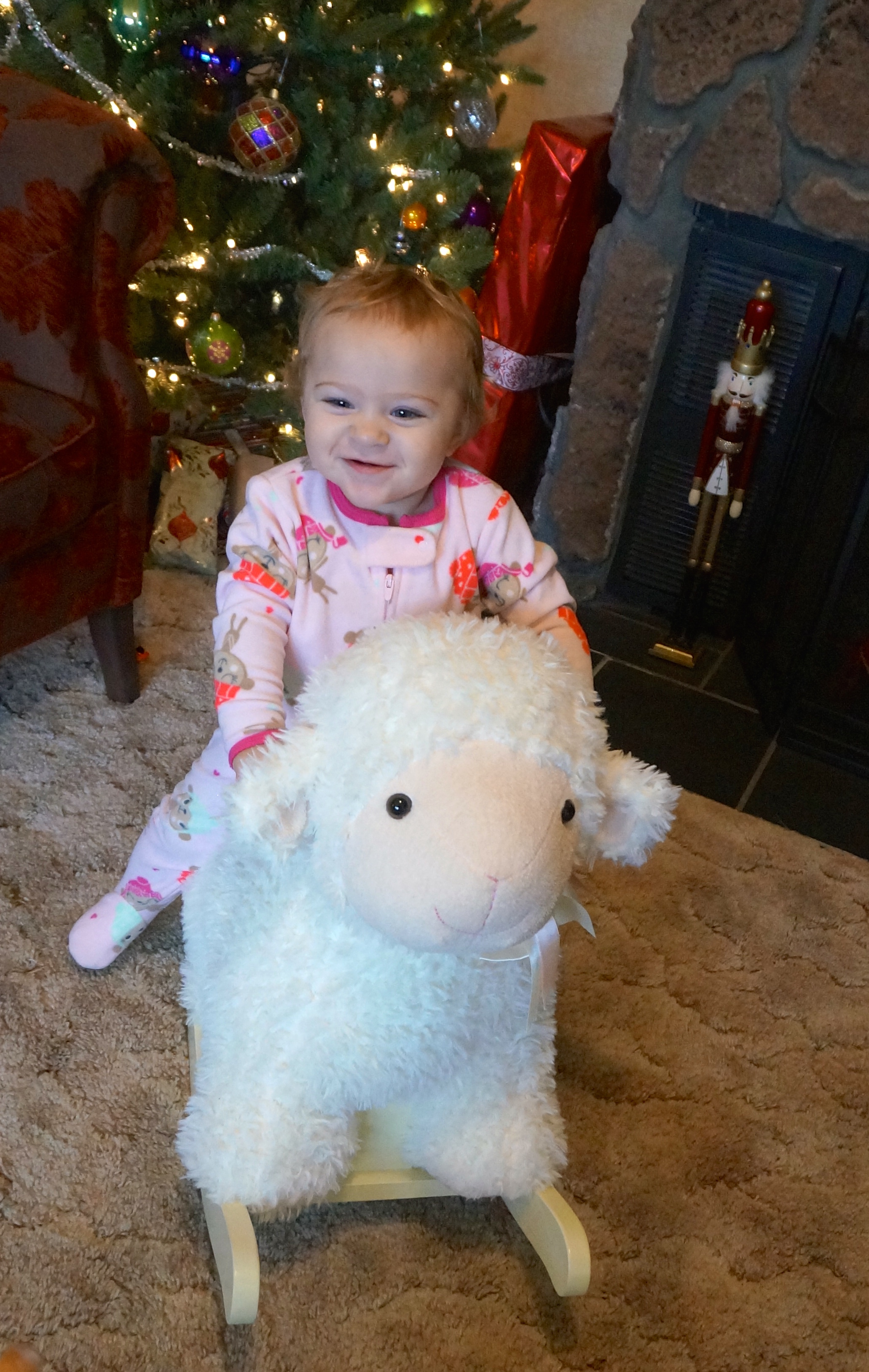
Now she’s a month past one year old, and she’s walking, running, climbing… and working so hard on talking. She’s evolved in her attempts at Niko’s name, from “O” to “Ko” to, today, “Geeko.” Cody, the puppy, was first called “Co” and now is “CoCo.” When we give her something, she says “Tah toooo!” for thank you, and she greets us with “Hey youuuuu!” Today, her newest word came trilling out when we went into her room to get her when she woke up this morning: “Wake!”

Such a big girl.
Such a big girl.

Yes, without a doubt, Sofia is in her best stage yet.

I just love the learning-to-talk stage. I remember when Niko was about 15 months old and was learning to say “fork.” He couldn’t say the “r” sound — still has trouble with that one — so it came out, in a loud, excited voice, “Fuuuuck!” We had to explain to servers and fellow diners at restaurants: “He sees a fork. A FORK. He’s very excited about that FORK!” It was pretty funny. We have a lovely video of him saying this, getting more and more intense in tone, until the fork he’s holding suddenly pokes him in the eye. The video cuts out as we rush to comfort him, but there’s a subsequent one from a few minutes later, in which he eyes it soberly: “Fuuuck.” The tone fits the situation so perfectly that I can’t help but laugh till I cry, every time I see it, despite the pain I know he experienced.

But the best part about the learning-to-talk stage? It doesn’t really end, not for years. Niko, at age four, loves words and is constantly trying new ones and asking for word meanings. He actively explores the language with joy and pleasure. He loves the feel of a new word in his mouth. He’ll say it repeatedly, in different settings, trying it until it feels right. Most recently, he attempted to say the name of the delicious new nuts he was trying: “Spidacheos!” It made us laugh, but it fills me with a sort of pre-nostalgia, too. I know that one day we’ll look back at this time of exploration and learning and say, “This was the best stage ever.” And it will be true.

(You can see videos of Niko saying “Spidacheos” and “Fuuuuuuck!” on my Facebook page; apparently my blog doesn’t have video enabled right now.)

Sparkle

A few days ago, I was driving home from dropping off Niko at preschool, and I drove into a fog bank that was shot through with rays from the rising sun. And suddenly, out of the blue, I was swamped with nostalgia.

Here’s the truth: I hate most of the things about Alaskan winter and don’t regret abandoning them all for the mild, really-more-like-prolonged-spring Oregon winter. Some of the key elements I’ve always disliked: Walking through snow. Slipping on ice. Driving on icy, badly-plowed or not-yet-plowed roads. Waiting all morning for my cold, damp pant legs to dry after dragging them through a snowy parking lot. Shoveling driveways. Driving through a blizzard. Brushing snow off windshields, scraping ice off windshields, dealing with ice buildup on windshield wipers. The terrifying, unstoppably glide as your vehicle fails to stop on a patch of ice. And that’s only the snow and ice problems. Don’t even get me started on the darkness and short days and the cold….

But there’s one thing that Alaskan winters do better than anywhere else, and for it to happen, there has to be fog and sunshine. That one amazing thing is hoarfrost. We call the fog that comes before the frost an ice fog, for the obvious reason that it causes the frost, but also because the fog is actually filled with tiny, suspended ice crystals. When the sun finds a way through and lights up the fog, the air is filled with glitter and sparkle. It’s breathtaking in its beauty. You can’t help but stop to stare around you.

The morning after an ice fog, everything is coated in thick, intricately patterned frost crystals. Trees are as white and sparkly as an artificial Christmas tree. The frost turns the world into a magical land of beautiful possibilities. On mornings like that, you suddenly realize that Alaska actually is as incredible as tourists think it is.

A frosty Anchorage afternoon.

Driving through that fog the other day, I remembered. And, believe it or not, driving on the ice-free road in a car that hadn’t had to have its engine run for ten minutes to be drivable, looking through a windshield with full visibility instead of semi-clear streaks scraped through ice, I discovered that I missed Alaska. Just for a minute. It didn’t last long. But for that minute, it occurred to me that I might like just one day of waking up to a fresh snowfall. Just one day to see the world covered in white. One day to see everything shining with jagged-edged, lacy, fragile frost crystals. Just once.

That night, the fog thickened and hung low over our home as the temperature dropped. I’d already forgotten the nostalgia, but Oregon must have heard my wish, because the next morning I awoke to a magical world of white. Not snow, but frost. Everywhere I looked, there was a thick coating of crystals. The grass, the trees, everything was shimmering white.

As I started to get breakfast ready, Niko ran to the window. “Wow,” he breathed, and I agreed. The sun was just starting to shine through the trees, lighting up the frost. On impulse, I asked him, “Would you like to go run in the frost for a few minutes?” He was thrilled, and ran outside, stomping and jumping up and down as he discovered the crunch of the frost.

Exploring a frosty morning

My nostalgia is gone now. I know that if we’d had the snowfall I wanted for that brief moment, we’d be shoveling a porch and a long, long driveway to make sure we could get out if necessary. We’d be cold, and wet, and probably lose our footing and fall a few times. Instead, what I got was the sparkle and glitter I’d been craving, without the added stress of dealing with snow.

Thanks, Oregon. You rock.

Baking Soda Freshener

In even the best-kept homes, there might be found an occasional…odor. Nobody likes to mention it, but there it is. Odors. They’re part of life. This is especially true in a home like mine, which contains a baby, a puppy, and a small boy. But even in a home with fewer sources for unpleasant smells, you’ll still find some: in trash cans, refrigerators, old carpets…Smells tend to saturate fabrics or plastic and just hang around.

There’s a solution. It’s inexpensive, nontoxic, and has been used for a long time: baking soda. I sprinkle it into the bottoms of trash cans before adding a bag and over half-filled trash cans, in diaper cans, and over carpets before vacuuming. In the refrigerator and freezer, some baking soda in a little cup can absorb that unpleasant stale smell that can build up. It really is that simple.

But you know me. Simple is great, but sometimes just a little more attention to detail can give even better results. I make an easy mixture that adds a light scent to a room as well as absorbing unwanted odors, and it has the bonus of being a laundry booster as well.

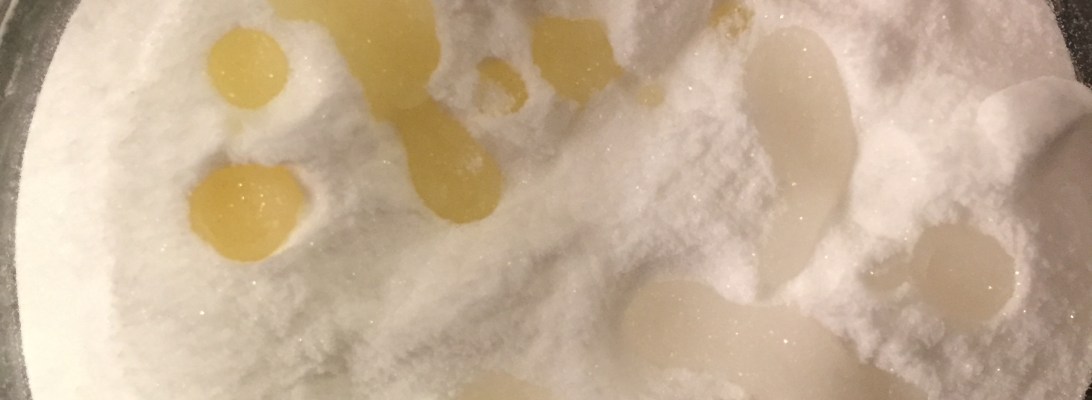
I start with a glass canister with a shaker lid — the kind you see in diners, holding sugar or powdered coffee creamer (ewwww). Fill it halfway up with borax, which, like baking soda, is another odor absorber as well as helping improve laundry detergent efficiency. Then fill it the rest of the way with baking soda. (I always have plenty of baking soda on hand because I buy in bulk, as I use it a lot — for bath soak, laundry stain remover, and other useful purposes as well as baking.) Finally, add a few drops of essential oil and mix it well. I usually use a bit of lavender and some lemon, but whatever you like should work fine. Don’t do too much! Essential oils are very concentrated scents, and you can get an overpowering aroma quickly. Just to give you an idea: I put in 6-8 drops of each oil for this batch, and yes, it was a bit strong.

So, a little pouring, a little stirring, and — Voila! A quick room freshener. Where to use it? I sprinkle it over laundry hampers, over the carpet before vacuuming in Niko’s and Sofia’s rooms (both of which have that distinctive small-child odor), and under Niko’s area rug to release a little scent each time we walk across it. I sprinkle a bit into the Diaper Genie each time I drop in a diaper — we do cloth diapers, and the Genie stores them beautifully before washing. It tries hard to block out odor, but it’s not perfect. The baking soda/borax mixture with a little essential oil helps absorb odor, but it also helps get the diapers clean when I wash them. Anywhere you want a little freshening is a good place to sprinkle some of this.

Happy Garlic

When I planted my garlic back in October, everything I read said it should be ready to harvest in December or January. I was doubtful. I’ve always lived in places where the garden was covered in at least two feet of snow in December; the idea of harvesting in winter is as fantastic to me as the thought of meeting a unicorn in a forest. However, nothing ventured, nothing gained, as they say, so I planted on faith and more or less forgot about them.

Planting garlic in October.

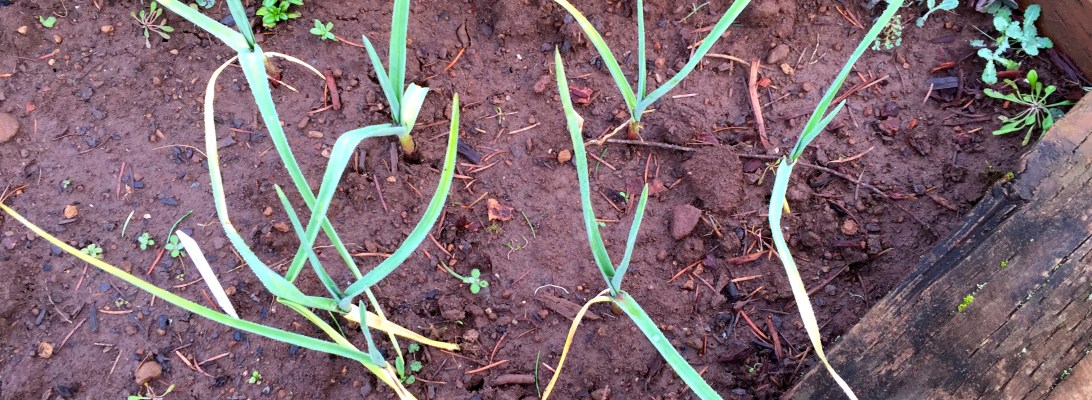
Yesterday I went out with both kids and the puppy to do some playing and weeding, and was delighted to notice that the tops of the garlic are dying off. This means, or so I’ve read, that the bulbs are mature. Now I’m supposed to stop watering them so they can dry out a bit before digging them up.

Garlic tops are dying off. Almost ready to harvest!

Wait… Stop watering? I live in Oregon. Winter is when we get rain. Plenty of rain. Rain every week. How do I stop watering? I’m actually asking for an answer, if anyone reading this has one. Currently, my tentative plan is to construct a little clear-plastic tent over them, so they can get sun but not water. Is that crazy? Do other people do that? Or do most people just dig them up when the tops finish dying off, and not worry about drying the ground?

In other gardening news: The garden is continuing to slowly wake up. Today I found that the fennel I planted last spring, which died off in the fall, has sent up a fluffy green plume. The mint, which grows in a vigorous, untidy bed near the garden shed, has started putting up delicate baby shoots. And the azalea behind the house has put out new leaves and, possibly, tiny flower buds. I also found some adorably chubby little rosette-shaped sprouts of a plant I never managed to identify last summer, but which put out large, flat-topped, pink flower heads. The flower heads were shaped like Queen Anne’s Lace, but the rest of the plant was completely different.

The kids were thrilled to have more time than usual outside. Niko went straight to his new tire swing, which kept him happy while I collected garden tools, and then he alternately ran back and forth across the yard with Cody and helped me pull weeds. Meanwhile, Sofia roamed the yard with not a single qualm at being so far from me — I kept having to go bring her back as she wandered away. I had put a baby leash on her, but she was too unsteady on her feet to use it to guide her as we walked, and it was far too short to use as a tether. So she just wandered while I kept an eye on her between weed pulls. Uproot — see Sofie peering into the wheelbarrow. Toss a weed into the wheelbarrow — she’s exploring the thyme. Next weed — Sofie’s discovered the blue gazing ball pedestal. She was happy as a clam, playing by herself.

Have I mentioned how much I love living and gardening here?

Fluffy Tutu

Sofia turned one last month, and we celebrated with a cake smash photo shoot. I made a polka-dot cake, decorated a plain white backdrop with a simple birthday banner, and dressed her in a pretty blue-and-silver tutu I made for the occasion. The polka-dot cake was a surprisingly successful learning experience, the birthday banner was an easy last-minute impulse craft, but the tutu is what I’m really proud of.

I had an idea in my mind of how I wanted the tutu to look, but I couldn’t find a tutorial online for one that worked with the materials I had on hand. So I just struck out on my own, designing as I went. I started by pulling out the tulle I had stored away in a bin. I had a swath of pretty, rich, blue tulle, some silver sheer fabric (not really tulle, but I made it work), and lots of white tulle. Then I opened my ribbon box and found some narrow, sheer, silver ribbon. I rummaged through my sewing box till I found a pack of wide elastic. (The silver butterfly in the photo is for a headband that I planned, but didn’t have enough fabric to finish.)

I wanted the tutu to be fairly long. To decide how long to cut my pieces, I put Sofia into a dress she has with a tutu skirt, made a note of where the waist fell, and measured the skirt. The tutu I wanted to make would have a waistband, while the tutu part of the dress we tried on started a bit below her waist, so I added another inch to the length, plus another inch for a seam allowance. For Sofia, that put the desired fabric length right around 8 inches. I used her body to measure my elastic waistband, too. I didn’t want the elastic to have to stretch in order to go around her waist, so I just circled her waist snugly with the elastic and cut it to that length.

To make a layered look that showed off the blue and silver, I cut each piece 4 inches wide. I didn’t have a whole lot of the blue and silver. I just kept cutting until I ran out, then cut about as much white as I had of both blue and silver. On my dining table, I laid out my strips in alternating, overlapping colors: white, blue, white, silver, white, blue… I arranged them so that each one overlapped the previous by about half its width.The white was barely visible, but it added needed bulk. My goal was to have a row of overlapping fabric that was about twice the length of the elastic I’d cut for the waistband, but I didn’t end up having that much on hand. If I’d planned ahead, of course, I could have calculated how much I needed and purchased accordingly. (This is what we call Crafting With ADHD. Seriously. It usually works out anyway.)

Once I’d laid out the whole array of fabric, I used matching blue thread to baste the fabric pieces together. Basting is stitching in such a way that the thread is easily pulled, either for temporarily holding fabric in place, or for gathering. I started by pushing the needle all the way through the first layer of fabric, drawing the thread through, then tying a firm knot in the end so it wouldn’t come pulling out prematurely. Then I alternated long stitches and short stitches (but not tiny ones — that would make the thread hard to pull later), making sure to catch each strip of fabric at least once. I basted all the way across, and then laid out the elastic band next to the fabric. Finally, I gathered the basted fabric together by gently pulling on the loose end of the thread, pushing the fabric back toward the knotted end, until the width of the basted-together fabric matched the length of the elastic. To secure the fabric, I quickly stuck a pin into each end of the fabric to hold it to the elastic.

Next, I turned the whole thing over and pinned the fabric to the elastic with sturdy quilting pins, folding the fabric over the elastic with a bit left over to tuck under. I put a pin every few inches. Since the fabric was already basted and gathered, I didn’t need a lot.

With the fabric pinned down, I used a needle and the blue thread to hand-stitch the fabric over the elastic. I used what I was taught to call a blanket stitch, though it’s actually more of a hybrid between the blanket stitch and a catch stitch. (The first link in the previous sentence goes to an instruction manual from Coats & Clark, 1959, and has instructions for both stitches; the second one is a more detailed tutorial for the catch stitch.) Using my thumb as a guide for stitch width, I pushed the needle down and back up in a right-to-left direction at the end of each stitch, then looped the needle through the stitch to secure it before the thread pulled all the way through. Setting the end of the stitch backward like that, plus catching the thread in a loop, makes this a very secure stitch. I just barely caught the front layer of fabric with the needle — the stitches don’t show at all. Each stitch caught the very edge of the elastic fabric, keeping it secure so it didn’t roll inside the waistband. Finally, I whip-stitched the two ends of the elastic band together. Stitching the waistband took me about twenty minutes.

If you have a good sewing machine and don’t mind the stitching showing through to the other side, you could just machine-stitch it, but I wanted invisible stitches — and, having been raised without electricity, I’m more comfortable with hand-stitching anyway. I should also add that this is NOT a good method to use if you want the elastic to stretch a lot. I fit the elastic band to sit gently on Sofia’s waist, so it only has to stretch a little as it goes over her hips — stretch it too much, and the stitches will start snapping. If you wanted the elastic to fit more snugly, you would stretch a shorter elastic length over the ungathered, basted fabric, pin along its length, and release it, letting the elastic do the gathering.

At this point, I could have been done. However, I didn’t think the finished product was as fluffy as I’d wanted.  If I’d had more fabric and could have gathered the tulle more tightly, or added another layer or two, it might have been fine. But I really wanted more pouf. I remembered a pretty tulle fairy dress I’d seen when searching (in vain) for a tutorial. The creator had used little tulle pieces to tie off the ends of the long tulle strips, and it had made a deliciously frothy bottom of the skirt. I knew I couldn’t recreate the look with what I had, but it did give me an idea for something a little similar. I used blue tulle pieces to tie off the white and silver strips, and silver ribbon to tie off the blue tulle. And voila! A sweet little tutu was born.

Birthday Polka-Dot Cake

Sofia turned one during the second week in December, and we decided to do a cake smash celebration with her, like we’d done when Niko turned one. I wanted a cute cake for her to smash that would coordinate with a perfect outfit for marvelous pictures. Aaron suggested that I make a polka-dot cake. I was mildly hesitant, because it seemed complex, but when he showed me a cake pop pan he’d found, I decided it seemed doable.

It was simultaneously easier and harder than I’d expected. First, of course, I did a search for how to make a polka-dot cake. I found a blog called “Once Upon a Pedestal,” by Deborah Stauch, which featured a tutorial for a polka-dot cake. Later on, after I’d gone through the whole process of making the cake, I found another blog, “Easy Baked,” which had a polka-dot cake tutorial that included some troubleshooting ideas that the original post didn’t have. This one was actually referenced by Ms. Stauch, and the author used Ms. Stauch’s instructions for her own cake. I wish I’d seen it when I was originally looking, because I ran into some problems.

Basic steps: Use two cake mixes; color one batch however you want your polka dots; bake your cake pops till they’re just done; surround them with the second batch of batter in layer pans; bake them a second time. Simple. Easy-peasy. Right? Ha.

The tutorial I followed suggested adding pudding mix to the cake mix. The idea was that this would make the cake denser, and the circles would be less likely to float. Unfortunately, what I thought was pudding mix in my cupboard was, in fact, Jell-O mix. Then I realized that my cake mix was a pudding cake. Problem solved! I thought. Ha.

Another instruction I didn’t follow was to use two cake mixes. I only wanted to make two layers in itty-bitty pans, not the three layer pans that the original tutorial suggested, so I thought one mix would be just fine. Incidentally, upon measuring (later, of course), I discovered that my mini pans were the same size as the pans Ms. Stauch used: six inches across. So one mix wasn’t enough even for my two pans. My guess is that if I’d done two, I’d have had enough to do seven balls per layer, rather than six, and also cover them more thoroughly in the pans.

I mention these errors just in case someone else reading this thinks taking shortcuts is a great idea. I think the cakes would have been MUCH easier, and looked better, if I’d just followed the instructions. What actually happened: the batter didn’t sufficiently cover the cake balls, and they floated up above the surface of the cakes. I salvaged them by covering them with a damp paper towel and setting another pan on top. It worked okay, but it could have been better.

Anyway, the end result was surprisingly pretty, considering all my mistakes. I measured out enough batter for the balls and tinted that batch with Wilton Moss Green gel coloring. I tinted the rest with Wilton Creamy Peach gel coloring. I baked the balls first, of course. Using my 12-ball Nordic Ware cake pop pan, I baked them for exactly 12 minutes at 350 degrees. This was the one thing that worked perfectly. They came out a beautiful soft green with not even a touch of brown, and all but one popped out of the pan without a hitch. You can see how they looked in the photos below.

Then I poured a little bit of the peach batter into the 6-inch baking pan (actually too much batter — it pushed the balls upward as it rose), arranged 6 balls in each pan, and poured the rest of the batter over. As you can see in the photos below, it really wasn’t enough batter to thoroughly cover them. A little more would have been better. I then baked the cake just like a normal cake. Afterward, I had to weigh down the top for 10 minutes, using a damp paper towel topped with another pan, to press down the round top with protruding green balls. This wouldn’t have been necessary if I’d just followed the directions.

I used whipped cream for the topping and filling. I used the peach for this, too. I used a flat metal spatula (like a giant butter knife), dipped in hot water, to smooth the sides. I’m not an expert; it didn’t turn out perfectly smooth, even though I spent an inordinate amount of time in the attempt. But it looks a lot better than it did before Aaron, who’s actually got some experience with cake decorating, suggested the hot-water method. Then, for the top, I used a flower tip on a pastry bag to make little flowers all over, and I dropped a pale-green sprinkle into the center of each flower. For a final touch, I poured more sprinkles around the bottom of the cake to make an irregular band of pale green.

It was a bit of an anxiety-causing process, doing all this work decorating a cake that I couldn’t be sure would look pretty when I cut into it. And I had no backup plan, of course. When I finally cut into the cake just before getting Sofie dressed for the cake smash pictures, I was so relieved at seeing how well it turned out. Polka dots in more or less appropriate places, colors complementary to each other, no horribly obvious flaws, and it looked adorable with the tutu and birthday banner I made for the occasion. Whew!