My Father’s Hands

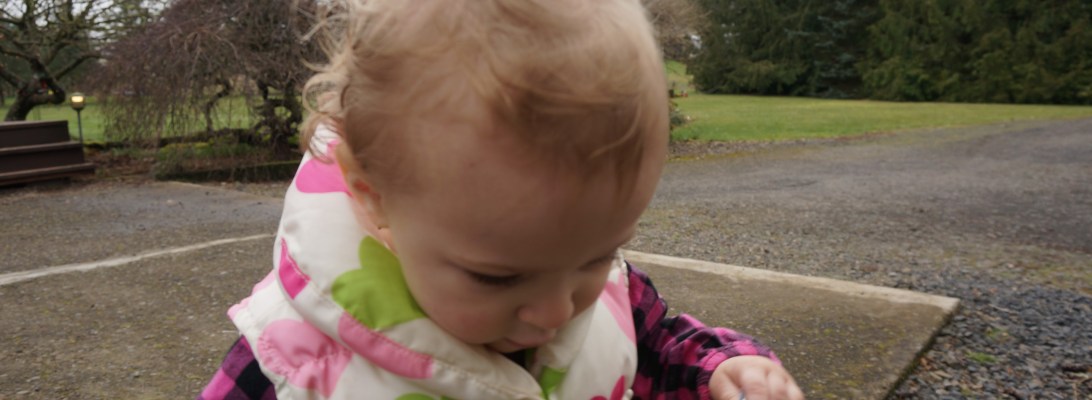
Sofia’s hair has recently become long enough for tiny pigtails and dainty barrettes. It’s wildly curly and needs to be thoroughly wetted in the morning so that it transforms from a crazy collection of fluffy cowlicks to an adorable set of tightly curled ringlets all over her head. I love combing it and watching the curls bounce into place.

A couple of days ago, I came across a little tangle in her hair. Tugging to get it out, I lost control of the comb, and it slid down across her ear. She flinched away, of course, and I chuckled. I couldn’t help laughing — I’d suddenly remembered my own experiences with ear-combing.

When I was four, my parents, residents of a Christian commune in Northwestern Ontario, decided to join another family who’d recently moved to a trapline in Northern British Columbia. It was a remote, beautiful place next to the Stikine River. Our family lived in a tiny cabin right next to the river, and we used the larger cabin up the hill as communal headquarters as well as living space for the other family.

Back on the commune, making breakfast was a chore shared by all the women in turn. Around the time we left, the population of the commune was about 200, so there would have been somewhere between 20 and 50 adult women to shoulder that task. On their mornings to cook, they would get up early, tiptoe out of their individual family homes (or dormitory, if they were single back then), and go to the main building to prepare the meal, which was served at seven. With so many women sharing the job, each woman only had to make breakfast once every couple of weeks. But on the trapline, there were only two women, so my mother would leave the house early about every other day, leaving my dad to get my brother and me ready for the day.

My dad is a gentle, creative man with craftsman’s hands. Those hands can achieve just about anything. Chopping down trees, smoothing the bark off the logs, building them into a shop. Creating his own lathe inside that shop, spinning wood on the lathe into delicate shapes: handles, round picture frames, jewelry boxes, a family of dolls for me. Those hands could sketch wildflowers, create an embroidery pattern, and make delicate stitches on fabric. They can execute a skilled pen-and-ink drawing, form a silly comic, make a detailed charcoal scene. His hands can coax music out of any instrument he picks up — a guitar, a recorder, a banjo. He made his own fiddle, mandolin, dulcimer. Truly, my father’s hands can do anything. Anything except comb a four-year-old’s hair without combing over her ears.

It would start off well. He’d ask my mom for pointers. She’d show him how to hold the hair in one hand, combing tangles out of the ends first, working upward. He’d try so hard to be gentle, starting on one side, successfully avoiding the first ear, working around to the other. We’d be almost done. I’d finally relax, positive that this time my ear would be safe. And then, RIP! The comb’s teeth would scrape over my sensitive ear, I’d wail, and he’d slump in defeat.

The rare times that my dad would manage to get all the way through my hair without combing my ear, he’d succumb to an even worse pitfall. Just above my ear on the right side of my head, hidden under my hair, is a wen. It’s a bump that used to be small, before it was built up with all the scar tissue from having its top ripped off with a comb, over and over. My dad would be so focused on avoiding my ears that he’d forget about the wen. The comb’s teeth would catch the top and rip off the fragile skin. Blood would seep out, matting my hair. We’d arrive at breakfast with one side of my hair still bedtime-fuzzy, stuck together with blood, and my mother would sigh and shake her head. And then for days I’d flinch anytime a comb came close to me, because while combing my ear was painful, combing the top off the wen was agonizing.

It’s funny, though. Having my hair combed by my dad hurt back then, but now, that sudden memory is heartwarming. I’m so glad that I have the memory of my father’s strong hands cradling my head, working a comb through my hair, making my hair shine despite the awkwardness that came from the unaccustomed task. And now it’s my turn to do the same for my daughter, feeling her baby hair spiral around my fingers, finding tricks to get her head in the right position, gently easing tangles out, and remembering how hard my father tried to be just as gentle with me as I try to be with my own little girl.
The Only Good Slug Is a Dead Slug

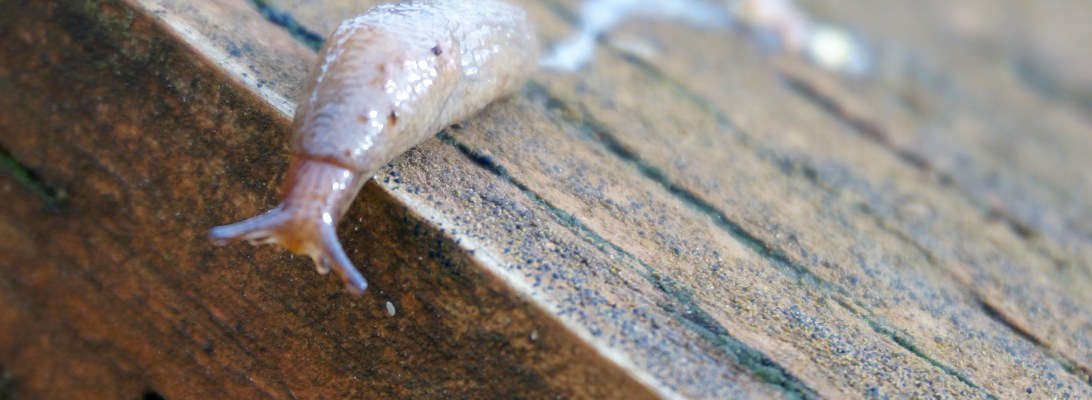
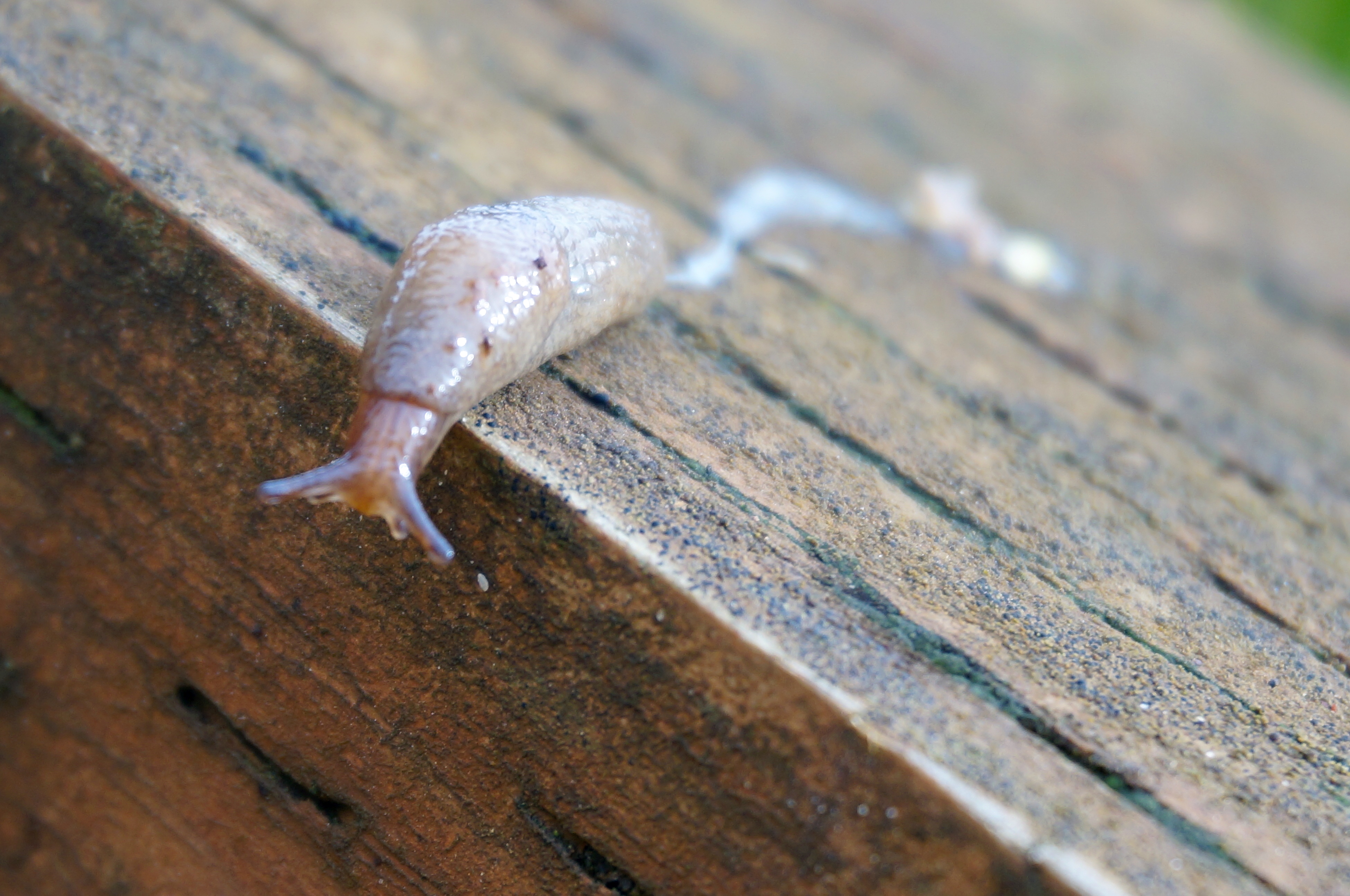
Over the last few weeks I’ve been on a relentless crusade to eradicate slugs from our yard.

I should point out that typically I don’t enjoy killing anything. I’m filled with guilt when I swish a spider down a drain. I mourn when I find a mouse in a trap. I hesitate before flattening a fly. When I find stink bugs or moths inside, I take them outside and release them. Once upon a time, this reluctance to kill applied to slugs as well. They’re almost cute, with their dainty little horns. Their slow glide along the ground is nearly graceful as they prowl in search of food. And occasionally I’ll discover one with lovely bright colors — so close to being pretty. When we first moved to Oregon, living in a rental house with a small yard and no garden, I called Niko over to watch in amazement as a large orange-spotted slug devoured a blade of grass. I thought of them as harmless.

Sliming along a raised garden bed.

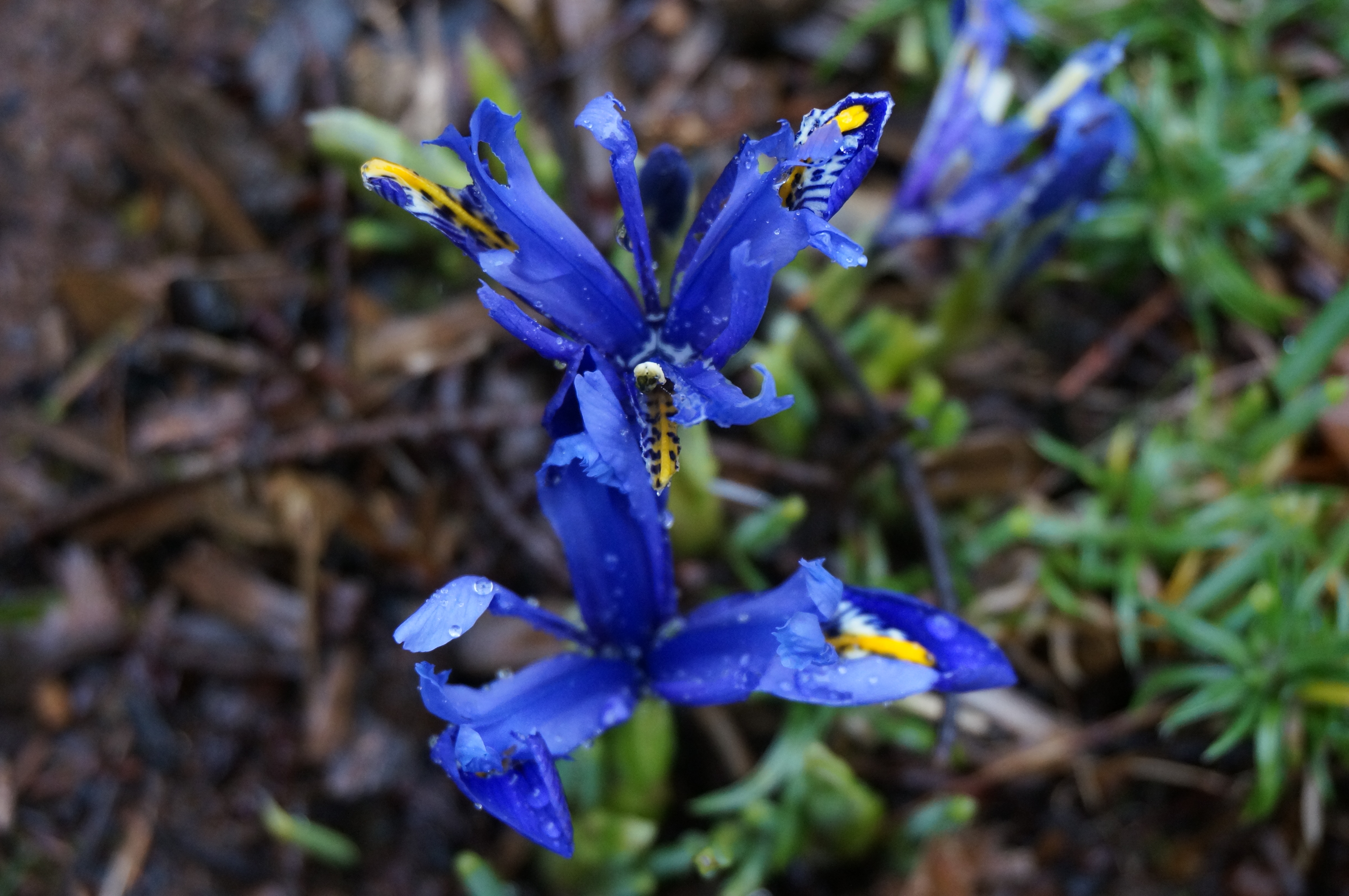
But now? Now I am filled with a deep passion of hatred for these destructive nibblers. Last year I saw slug-holes in my nasturtiums and basil, oregano and baby cucumbers, and I was sad. But this year, witnessing the chunks eaten out of the tops of hyacinth buds, new dwarf irises, and baby daffodils, I am enraged. Those slimy thieves are going down.

Slug-eaten iris. Last straw!

So, a couple of weeks ago, as you can read here, I set out both cornmeal and a honey-yeast mixture in jars throughout the garden, and waited.

The cornmeal was immediately effective. The slugs loved it. They didn’t seem to be immediately incapacitated by it, but they were distracted from the plants and easy to catch. The side of the jar acted as an umbrella, keeping the cornmeal dry — until we got a driving rain that splashed in. After that, it was less effective. My gardening New England aunt told me the cornmeal needs to be dry in order to catch the slugs, and the evidence in my garden certainly supports that. It seems that both water and slime from previous slugs renders the cornmeal an ineffective trap. I picked up some more cornmeal in the bulk section of the grocery store, both a coarse polenta/grits grind and a finer grind (I plan to mix them), so I’ll be making new traps soon.

Why does the cornmeal work? My knowledgeable aunt explained that, in order to move over the rough, dry cornmeal, the slugs have to produce more and more slime, so much so that they become dehydrated. Result: dead slugs.

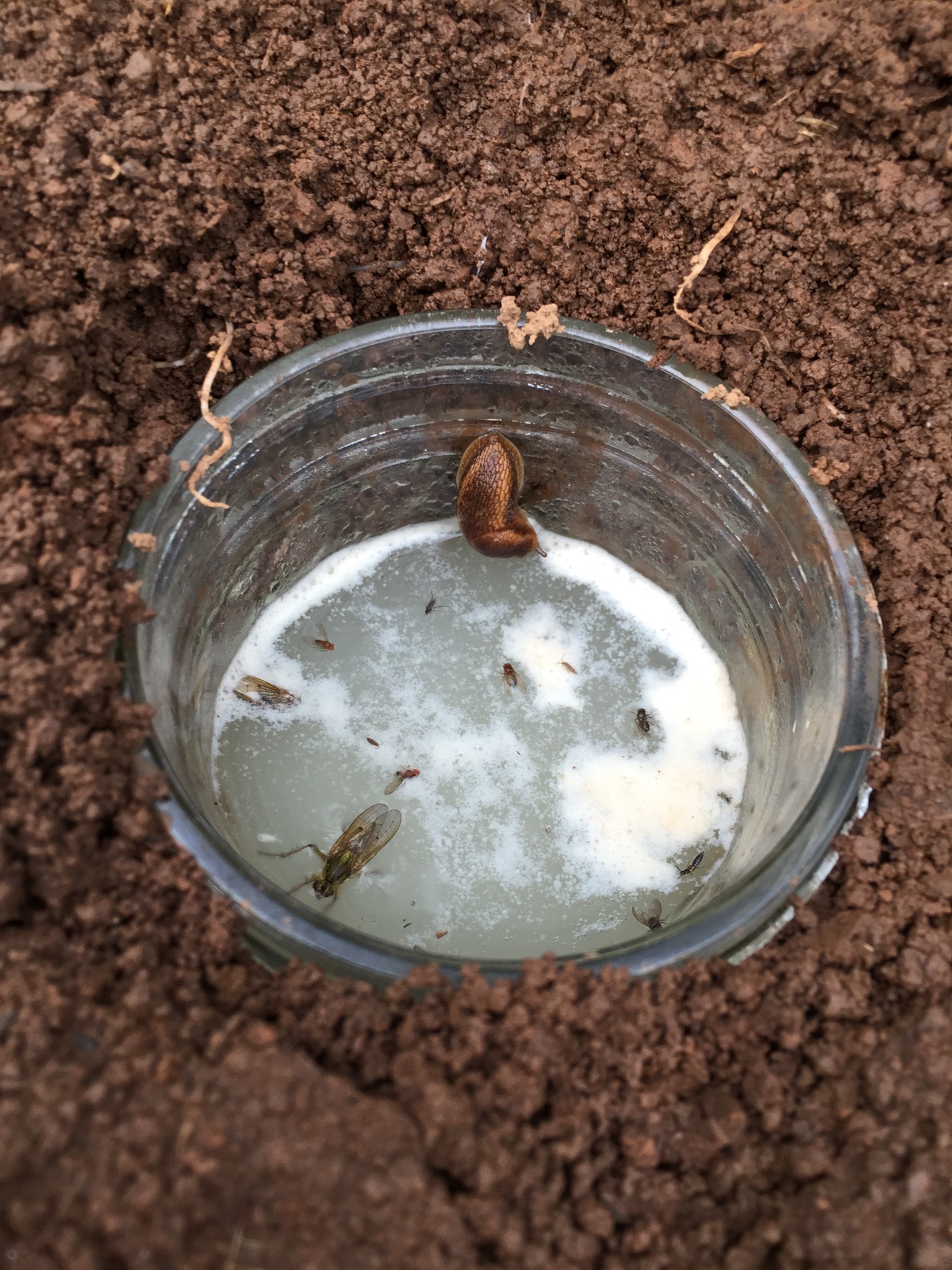
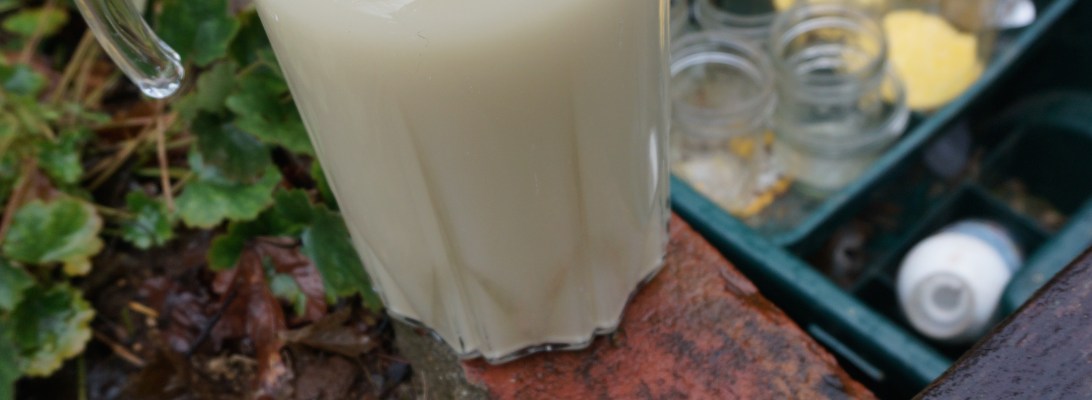
At first, the yeast mixture was less successful. I followed the instructions in the article I’d read, boiling honey and yeast together, despite my worry that killing the yeast by boiling it would make it unattractive to the slugs. I was right. They weren’t interested in the least in the one jar I put out that first day. So, I sprinkled fresh yeast on top of the mixture that still filled the pitcher, and waited a day or so till it began to foam gently and smell pleasantly yeasty (it wouldn’t have taken so long if I’d had more yeast). I refilled the jar I’d set out and then placed more jars throughout the gardens. By the time I’d finished the last jar, the first jar already had its first prey. Victory. Next time I do this, I’ll add the yeast after the hot honey water has cooled, and add more than the small pinch I sprinkled in after the initial failed experiment — I was out of yeast when I refreshed the pitcher, but I now have a new jar.

The yeast and honey mixture works like a charm.

Meanwhile, since my aunt told me to NEVER squish slugs in the garden for fear of releasing eggs into the soil, I’ve been carrying around a disgusting jar of salt water into which I drop any slug I encounter while weeding or planting or just strolling. It’s gross, but I don’t care. This is war.

Death to slugs. The only good slug is a dead slug!

Valentine Breakfast: Bakewell Buns

I came across these delicious muffins in a blog post from Cooking With Craic a couple of months ago. The author, a Canadian living in Ireland, had fallen in love with the popular Irish pastries, and had developed a delicious recipe. She says,

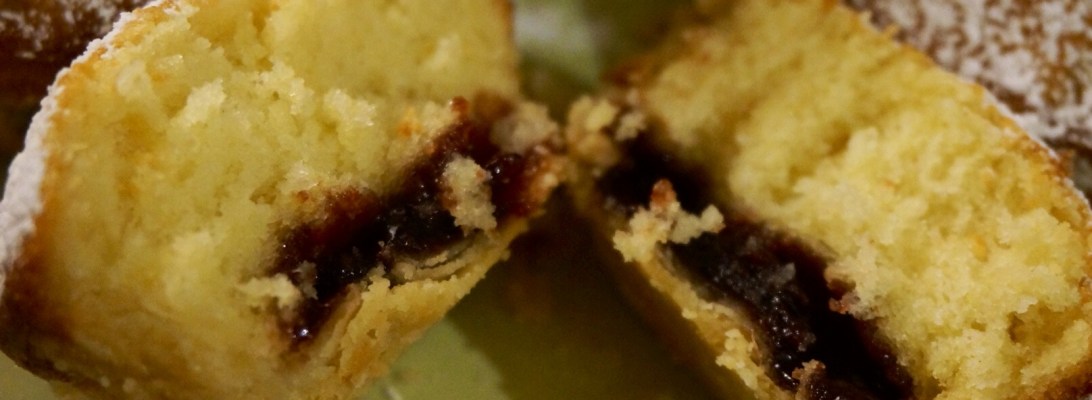
The bakewell. You can find these at most bakeries around the country. They consist of shortcrust pastry bottoms, jammy middles and Madeira sponge tops.

I’ve been waiting for a good opportunity to make these, and yesterday I finally found the perfect timing. I had planned an easy dinner: throw a slab of meat on the grill for an hour, toss some yams into the oven, make a salad, warm some sourdough bread. Done. And Valentine’s Day seemed as good a time as any to make a sweet treat. So while the meat was cooking, I rolled out some of the Pioneer Woman’s Perfect Pie Crust that I’d had conveniently waiting in the freezer, whipped up a Madeira sponge batter (I’d never heard of it before this recipe, but I’m very happy to have experienced it), and popped the buns in the oven just as the meat was coming out. We sampled some after dinner and saved the rest for today’s breakfast. I’m thinking they’d be best for brunch or for a mid-afternoon snack, not so much as dessert. So yummy! Here are some pictures:

You can read the recipe here.

“White Couch Feeding”

Every now and then something comes along that’s too good not to share. Today my aunt, the mother of six children who are nearly all grown now, shared this delightful collection of ridiculously serene stock family photos that have been realistically captioned by moms. My aunt had a good laugh at it and then shared it with me, remembering that I’m in the middle of parenting my own rambunctious kidlets (though I doubt I’ll ever be able to match her collection of six of them).

My favorite captions:

You were right! Ever since we started White Couch Feeding with Emmett, he’s been eating like a champ.

And this one: IMG_2317.PNG

Click here to see the whole collection.

Sweet Funny Valentine

At four years old, Niko’s understanding of “Valentimes” Day is pretty sketchy. “Why is there an arrow in that heart?” he demands. I tell him that there’s a story about someone named Cupid who had a special arrow that he would shoot into people, making them love each other. “But that’s not nice. He shouldn’t shoot people. That hurts.” I explain that it’s a SPECIAL arrow that doesn’t hurt. He’s not convinced. “He shouldn’t hurt people,” he insists.

He feels a certain sense of power, I can tell, selecting Valentine cards for first his classmates, his teachers, then a few family members. He takes the responsibility very seriously, pondering each choice as if it will change lives around the world and through all of history. I have to practice my slow breathing in order to keep myself from ripping the cards from his hands and snarling, “Just let me do it!” I know my impulse is wrong. Bad mom. But I do let him make his choices despite my impatience, so there’s that.

I never experienced this holiday as a child, though I do remember looking forward to February because of the bags of cinnamon hearts you could buy. I grew up in a Christian commune, part of a group known as the Move which held as a minor part of its flexible, ever-shifting doctrine the concept that holiday celebrations were worldly and sometimes pagan and ought to be avoided if one wished to truly dedicate oneself to God. Valentine’s wasn’t actively frowned upon like Christmas and (Lord preserve us) Halloween, but neither was it encouraged or promoted in any way when I was a child. So I never decorated Valentine shoeboxes or prepared cards for an entire class or fretted over whether I, too, would receive candy and cards from friends. I don’t feel I missed anything, particularly — but it’s one more point of connection with my son that’s missing. It’s not an essential one, but sometimes I wonder how many of these disconnected experiences can build up before we have so little in common that we can’t communicate. A silly worry, maybe, but it’s there.

This anxious thought buzzes around in my head, along with Are these cards too big for the shoeboxes? Will other families send candy, or will we be the Bad Parents handing out sugar? Will Niko be able to stay calm during a classroom celebration?  and Did I remember to turn off the oven? as Niko painstakingly scrawls his name in each card. I can never think about just one thing, never truly focus on the task at hand — always my mind is busy with many ideas, questions, worries, plans, all bouncing in different directions until I simply can’t continue. Partly ADHD, partly motherhood, I guess. Luckily, I’m working with a four-year-old, and our attention spans run out at about the same time. We put the stack of cards carefully aside while he colors in another card and I help his baby sister hold a crayon on a piece of scrap paper. He peppers me with questions. “Why do we love each other on Valentimes? Is today Valentimes? Will it always be Valentimes? Can I make a card for you? I want a card that says Niko.”

I try to explain that yes, ValentiNNe’s Day (stress on the NNNNNN as a tactful pronunciation correction…) is a special day for loving each other, but really we always love each other, and that he will have lots and lots of cards that say Niko once all his classmates bring their cards to school. He isn’t entirely convinced, but he’s enjoying writing the cards, so he accepts this for now.

After school Wednesday, the day of his class’s Valentine celebration, his face shines with the aura of a child who’s had an excellent time. On his head is a red heart-festooned headband, with heart-tipped antennae bobbing on the front.He didn’t make it; he wasn’t feeling especially participatory, but he wanted to wear one, and a kind friend made one for him. He touches it carefully, with pride, telling me about his antennae that he can smell with, pointing out the heart cutouts, adjusting it on his head. Then he shows me his little mailbox, crammed full of tiny cards. His face reflects his amazement. “Look at all my cards!” His amazement grows when we open them at home, and he discovers that some of them have special treats: a deconstructable little hamburger, a Spiderman and a heart eraser, sticky gel clings, a lollipop.

My love bug
My love bug

Clearly, this holiday is going to be a favorite. Love, arrows, antennae, candy…how much better can a day get? I don’t miss celebrating it when I was little, but at the same time, I’m glad I get the chance to see the pleasure on my son’s face as he looks over his little cards and gifts, evidence that another child was thinking about him, too.

Happy almost-Valentine’s Day!

Trellis for Squash Vines

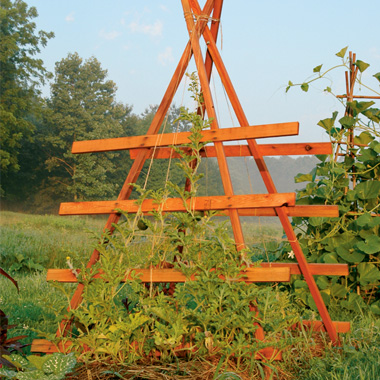
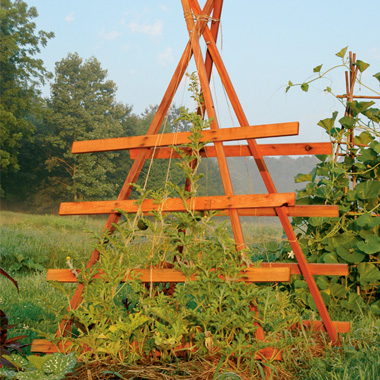
As I scrolled through my Facebook feed this morning, I came across a how-to article that a friend had posted on her timeline. It was a trellis for squash vines, so the vines climb up instead of spreading out over the ground:

Squash Trellis http://www.organicgardening.com/SquashTrellis

Last year, I had demonstrated my inexperience by planting half a dozen cucumbers in a small space — one end of a triangle-shaped bed about six feet long with a four-foot base — and I seriously regretted it. The vines tangled, grew on top of each other, and spread out of their bed, running into the garden path and threatening other beds in the wheel-shaped garden. I’ve been trying to think of a better way to do it, but the trellises I’ve thought of have been large, permanent structures. This one looks perfect. Sturdy but lightweight, movable from year to year. It will allow the vines to take up less garden space while the fruit stays dirt-free. Check it out:

Save space in the garden without sacrificing a single squash by making a simple, inexpensive, and easy-to-build trellis. Ours easily handles six to eight delicata squash plants and takes up only 16 square feet of garden space.

Click here to read the article.

Mystery Pond Creature!

This morning, I was delighted to see a small slithery creature, some sort of salamander — about the length of my hand from nose to tail tip — swimming in our tiny pond behind the house. This is the pond in which the goldfish carnage in November occurred, so not only was I pleased to see the mystery creature for its own sake, I was happy to see that the pond seems to be a healthy environment again.

After taking a few pictures, I started to worry that it wasn’t actually happy there. The pond has steep sides, and the water level is a little low, so it would be quite a climb to get out. It kept swimming to the edge and scrabbling at the sides with its tiny feet, but making no progress. I called Niko over so he could look at the creature, and then I reached in and lifted it out. I expected to have to chase it around, but it didn’t attempt to evade my hand. I set it gently down on a rock, where it sat and looked around. It ventured to the edge and peered over but didn’t try to climb down. So I lifted it again, and set it down in the garden. The salamander then proceeded to crawl back to the rocks at the edge of the pond, trying to fit through a far-too-small crevice. I gently directed it to a larger crevice, and it slithered through and rested there, looking down at the water. At this point Sofia realized she’d been abandoned in her bouncy seat, so I never got to see if the salamander decided to go back into the pond. I didn’t see it later when I looked, though. I suspect it was hiding among the rocks that make up the little waterfall.

I spent far more time searching for an identification than I should have, but I still don’t know what kind of salamander this is. I’m pretty sure it is a salamander, not a newt (a rougher-skinned subgroup). But none of the salamanders I found pictures of quite matched. I found a couple that were the right color and size, but they all had wormy tails, not flat ribbon-like ones as this salamander does. Any ideas?

Feathered Visitors

I love watching the birds that visit us as they eat, flutter, hop, and interact. Abiding by a policy of cautious tolerance, they mostly ignore each other: at the feeder that hangs at the edge of the porch, while dipping into the surface of our largest pond or making a crazy spray of water by beating their wings in the little waterfall, and as they stroll across the lawn in search of favorite snacks. Occasionally a big scrub jay or Steller’s jay will bully the little birds away from the feeder, and once a kingfisher swooped across the porch and scared everyone away. But usually the view from our kitchen window is peaceful.

Over the last month or so, we’ve had some new birds at our feeder and splashing in the pond. I was excited to see my old friend, the black-capped chickadee, whom I knew from living in more northerly places. I had thought that the presence of the chestnut-backed chickadee meant we were out of the black-capped chickadee’s range, but a month ago I glanced out my window, and there he was!

I love this cheerful little black-capped chickadee.

We also have a pair of varied thrushes. I thought at first they were two different types of birds, but ten minutes or so searching the Cornell Lab of Ornithology’s “All About Birds” site revealed that the bright orange male and the soft peach female are the same species. There’s also a robin in the (embarrassingly pixellated) picture with the female — they stayed all winter, but their numbers seem to be increasing over the last month, at least to my inexperienced and unscientific eye.

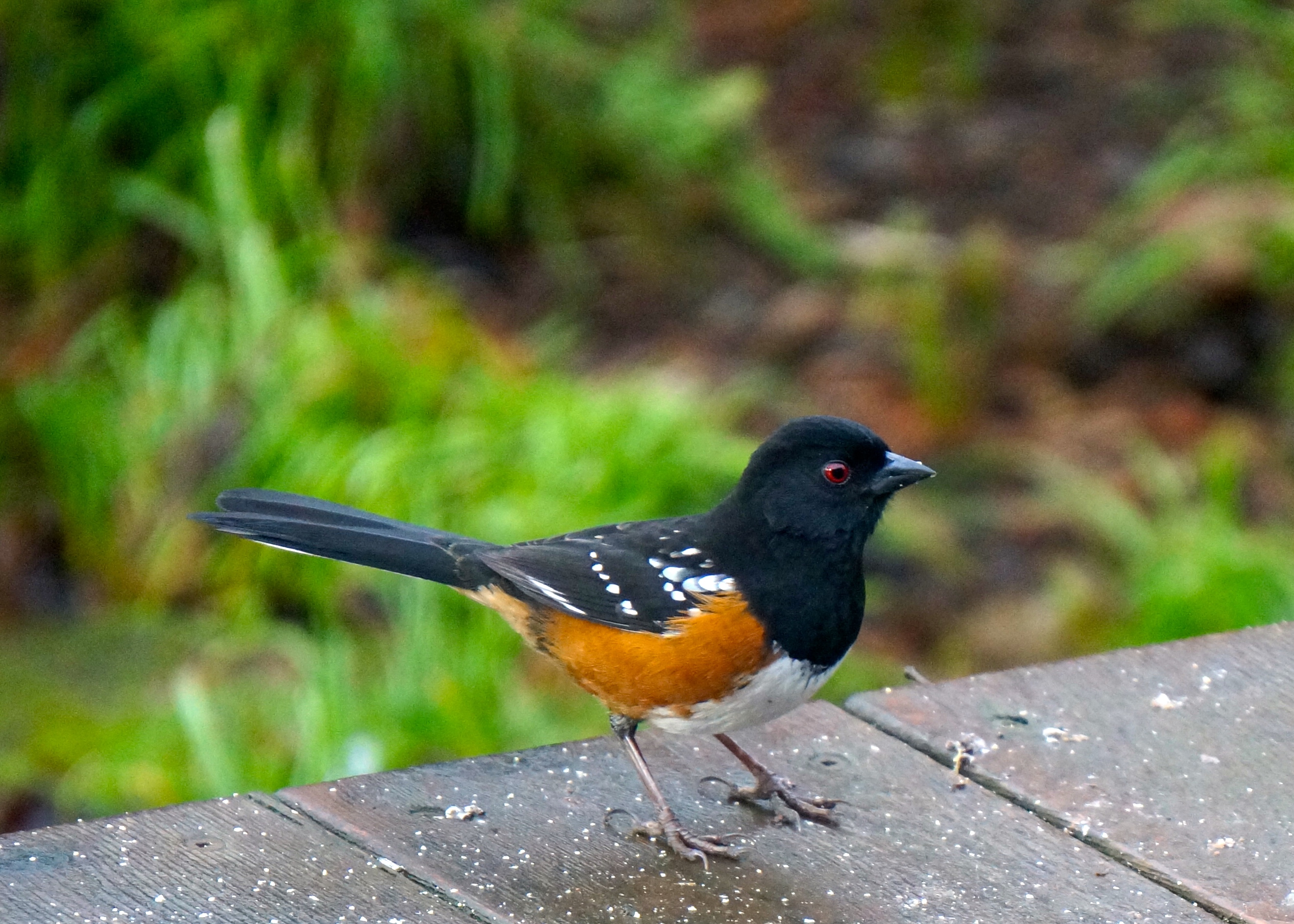
Another new feathered visitor, first seen about two months ago, is the spotted towhee. It’s an attractive bird with a bright orange-red breast and glossy black head and neck.

Spotted towhee
Spotted towhee

This little guy might not look exciting, but I was happy to see a familiar bird — a common sparrow. I’ve seen lots of golden-crowned sparrows at the feeder through the fall and winter, but this was my first time seeing this modest little bird.

And I’ve been seeing this Northern Flicker for some time now, but for some reason his bright red teardrop cheek markings are unusually vivid right now — or maybe I just haven’t been too observant lately.

Northern flicker with bright red cheeks

My most exciting photo triumph isn’t from a new bird, though, but from birds I’ve consistently failed to get a photo of for nearly a year now. We have a family of California quail that roam our property and the adjacent fields. They’re really shy, and though they’ve visited our porch to get dropped seeds, I’ve never managed to get a picture. Until this moment a week ago, when the whole family came strolling up the lawn to idle around the pond and snack on the seeds fallen from the hanging feeder, as if they were visiting a favorite cafe. Finally, finally, finally, I captured them! Aren’t they beautiful?

Slugs, Begone!

We have a slug problem. I first noticed while doing a pre-spring weeding in the flower and vegetable bed, when I kept turning up the slimy little nibblers in the soil. Then I noticed chunks bitten out of new shoots. Recently, I saw flower buds with bites. But Thursday’s transgression was the worst yet: dwarf iris’s first delicate blooms, the year’s second flowers (hellebore beat them by a week), bitten to pieces! Unacceptable.

Slug-eaten iris. Last straw!

At lunch, I broke our house rules, opened my iPad at the table, and did a search for “slug deterrents.” I found an illustrated article at WikiHow that gave me several ideas, two of which I put into practice.

The first one I’m trying is the cornmeal method. Very easy. Dump cornmeal into a jar. Lay it on its side. The slugs smell it, crawl in, and die, because…I’m not sure why. The article says the texture is too rough, but I’m not sure if it cuts their bodies up or if they die from eating it. Either way, it’s so easy I had to try it.

The second approach I decided on is the yeast-and-honey method. I boiled yeast and honey together, about 1/2 cup each, in a half gallon of water.  I hesitated over the boiling instruction at first, since it would kill the yeast. But then I concluded that this might be a good thing; otherwise we’d have yeast bubbling all over the garden.  I poured the mixture into jelly jars (I wanted to use plastic disposable cups, but we had none). Then I dug a hole in the garden near a patch of tender shoots using my nifty transplanting tool, and sunk a jar into a hole. The idea here is that the slugs will be attracted to the smell of the mixture, crawl in, and be unable to escape, drowning. I only got to place one jar, though, because it was at this point that Sofia did a face plant into a patch of mud and had to be taken inside. Ah, the hazards of gardening with babies on rainy days…

We shall soon see how these are working out! Already, taking Cody out for a bedtime potty venture, I noticed that a cornmeal jar near the back door had attracted two slugs. I’m hopeful that I can save my emerging blooms. To see how these methods worked out, click here.