I'm a temporarily staying-at-home mom of two living in Oregon, learning all over again (after 15 years of city life) how to garden, harvest, and put up food. You might see posts about baking, parenting, crafting, organization – anything that strikes my fancy!
Recently I came across another mom’s list of things she “can’t even…” now that she’s a parent. Whether you’re a stay-at-home parent or one who works outside, if you have small children, you probably have your own litany of Things You Can’t Even. I thought I’d become resigned to mine. After all, the trade off — my two beautiful, bright, constantly learning and changing little people — is worth the loss of child-free independence.
And then, with my littlest’s weaning and subsequent champion nap-taking and nighttime sleeping, I started pushing my limits. I began questioning my biggest Can’t Even. Maybe I CAN use the bathroom alone, I thought. If I hurry. If they’re distracted. If they don’t see me leave, don’t hear the door shut. After several successes, I grew complacent. I can do this! I thought. I reveled in the freedom, at least once a day. Sometimes twice. Just me. Alone. In the bathroom.
Until today. I left them painting at the small table. I tiptoed away. In the bathroom, I kept an ear alert for suspicious sounds. Nothing. I hurried out, camera in hand, to capture the picture of colorful youthful creativity I was sure I’d find.
Creative, yes. Colorful, indeed. A living canvas, one might say:
I can’t even. I can’t even use the bathroom alone. Ever.
Today is overcast. It’s maybe the second or third overcast day we’ve had this summer, and it’s a pleasant break from the heat here in the Portland, Oregon area. Besides being refreshing, an overcast day is perfect for capturing photos. I’m not an experienced photographer, but I have learned that much. The colors are vivid and details clearer than on a bright, sunny day.
So, with the kids playing peacefully with their new-to-us basketball hoop in the driveway (thanks to our neighbors’ decision to clean out the leftovers of their now-grown son’s childhood), I wandered across the yard to take a closer look at some bull thistles growing against the fence near our raspberries. They’re on the far side of the fence, in a neighbor’s hay field, making them near-impossible to uproot. But they are beautiful nonetheless, if I set aside mild concern for the wellbeing of our raspberries.
Bull Thistle
Bee on a thistle
I snapped a few photos with the camera, and was ready to move on to meander through the flower beds looking for photogenic subjects. As I turned to leave, a flash of brilliant color caught my eye. I leaned in for a closer look. It was an insect. Bee-shaped and bee-sized. Acting bee-like as well, burrowing down into the flower in search of nectar and pollen. But this bee was a vivid, iridescent green usually reserved for exotic tropical creatures and hummingbirds.
Of course, I aimed the camera. I got in two clicks before the bee darted off. Naturally, both shots were so blurry that the insect was indistinguishable. But now I’m on the hunt. I’m going to be stalking that thistle, waiting for that bee to return so I can capture it on camera. I looked it up and learned that it’s a halictid bee, probably in the genus agapostemon. Here’s a beautiful specimen not, alas, photographed by me. I took it from the site CirrusImage.com, which has detailed information about insects and spiders.
Halictid Bee – Agapostemon splendens, from CirrusImage.com
Oh, and the peacefully-playing kids? That axiom “Silence is golden, unless you have a toddler…then silence is very, very suspicious” is one I have never managed to take to heart no matter how many times it’s proven to be true. Here’s what my quiet kids were doing while I was happily snapping photos:
I know kids pretty well, I think. I’ve been babysitting other people’s kids since I was old enough to be left on my own — age eleven or twelve. During my senior year in high school, I used our tiny church school’s senior Independent Study program to teach a combined first-and-second grade class three subjects (two of them were split over half the year, so it was an hour a day of teaching). I spent two years as a preschool teacher in a daycare. In my favorite pre-teaching job ever, I spent five years working mostly in the children’s department at Anchorage’s Barnes & Noble. I have a bachelor’s degree in elementary education, and I have five years of teaching under my belt. I’m the parent of an active four-year-old and a firecracker 18-month-old. So, really, I’m not new to the whole dealing-with-kids thing.
The problem is, there’s knowing kids as a general category, and then there’s knowing how to deal with one particular child. My one particular child, Sofia, is a darling, bright, engaging little girl who, at 15 months, appeared to simply never want to ever sleep. She fought it like no one I’ve ever known.
As a tiny baby, Sofie had colic. She showed every sign of being in pain nearly all the time. She cried most of every day; she screamed most of every night. Around 1 or 2 in the morning, she would calm down enough to fall asleep, only to wake after 45 minutes needing to nurse. For the first four months of her life, I was lucky to get three or four hours of disconnected sleep nightly… and that nifty idea of napping when baby naps? She never napped. She would sleep in our Ergo carrier, strapped to my chest, and that was it.
We found that part of her colic-like symptoms were the result of a milk protein sensitivity, which meant that she was calmer and in less pain if I stayed away from dairy. It also meant she couldn’t handle formula, even the “gentle protein” kind; and for some reason the milk I pumped was souring immediately, so bottles were no go. I simply resigned myself — more or less — to having her attached to me constantly. I carried her in the Ergo while I cooked, cleaned, weeded, and did everything else that needed to be done. Until she was about six months old, she would panic if I set her down for more than five minutes; around that time, I could set her down for about half an hour at a time before I had to pick her back up. I rocked her to sleep each night before gingerly laying her down each night; she took most of her daytime naps, or started them, in her Ergo carrier on my back or chest. I believe the term “high-needs baby” could correctly be applied here.
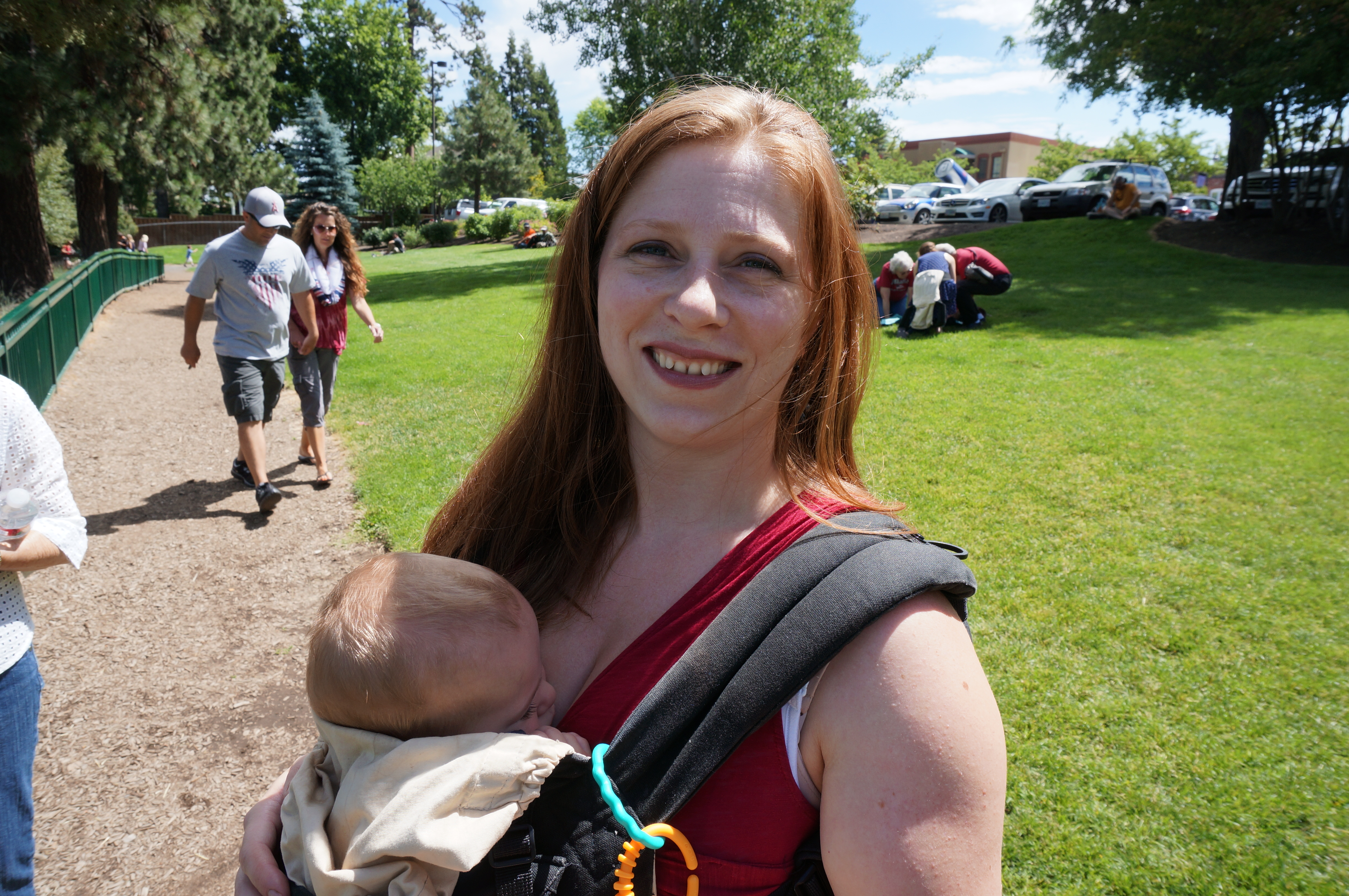
Seven-month-old Sofia napping in her Ergo during a Fourth of July walk.
At fifteen months old, she was almost a year past her colicky stage (though too much dairy in her diet would still keep her awake at night). We were weaning, but I would still nurse and rock her to sleep each night, spending 45 minutes or so putting her to bed. She would wake anywhere from two to five times at night; most nights, she’d sleep in about two-hour increments before waking, and I’d nurse her back to sleep each time. It was exhausting, but was — I thought — what she needed.
I knew I couldn’t do this forever, and with a 2-day trip coming up during which Aaron’s mom would stay with the kids, I was on a deadline to figure out a better way to put Sofia to sleep at night and nap during the day. I was determined not to use the Cry it Out method — despite my exhaustion, I just couldn’t face the idea of ignoring my baby’s cries. But I needed a solution.
I asked my mom how she night-weaned my brother and me. She told me that once we were eating solid food, she reasoned that waking up during the night was just habit, and she simply let us cry for a little bit till we learned that we wouldn’t be fed. At that point, we stopped crying at night. “How long did we cry for?” I asked. “How long is too long? Twenty minutes?”
“I’d say twenty minutes is too long,” she agreed. “You didn’t cry that long. Maybe ten minutes, and then you just went back to sleep.”
Well, that settled that. Sofia is more than capable of screaming in rage for two solid hours. She stops, not when she’s exhausted, but when her situation changes. It’s now been months since she’s done this, but the memory is still raw. Her screams are piercing, literally painful to the ear. So letting her cry at night didn’t seem like a workable solution — after all, the rest of us, including her four-year-old brother, needed to sleep too. Back to the drawing board.
Not long after my conversation with my mom, Aaron and I went on a rare evening date. Our babysitter, Alyssa, arrived with her own newborn just as fifteen-month-old Sofia was waking up from a nap. We discussed bedtime routines. “I honestly don’t know how well she’ll sleep for you,” I confessed. “I nurse her to sleep, and it takes forever. If it doesn’t work for you, don’t worry — I’ll put her to bed when we get home.”
Around 9:00, I sent Alyssa a quick text — “How’s it going?”
“Just fine!” she answered. “Everyone’s asleep.”
What? Everyone? “Sofia too?” I asked.
“She’s been asleep for about half an hour. She hardly cried at all. She went down really well.”
Over the next few days, I couldn’t help but wonder what magic Alyssa had worked. How had she gotten Sofia to sleep? Finally I couldn’t stand it any more. I texted Alyssa: “Do you think you could tell me what technique you used to get Sofie to sleep? I could really use some help figuring out how to get her to sleep without being nursed.”
She called me back. “I’m sorry, I wish I could help you, but I really didn’t do anything special. We just did all the bedtime stuff, read a story together, and then I put her into her crib and closed the door. She cried for about a minute, and then she went to sleep.”
Waaiiiiit a minute. She put her into her crib…and then walked away? Just like that? Impossible. She must have worked some wizardly mind magic on her. Still, the thought seemed full of potential. I might not have Alyssa’s touch (she also got Sofie to take a bottle when I couldn’t), but I do know how to use my legs to walk.
That night I braced myself to unleash hell. “I’m going to try it,” I told Aaron. “I’m just going to walk away.” We read a story in Niko’s bed, I tucked Niko in, and then I carried Sofia to her own room. “It’s time for bed,” I told her. “Niko is in his bed. Mama and Daddy are going to go to our bed. And you’re going to sleep in your bed, too.” I kissed her, wrapped her in her favorite soft blanket, and laid her down. To my amazement, she immediately rolled over onto her belly, stuck her little bottom into the air, and cuddled down into the bed without resistance. Her bright eyes watched me calmly, a peaceful smile on her face. I tucked her warm yellow crocheted blanket from Grandma around her, said good night, and walked out of the room. Then I stood outside her door, holding my breath. There was a soft wail. Another. And then…silence. Silence stretching on for minutes. I finally tiptoed away from the door, reeling with the shock. Realization was slowly dawning: for who knows how long now, Sofia hadn’t wanted to be rocked to sleep. She had been wanting to go to sleep on her own. Her resistance to sleeping at bedtime had been resistance to being rocked. And it took an evening with a babysitter for me to discover this.
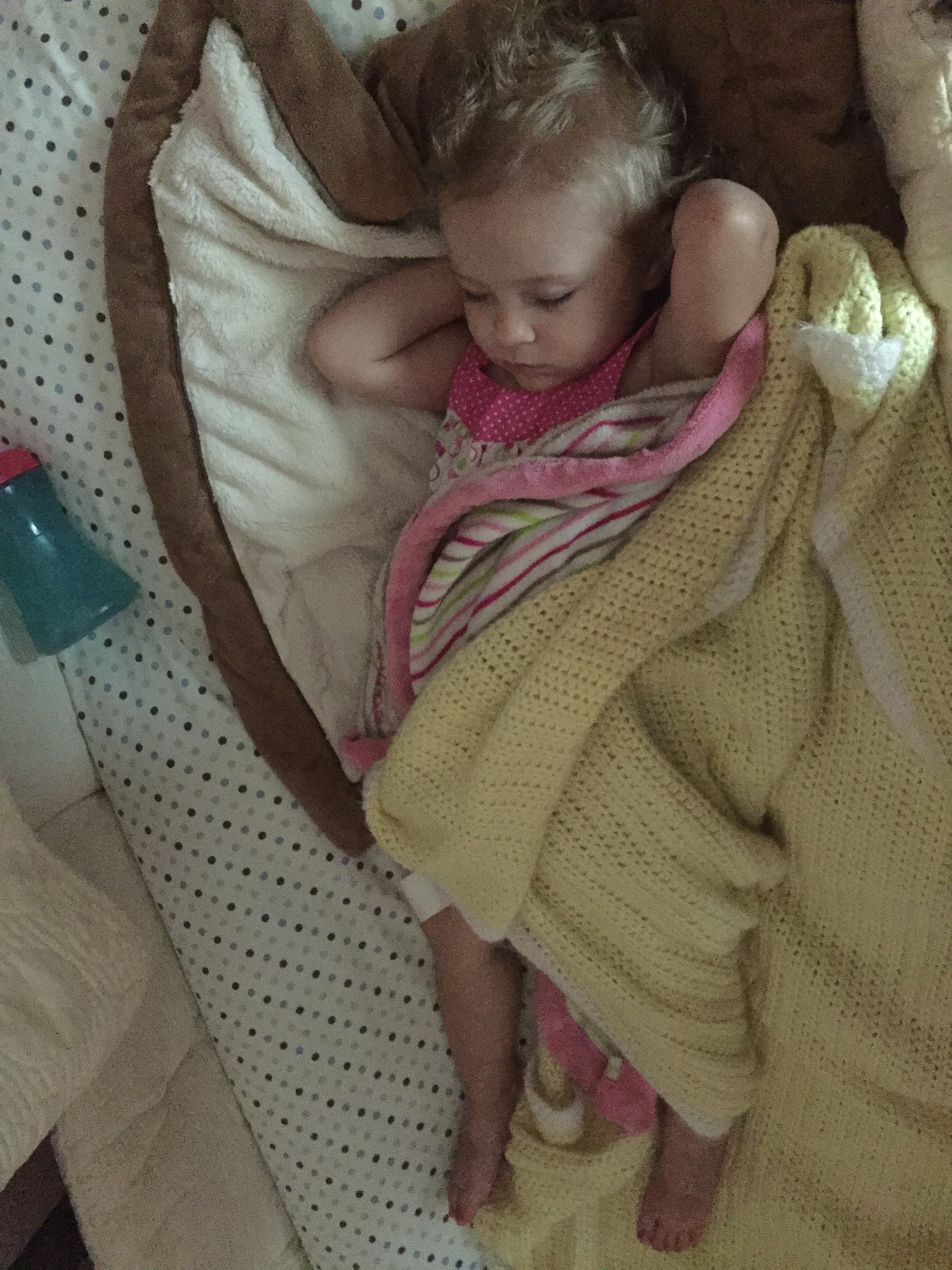
Sofia rests peacefully at nap time… all by herself!
Yes, I know kids. But what I’m learning is this: no matter how experienced a parent is, how in tune with a child’s needs, at some point, we all need a fresh perspective. The most dedicated parent sometimes misses something essential. This rather humbling experience was one of the best things that’s happened to our family. Sofia, now eighteen months old, has blossomed into a joyful, loving toddler. Putting her to bed without rocking or nursing paved the way for night weaning. I was finally able to take my mom’s advice and let her cry when she woke up at night — and just as my mother predicted, she cried for less than ten minutes before she decided it wasn’t worth the trouble. And weaning turned her into a different child. She now runs to her dad when she sees him, rather than withdrawing. She no longer panics the moment I leave a room. She explores, climbs, experiments with new words, waves to strangers, gives hugs to her dad and big brother. She is…fun. I’m enjoying her like I never truly did before. And it all started with a babysitter who just tried doing something a little differently than I’d been doing it.
I’ve never been so delighted to devour a giant slice of humble pie. Mmmmmm, delicious.
About a month ago, I was weeding a garden behind our house with the kids when I caught sight of Sofia in the garden (forbidden territory), wielding a little Frog House like a banner. As I hurried toward her to rescue the fragile house and any nearby flowers, I heard an odd rattle. Sofia giggled and shook the Frog House again, and again I heard the rattle, this time noticing some dry grass sticking out of the bottom.
Abandoned dark-eyed junco nest
Oh, no. Someone had built a nest on the ground inside the Frog House, and now my child was rattling the poor little eggs inside as if it were a maraca.
The mama bird never did come back. I was able to identify the eggs as almost certainly belonging to a dark-eyed junco, and I eventually took it to Niko’s teacher to use in a little nature center.
After the disappointment of not being able to let the kids witness the eggs hatching and seeing baby birds, I was delighted to look up not long after that and see, up in the large vine maple behind our garage, a new nest — complete with a patient robin. I’ve been watching the nest ever since, hoping to get some photos when the mama was away.
Today I thought I had my opportunity. I climbed up a very high ladder to get a picture of what I thought was a momentarily empty nest, only to find mama very much in residence! I didn’t want to scare her, so I just snapped off a couple of photos from a bit more of a distance than I’d hoped. Nevertheless, I’m thrilled that we have an active nest.
Here’s Mama Robin, guarding her babies so patiently:
There’s been an opinion piece from the Scary Mommy blog floating around the interwebs recently, entitled “9 Reasons Why I Won’t Make My Kids Share,” by Joelle Wisler. I’ve seen it several times, and it’s irked me from the beginning. Each rereading (yes, I’m a compulsive reader, so I’ve read it at least four times now) causes my ire to grow. I have several reasons for being irritated by this mom’s description of what sharing means and why she wants nothing to do with it.
First, Ms. Wisler opens her piece with this analogy:
You have just settled yourself down at your favorite coffee shop with a hot drink and you open up your laptop. A stranger walks up to you and says,
“Hey, let me have a turn on that thing.”
You say, “Um, no. This is MY laptop.”
He says, “No fair! It’s my turn!”
And then he goes and tells on you to the barista. The barista comes over and says, “OK, I think you’ve had enough time on the laptop. It’s time to give your friend a turn.”
And then she takes your laptop away from you. That’s crazy, right?
But, you see, that isn’t sharing. That’s a very strange case of enabled entitlement. Her analogy sounds crazy because it is crazy. If your child takes his personal Etch-a-Sketch to the playground and sits quietly on a bench using it, nobody expects him to hand it over to some other kid — because it belongs to him. It’s not public or common property. But here are some real-life examples of when an adult might, in fact, be expected to share.
You settled down at your favorite cafe and plugged your laptop in to the one available outlet an hour ago. Another customer, who’s also using a laptop and has been unplugged for 45 minutes, politely asks if he can have a turn with the outlet. You are a decent human being, so you quickly unplug your cord as you apologize for monopolizing it.
You’re at your local gym. Your favorite piece of weight equipment for toning your abs just happens to be the only one of its type in the place. In the zone, you pound out set after set until your vision blurs, but suddenly you’re interrupted by a polite voice saying, “Are you almost finished here? A few other members were hoping to use this.” Because you learned manners as a child, you feel embarrassed as you realize you’ve used it for fifteen minutes, and you apologize to the waiting gym members as you quickly vacate the seat.
On a lovely sunny day, you visit a local park. You see a bench in the perfect spot to bask in the solar glow, so you stretch out with a contented sigh. A few minutes later, a shadow falls across your face, and you open your eyes to behold a hugely pregnant woman with her elderly grandfather leaning on her shoulder, both out for a summer afternoon’s stroll. Since you’re a considerate soul, you quickly sit up and offer a friendly smile, in case the duo wishes to take a short rest in the course of their perambulation.
Ms. Wisler’s #4 point was just as odd. It literally made my jaw drop — I mean, my mouth opened and shut as I tried to form words, but all that came out was “Whaaaaaa?” She says,
It’s weird. Sharing is weird. As adults, do we share our cars? Our ottomans? Our husbands? Last I checked, I wasn’t a sister wife.
But…but…YES WE DO! We do share all of those things, routinely, without even thinking about it. What kind of alternate universe is she inhabiting? I share my car with my husband, both my kids, and any assortment of friends or family who might be present and requiring transportation or companionship. If I had an ottoman, of course I’d share it. My family and visitors would use it if sitting in a chair near it. In fact, I might even use it at the same time as someone else, since my son has an odd habit of climbing onto my legs and lying down on them every time I put my feet up. Yes, I would share my ottoman without hesitation. And my husband? Well, first of all, though I’m married to him, my husband isn’t my possession. But I do share him. Besides being my husband, he’s also the father of my two children, the son of his parents, the brother of his siblings, the colleague of his co-workers. He has numerous other relationships. I don’t get him all to myself. Wanting him to spend all of his time with only me would be a sign of a dangerous level of codependency.
Number 5 and number 9 just solidified my belief that Ms. Wisler is approaching this issue from a perspective vastly different from that of most socialized humans. She says,
I’m not interested in fair. Contrary to popular belief in the grade school set, life actually ISN’T fair. And it won’t ever be. Good luck out there, little people. Yes, that kid has had the toy for longer than you. That’s rough, but I think you’ll make it through.
And,
Maybe if children learn that they can’t have everything they want right when they want it, there will be a lot nicer people growing up in the world. You know, people who don’t throw a temper tantrum at every little provocation…
But, you see, fairness actually is important. Regularly making the attempt to act with fairness (or, better yet, kindness) is what makes society run smoothly and pleasantly. Childhood is the ideal time to learn to take the feelings, needs, and desires of others into account.
No, life isn’t always fair, but you can be. Fair means if there’s one available swing on the playground, you use it for a reasonable amount of time. Fair means taking turns, or figuring out a way to play together. And no, fair doesn’t mean having what you want right when you want it. You might need to wait. But should my child miss out on using that swing altogether because your child refuses to give it up for half an hour, despite the growing crowd of disappointed kids who all hoped to play on it?
As an adult, sharing fairly includes returning those library books when you’re done, or leaving the extra-wide parking space near the entrance for people in wheelchairs. Just because the book is in your possession doesn’t mean you get to keep it for the rest of your life; just because you don’t feel like walking doesn’t mean you should make the store inaccessible for those who need maneuvering space.
Learning to share as a child makes you more bearable as an adult. It makes the world more pleasant. It helps to ensure that limited resources continue to be available. Learning to share will not damage a child’s psyche. True, life isn’t always fair. I think most of us agree, though, that attempting fairness whenever possible will help us all enjoy this world a little more.
Glancing down at a questionnaire Niko’s doctor had handed me on the way out of the office today, one item stood out: Frequently worried or afraid. I was supposed to select the degree to which the description might be true: Not at all; Somewhat; A lot, or some similar scale. I sighed as I checked off A lot.
Worried or fearful aren’t words the average observer might immediately think of as descriptors for my ebullient son. He is curious about absolutely everything, full of questions about life, death, dinosaurs, the solar system, you name it. His questions are thoughtfully designed to extract every possible drop of knowledge from the mind of his conversational partner. Nothing makes him happier than learning that Deinonychus’s teeth were sharp as steak knives, or North American porcupines have barbed quills.
But give him two minutes of silence in the car, or the peaceful quiet of his bed at night, and his mind begins roiling with the ramifications of all these facts. Will a porcupine’s quills HURT us? But why? It’s not nice to hurt people. Why did that bird die? Will I die? When? Will you still love me if I die… or if you die?
Tonight, nearly two hours had passed after putting Niko to bed…after hugs, kisses, cuddles, reassurances, tucking in yet again, soothing the panic of the realization Stuffy had been left in the car, rescuing Stuffy, more hugs, more kisses, ditto for Stuffy too… After all that, I was thinking yearningly of my own bed when I heard a small, anxious
voice. “Moommmmmmyyyyyy!”
I opened his door. “What’s wrong?”
“I need you. I really really neeeeeeed you.”
Usually I can withstand even the most heartfelt neeeeeed, but this one sounded more urgent than usual. I climbed onto his bed and cuddled beside him, any hope for an early night vanishing. “Why do you need me?”
We talked about loneliness, about how far away Mom seemed at night. I reminded him that really I was very close, just a few steps away, and showed him how close his sister was, too — just right next to him, on the other side of the wall. He seemed to relax for a moment, and then in a rush the real problem came out.
“When I was brushing my teeth in the bathroom” — and here his voice wobbled, grew thick with tears — “I almost started to cry.”
“Why did you almost cry?”
“I didn’t want to go to school tomorrow. I was just nervous.”
“What part of school made you feel nervous?”
“Dramatic play. I was worried about dramatic play.”
Dramatic play is not typically a concern for Niko. He loves costumes, always has, and this winter, after a huge amount of effort from his preschool teacher, he had a breakthrough: he discovered his imagination and the joy of pretending. His excessively literalist tendencies make those ventures into make-believe all the more delight-filled. And he often mentions the dramatic play center as one of his favorites. So it was with growing puzzlement that I dutifully asked, “Why were you worried about dramatic play?”
“It’s the wooden food. I’m worried about the avocado.”
“I just don’t want to eat it. I really don’t like avocados.”
Avocados. This child was lying awake for two hours worrying about the possibility that he might have to pretend to eat a wooden avocado. TWO HOURS. It turns out that it was a social dilemma: he wanted to participate and be a server, but what if — oh, the horror! — what if someone asked for the avocado? “If someone else asks for the avocado, you don’t have to eat it, do you?” I pointed out. Not that simple, of course: what if they offered him a bite? “It’s pretend. So you just pretend to eat it, and pretend you like it. Or you say no thank you. Or you take a pretend bite and say it’s not your favorite and you’d rather try a, a, a tomato.” Problem solved. Whew! After two…well, now almost three…hours of obsessing over a toy avocado, his mind was finally peaceful enough to sleep.
Yes, if a toy avocado can cause such havoc, I think it’s safe for me to check off “A lot” beside Frequently worried. Lying awake for three hours, pondering the social implications of pretend serving a toy food he himself does not care for…
What a boy.
There’s a fairly common thing that happens to people who take medication for mental health issues. When the medication is successful, you tend to start feeling like you don’t really have a problem. This especially happens if you share examples of how your particular problem affects you, and other people tell you bracingly, “Oh, that happens to me all the time! You’re fine!” It’s easy to start wondering if you’re overthinking this, if maybe you’re really okay after all.
This happened to me for the first time about a year and a half ago, a few months after moving to Oregon. Since I was no longer working as a teacher, my insurance had expired, and I was now using Aaron’s insurance. With the change in coverage, my copay for the medication I take for ADHD went from $20 to $60. Previously, I’d paid $40 per month for both my asthma inhaler and my ADHD meds; the new cost would be $100. Now, we’re not destitute by any means. But we do try to spend our money wisely and save where we can. It occurred to us that maybe, just maybe, I didn’t need the medication any longer since I didn’t need to maintain a classroom and manage a room full of children. I was only managing one child, a pregnancy, and a house. It would be okay, we reasoned, for me to exhibit ADHD symptoms in the safe environment of our home.
So I just stopped taking the medication. And at first, it wasn’t all that bad. I mean, it wasn’t great. A few days in, the dishes were piled up in the sink. Crumbs littered the floor. I drifted aimlessly, unable to remember what needed to be done for long enough to do it. I fed and dressed Niko and myself, but beyond that, I was in a fog. Several days after that, the trash was starting to smell when I forgot to take it out… and forgot… and forgot. Toys littered the floor, clothes lay in drifts in the bedrooms. The dishes covered the counter as well as the sink, and fruit flies moved in. Niko wore his pajamas all day, and I couldn’t think of a reason to change my own clothes. I wanted to go back onto medication, but the decision to stop taking it had coincided with my last available refill from my Alaskan doctor, and I hadn’t yet found a new provider. I couldn’t find the motivation or focus to search for a new one and make the necessary phone calls.
It got worse. About a week and a half after stopping the medication, the blackness moved in. Strattera is a medication used to treat ADHD, but since I started taking it about three or four years ago, I haven’t had a single episode of depression. (It’s worth noting that it was originally developed for depression, but test subjects found their ADHD symptoms improving instead.) Previously, I experienced it on a cycle of roughly a year from the start of one episode to the start of the next. It’s now been over five years since I’ve experienced depression (I didn’t experience it during my pregnancy with Niko or for the year and a half between his birth and the start of Strattera). I haven’t been sure that Strattera was what was keeping depression at bay — after all, that’s not what it’s marketed for — but whether or not it’s been responsible, it was about a week and a half after stopping my meds that things took a sharp turn for the worse.
It wasn’t a full-fledged episode of depression. It was just a shadow on the horizon. Just a looming cloud of black emptiness, hovering just close enough that I felt its threat. Just close enough to bring a flood of memories of the dark nothingness, the endless pit. And I completely panicked. I huddled on the couch, sobbing, my grasp on reality weakening. My son was being his ordinary self, directing a flood of happy chatter in my direction, unaware of my desperation. As I tried to cope with the waves of hopeless terror washing over me simultaneously with Niko’s needs, I was struck by a snarling, primal need to eliminate the source of irritation. I wanted him gone. Out of the picture. Permanently.
Bizarrely, it was that sudden attack of internal rage that horrified me enough to snap me briefly out of my panic attack. I pulled myself together, put Niko to bed for the night, and started texting my best friend, who lives in Alaska. I don’t remember what I said, but it was worrying enough to her that she called me seconds later (despite the fact that we almost never speak — 97% of our communication is through text). I picked up the phone up, but I couldn’t talk — I was crying too hard. Bless her heart, that girl calmed me down enough that I could tell her what had happened. She told me exactly what I needed to do — BREATHE. Tell Aaron what’s happening when you’re done talking to me, it’s ridiculous to try to protect him from your issues, he can’t support you if he doesn’t know. Find a doctor first thing tomorrow to refill your prescription, never mind the stupid money, it’s not like you’re poverty-stricken. Call me or Aaron right away if you think you’re going to hurt yourself or Niko, no matter what time it is. I love you. You’re going to be okay.
Obediently, I texted Aaron the general gist, then crawled into bed to sob myself to sleep. I woke up the next morning to my phone buzzing. Have you found a doctor yet? Oh. Right. Actually, I had a doctor, or a midwife group, to be exact. I called the office and explained what was happening. They immediately wrote a prescription and sent it to a pharmacy near their practice, where it waited for me free of charge until I could figure out how to get the new prescription costs to fit our budget — it turns out, thank God, that people move REALLY FAST to help when you mention a terrifying urge to hurt your child. Next time I saw my midwife group, I met with a social worker who gently questioned me about how I was doing, reminding me that I needed to find a general practitioner, since they specialized in births, not mental health.
And just like that, I was back on medication. The black cloud receded. The fog in my mind lifted. I cleaned the kitchen, dressed myself and Niko, and breathed a shaky sigh of relief. And then I started searching our insurance provider’s website for doctors.
Yes, sometimes medication works too well. We forget what it’s doing. We wonder if we really need it. And we forget how to cope without it. Strangely, I’m glad I had that experience, because it gives me a strong contrast between who I am unmedicated, and who I am with a bit of help. I don’t want to find myself in that place of utter desperation, ever again. And that’s why I will continue to take those nasty, gag-inducing pills every single night. I like who I am when I have medication to help me move toward my potential. I like having a fighting chance to think clearly, to focus on tasks, to remember to wash those dishes before they get crusty. I don’t like the fact that I need to take pills to keep me sane; I do appreciate being able to like myself and be myself.
So. Bottoms up. Down the hatch. Chug chug. Vive la médecine!
Easter: a time of candy-coated Robin Eggs, colorful pastel jelly beans, and chocolate bunnies; of melting snow, muddy slush, an influx of visitors from far away, and hours upon hours of church services.
For me, childhood memories of Easter don’t include sunrise services, new bright-colored Sunday hats, or egg dying. No giant bunnies delivering baskets of spring-themed treats, no egg hunts on lawns. No, when I was growing up in a Christian commune in Northwestern Ontario, I knew that the bunnies and eggs of worldly Easter celebrations were a nod to Ishtar, a fertility goddess of long ago, and to be avoided at all costs lest our pure hearts be darkened by the taint of paganism. Well, except for those egg-shaped candies and chocolate bunnies. After all, it would be wasteful to miss the once-a-year opportunity to savor the best confections the village’s tiny general store had to offer.
My parents are part of the Move, a commune-based Christian movement that started in the early 70s, notable in part by the eschewing of all worldly entanglements. This category most emphatically included paganism-tainted celebrations like Christmas or Easter. Paganism, in this case, was a convenient catch-all description for any and all non-Christian religions, especially (but not limited to) ancient ones. By now, I should mention, Easter hats and shiny plastic eggs most probably abound in the communes right about this time of year. But when I was a child, they were frowned upon.
Instead of egg hunts on the lawn and brightly-colored baskets of treats, the children of my community looked forward to Convention. Convention was one of the Big Three, three yearly celebrations that were far more important than secular, pagan, or misguided religious holidays like Christmas, Easter, or Halloween. In our close-knit trio of communes, the Big Three were graduation, Thanksgiving, and Convention. Convention was a yearly long-weekend event. The important leaders of our network of communes and churches were known hierarchically as the “Traveling Ministry” (the lesser traveling preachers and teachers) and “Father Ministry” (the ruling class who handed down decisions both religious and practical). They would arrive the first weekend in March, along with other visitors who would come from all directions to attend all-day revival-style services, causing our group to double or triple in size for several days.
We’d cook and shop in a frenzy for a week ahead of time. Zucchini bread, banana bread, poppyseed muffins, blueberry muffins, and hundreds and hundreds of cookies, all were baked off and stored in the big freezers in the cellar below our main building. Someone good at both cooking and shopping, like Aunt Robin, who was in charge of our commune’s bookkeeping and thus preferred to do the shopping herself, would do a huge shopping trip and come home with plenty of supplies for making easy meals for three hundred people: lunch meat (a rare treat), lots of mayonnaise, store-bought bread and kaiser rolls (more rarities), fresh oranges and bananas, and cases of disposable dishes.
The kids would whisper excitedly, sharing overheard gossip about the coming visitors. Did you hear that John and Sarah started their year? That means a wedding soon! Wonder if we’ll go? or, Guess who’s staying at our house! Nooooo, we wanted them! We’ll probably have someone with five screaming babies! We’d be enlisted for huge cleaning projects and for once wouldn’t try to dodge out, reveling in the excitement as we scrubbed floors, cleaned the tops of cupboards, washed windows, and helped touch up paint.
And then the visitors would start flooding in. We’d share our rooms with kids our age, if we were lucky, or give up our rooms to older visitors while we slept on living room floors or couches. Younger singles (properly chaperoned, of course) would camp out in the big dining room of our main building, the Tabernacle, while the building’s living room was turned into a bedroom for a family. The other two communes in our church were doing the same, stretching their borders and crowding their homes to welcome visitors from hundreds of miles around who’d come for the yearly convention. Freshly mopped floors would be flooded with slush and mud from visitors’ boots, to the consternation of the guilty visitors and silent frustration of the teens who’d been on their knees scrubbing just a day before.
The first meeting was on Friday afternoon. We rented the village’s community hall for the occasion, since none of the three commune’s Tabernacles could hold the swollen congregation. After a flurry of extra hairspray and double-checking of favorite dresses or parentally-inflicted ties in the mirror, we’d traipse through snow, slush, or mud up the long hill to the community hall in clunky boots, dress shoes in hand. There would be a flutter of activity as older children took advantage of the exciting situation to beg permission to sit with their cousins and friends with more permissive parents, and teens claimed the right to sit separately from their families (but always in a row ahead of their parents, to prevent out-of-sight shenanigans). Older teens and young singles found friends and prospective beaus, shyly sitting next to their crushes knowing that it would create a stir of speculation — “Did you see Paul sitting next to Jennifer? Are they an item? I guess we’ll see if they sit together tomorrow too.” One’s choice of seat during convention was of immense importance.
The excited chatter of friends greeting each other after a year or more apart filled the hall, only quieted by the first chords from piano or guitar near the front of the room. With a rustle and hush, people found their Bible-marked seats and prepared to sing with gusto for forty-five minutes or more, three hundred voices raised in exuberant song while feet tapped, hands clapped out rhythms, and bodies swayed. During the more upbeat songs, you could get seasick if you looked out over the undulating crowd of dancing worshipers, hands lifting upward and hips keeping time.
All too soon, the music came to an end, and our reluctant bottoms found the seats that would hold us for the next two or three hours. Out came teacher-mandated notebooks, pens in multiple colors, Bibles, and… rustle rustle rattle crunch — the bags of candy we’d stockpiled for the occasion. Malt-filled, hard-shelled Robin Eggs; pastel jelly beans; sour gummy worms; chocolate eggs; all the best Easter candy. We’d share down the row with our friends, making sure those with sugar-conscious parents got a secretive handful while their moms and dads were absorbed in finding I Thessalonians.
There was more to Convention than the candy, of course. There was the easing of aching toes out of high-heeled shoes after a vigorous song service. The preaching. The trick of keeping double notebooks, one for dutifully recording the message of the preacher (one message per meeting), one for communicating with friends, doodling, and writing silly poems. The rustle that spread across the room as one hundred women expectantly worked their feet back into the shoes in response to the winding-down tone of Brother Buddy’s voice after a two-hour message; the audible sigh of disappointment as he revved back up for another thirty-minute run. The youth meetings…. oh, the youth meetings, fertile ground for planting seeds of terrible doubt and anxiety with the messages of purity directed at hormonal teenagers.
Yes, there are plenty of Convention memories. But what will always stand out in my mind, and what I always remember when I see stores filling with Easter signs and merchandise, is sitting in a long row of giggling teenagers, passing our favorite spring candies back and forth. The crunch and sweet chocolate malt flavor of Robin Eggs is inextricably entwined in my mind with friendship, with notes passed, with collaboration on goofy rhymes about Brother Joe’s enthusiastic speaking style. Easter candy makes me homesick.
It was a routine Wednesday morning drive to preschool. I kept my eyes on the road, fielding happy chatter from the back seat while listening to our special “Wake Up” playlist, carefully crafted to appeal to Mom, Dad, and Niko.
As I slowed to pass the big high school on our route, Niko asked, “Did you go to this school when you were a little girl?”
“No, I didn’t live here then.”
“Where did you live?”
“I lived in Canada, with Meemaw and Grandpa.” He knows this, but I guess he likes to hear it repeatedly.
“But were you still my mommy?”
I had to think a moment. In a four-year-old’s mind, past, present, and future are not separated as clearly as in an adult mind. Finally I explained, “I wasn’t your mommy yet because you weren’t born yet.”
To my astonishment, the long pause that followed ended with an anguished wail. “What’s wrong?” I asked him.
“Why weren’t you my mommy yet? I really wanted a mommy! I needed you! I missed you when I was so little I wasn’t borned yet! Why did I have to wait so long to get a mommy?”
Um. Hmmmm. Okay.
Sometimes I wish I could just open up that boy’s mind and take a good look around in there.


 I can’t even. I can’t even use the bathroom alone. Ever.










 A Bright Ray of Hope