God’s Finger

I’ve mentioned it a few times, the Big Hemiplegic Migraine that sent me to the ER in a dramatic sort of full body alert that I’d never before experienced, unable to speak or fully use my right side, barely able to remember how to form words on paper, too weak to walk alone, and very very scared. Those big and obvious symptoms have long faded, and now the extreme versions of other symptoms are starting to recede a bit too, but right now those lesser, non-scary symptoms are still somewhat ramped up and extreme, and a little distracting.

My ADHD brain has taken this distraction and run with it, constantly making analogies to explain and categorize the odd sensations I’ve been experiencing. I’ve cataloged them here for your reading pleasure. I hope you enjoy them more than I do.

Nearly all the time, there’s a gentle vibrating tickle at the back of my neck, trailing down my spine. If you were raised in a church with a leaning toward Pentecostal, Apostolic, Charismatic, or some other such Holy Spirit-led group, or belonged to another fervent religious group, this may be a familiar sensation to you. You’re caught up in the heights of ecstatic praise, and a brother or sister or elder begins shouting out a prophetic message in the exact words of the Scripture you read that morning: there it is, that gentle tickle on the back of your neck. A more mundane setting for this sensation might be a struggling single mom who brings a five-dollar coat for her child to the register at a secondhand store, and happens to slip her hand into the pocket, where she finds…a five-dollar bill. I guarantee she feels a tickle on the back of her neck, a shimmer along her spine. That, dear readers, is the finger of God.

I feel the finger of God a lot these days. It’s a little disconcerting. When I was a teenager, my Aunt Gaye and her sister, my sort-of Aunt Julie, used to run their fingers down our spines (or their knuckles, if they felt like being emphatic) when their daughters and nieces were demonstrating poor posture. I grew to half-expect this from my aunts; one never quite expects God’s finger to hover permanently over one’s spine.

Most days, this tickle intensifies and spreads upwards into my scalp. My hair lifts, and my skin prickles. I can describe this one easily, in terms everyone will understand: spooky stories during a sleepover! Or… that feeling when you know you’re sharing space with a ghost.

About fifteen years ago, when I was a student at a Christian college which was part of a network of communes spread across mostly North America (with a few elsewhere worldwide, too), I was visiting friends at the home of one of the commune’s hosting families (that is, they were commune residents who hosted college students during the school year). It was just us five girls, the high-school-aged daughter of the family and four college girls. We knew we were in the house alone; we’d recently been upstairs, where we were the only ones present, and were now down in the kitchen getting a snack. During a pause in conversation, we heard footsteps. Heavy footsteps, above our heads. Five heads swiveled toward the stairs, then back toward each other. Sherri shook her head; no, she confirmed, no one else was home. We listened in utter silence as the footsteps moved back and forth from room to room. And then. The footsteps came to the top of the stairs. We clearly heard footsteps descending. Vertebrae in five necks crackled as our heads whipped toward the staircase, which was in clear view from the kitchen counter.

No one was there.

Oh yes, our scalps were prickling.

I feel that way a lot these days. I’m pursued by ghosts.

Some days, the gentle tickle and the prickling scalp intensify still more and spreads into my face and hands and sometimes my toes. It becomes a tingle punctuated with numb spots. Usually it’s merely bothersome, though occasionally, rarely, it’s enough to make my hands clumsy or make eating difficult. It concentrates around my eye sockets, temples, nostrils, mouth. Sometimes my lips, tongue, and roof of my mouth become partly numb. Is this sounding a bit familiar? Yes, indeed. It’s like a visit to the dentist.

I’m a redhead, incidentally. In addition to feeling certain types of pain differently than other people, redheads are also, weirdly, resistant to certain types of pain medication, like the lidocaine dentists use. Often this isn’t too much of an issue, but I remember one horrific incident. Really unpleasant. My childhood dentist, the wild-eyebrowed, kind-eyed, bluntly-spoken Dr. LeCoq, to whom all the commune mothers took their children, was preparing me for an extra-deep filling one day in my late teens. I’d had plenty of fillings before, and had often felt a little pain with drilling (though the good Dr. LeCoq didn’t entirely believe me), but this time was different. This time, I never went entirely numb.

Dr. LeCoq gave me a shot, told me I would soon be able to feel pressure but not pain, demonstrated by tapping my thumbnail, and left the room. He returned the appropriate amount of time later, cheerfully tapping my gum with some metal instrument of torture. “Ow,” I said. “Huh,” he said, “that’s odd,” and gave me another shot. This continued as long as was ethically allowable — at some point I’d had as much lidocaine as I could possibly have, and he simply had to either drill or let me go home. I was almost numb, really, so I told him to drill. Oh, yes. There’s a reason anesthesia is widely used in modern times.

Well. Anyway. That’s not really the point. The point is, my face often feels like that. It feels like my dentist — who felt terrible about the whole thing, by the way — has given me the first ineffective shot of lidocaine, and I haven’t gone entirely numb: I can smile with both sides of my mouth, talk clearly, eat without drooling; but it feels…funny. On those days, I’m in a perpetual visit to the dentist. But no one’s giving me free toothbrushes.

Most days, that’s as bad as it gets. I mean, there are a few days when the facial sensations are amped up to electric fly swatter levels, when I’m nearly convinced that should a fly happen to land on my face, it would be zapped to death. It’s mildly painful. Mildly, as in, there are mild electrical shocks running across my face and sometimes through my hands without stopping. It could be worse. It’s nothing like sciatica, which feels more like the sensation of running full bore into an electric livestock fence, concentrated into one area of back and hip. So, really, it’s mild. Fly swatter… electric fence… meh, I’ll take the fly swatter, thanks.

So there you have it. If you’re a family member, and a friend is asking after me, and you REALLY feel you wish to give them all the details, just remember: finger of God, ghost stories, dentist’s office, electric fly swatter.

I’m fine, by the way — energy is returning bit by bit, to the point that daily life is about back to normal; migraines have receded completely, thanks to preventative medication; I’ve recovered nearly all the normal use of my right hand, only noticing issues if I’m trying to thread a needle or write in a small space; I haven’t had trouble walking in nearly a month. The painful electrical sensation in my face is rare, usually lasting just a short time. I’m thankful that, so far, this is affecting me less than it seems to affect other people who experience hemiplegic migraines. Those symptoms I listed above? Weird; strange; distracting; sometimes amusing. Almost never painful. They don’t interfere with daily activities. So yes, really: I’m okay. 

I’ll just be even more happy when the finger of God lifts for awhile, the ghost goes off to haunt someone else, the dentist gives up and sends me away, and the batteries in the fly swatter give out.

IMG_2098.JPG

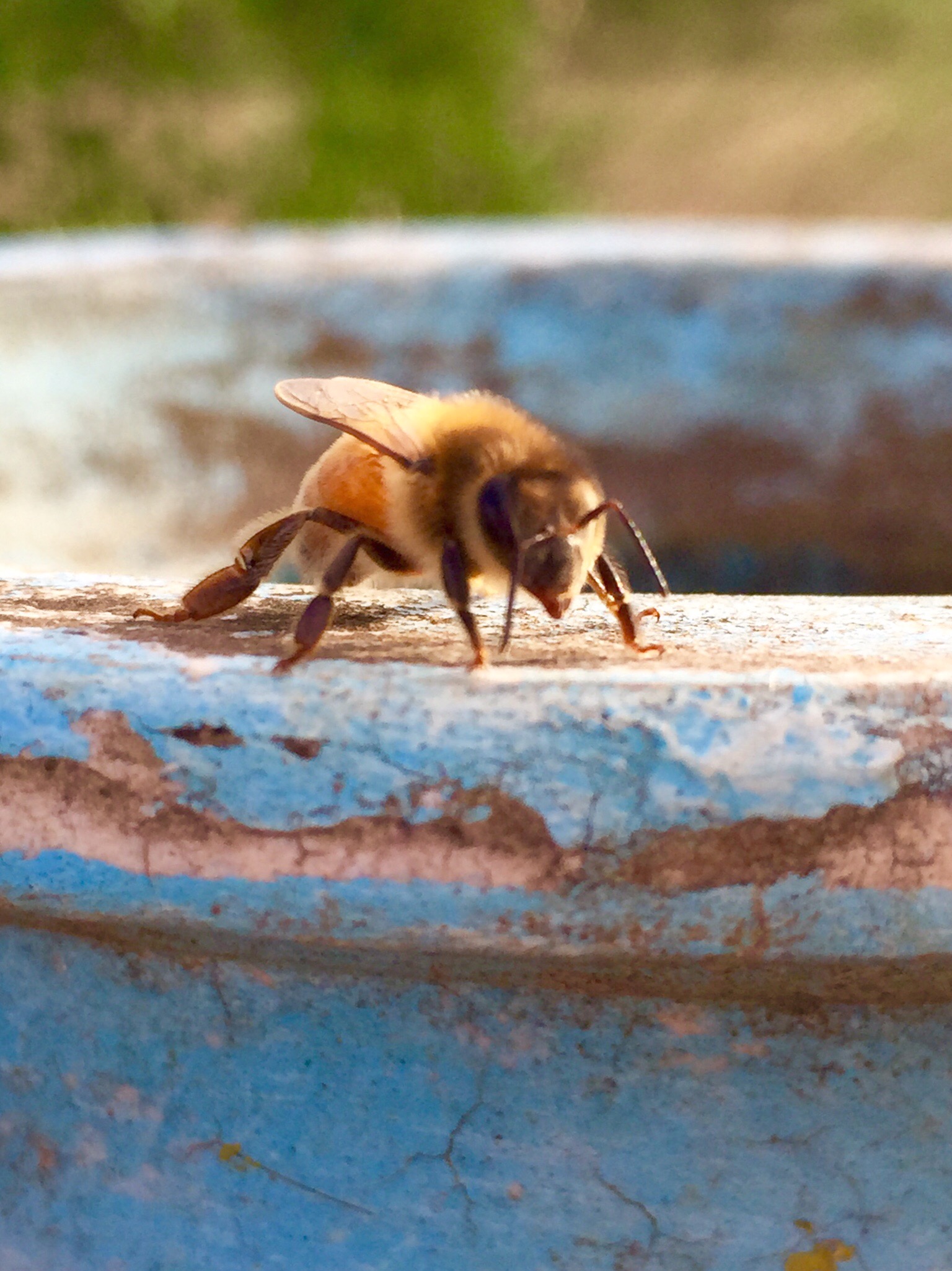
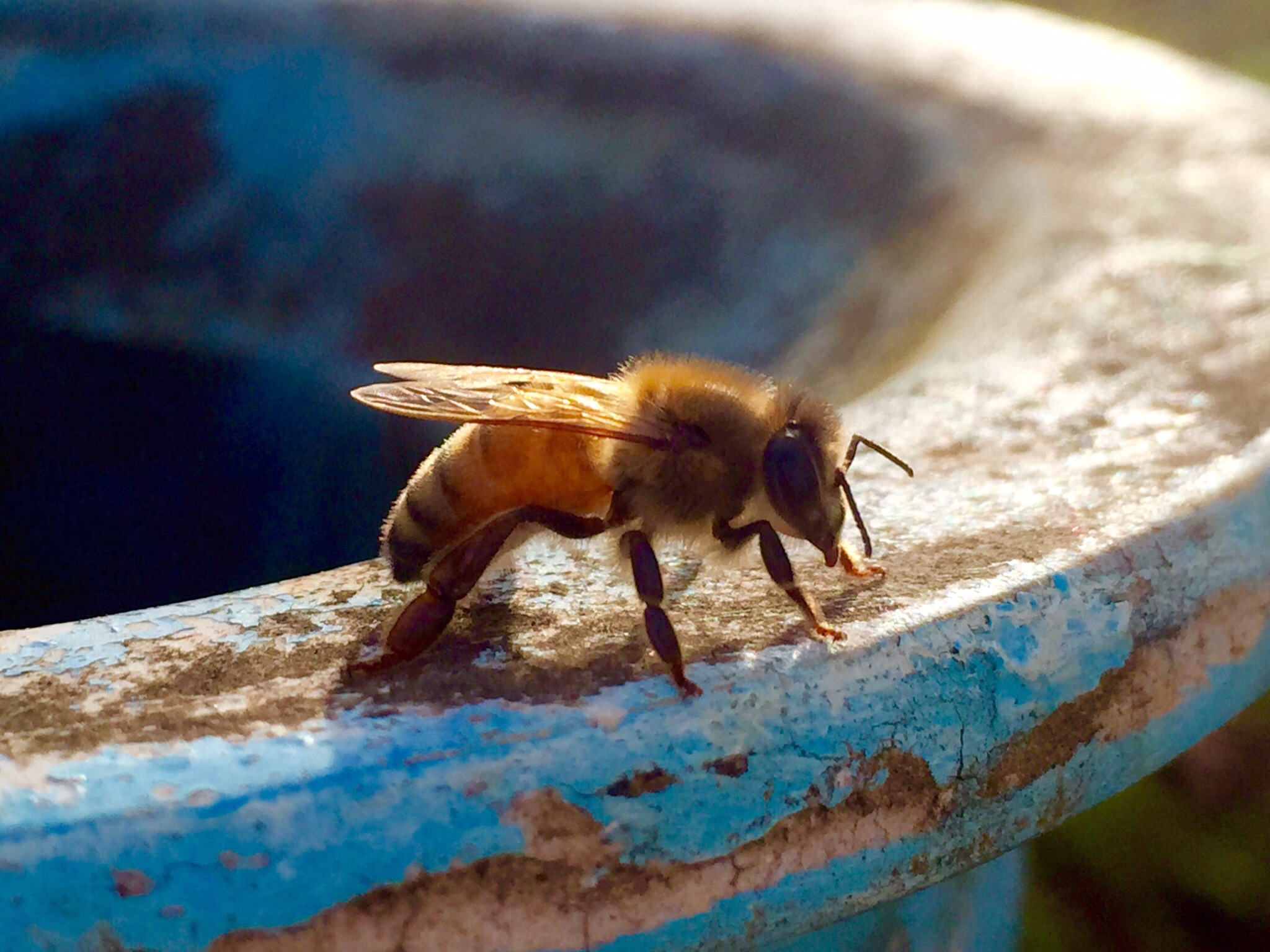
Lonely Bee

  I don’t know her story. She seemed a little lost, and slow, maybe chilled, despite the sun. She stretched her legs and walked slowly around the edge of the gazing ball’s empty plinth, her pollen baskets empty despite the unfortunately bolted broccoli flowers, the pepper blossoms, and surprising array of late summer and early autumn strawberry blossoms and berries, all within three feet of her perch.  
 I wondered if perhaps she was an aged parishioner of a neighboring hive, out for a last hurrah as her pollen- and nectar-gathering days drew to a close. Or perhaps she fancied herself royalty, small and alone though she was. She was in no hurry to leave, and obliged my photographical excesses with a polite coolness, occasionally shifting angle or direction to provide a more flattering angle, but never being so gauche as to actually direct her attention toward the giant imposter.  

 Whoever she was, I was delighted that she paused in her travels to alight in the middle of our garden at just the right time for me to spy her.    


Irises, Earthworms, Estivation!

A week or so ago, there was a tap on the door. I almost didn’t respond, thinking it was a hopping bird or swaying branch — who taps instead of ringing doorbells, when presented with so conveniently placed a doorbell as ours, and with no thoughtfully hung “Shhhh…Naptime!” sign next to it? But I did go to the door, and when I saw the big box on the porch and the back of the mail carrier vanishing into his truck with a cheerful wave, I was flooded both with pleased anticipation at the prospect of opening a package, and with bewildered gratefulness at the stranger’s oddly kind consideration. How did he KNOW my kids were napping and I would have curled up in a fetal ball of anguished despair, uttering ululating wails of mourning for the prematurely ended quiet time, had the doorbell rung?
The box was full of iris rhizomes. I’ve never planted irises before, so I was fascinated to see them. The individual iris roots were cushioned by swirls of long, fine wood shavings, reminiscent of those that would pile up under my dad’s lathe when he turned chair legs or picture frames or jewelry boxes. The irises are surprisingly pretty, with fan-shaped crowns rising above the lumpy rhizomes and twisty roots. They look like this:

Newly arrived iris rhizomes from Schreiner’s Iris Gardens    

A couple of days later we said goodbye to my mom, who’d just spent a delightfully out-of-character spontaneous weeklong visit with us, and I was left feeling at loose ends. After we waved her off, I commented to Aaron how nice it was for the morning to still be fairly cool. That’s when I realized it would be a good time to distract myself and the somewhat dejected Niko from missing Meemaw, and dig up the irises’ new home.

The garden bed against our shed, which is a potting and storage shed in one end and a woodworking shop in the larger remaining space, is filled with perennials that could be charming in the right setting but really just… aren’t. They all flower together, in the mid-to-late spring, and then simultaneously turn to scraggle and seed. The various plants all seem to flower along tall stems, with flowers dying near the base as new ones bud and open closer to the top, so they can’t be tidied up by deadheading. They’re always half full of dead flowers, browning leaves, collapsing stems, and seed fluff. This is our second summer here, and I’m finally realizing it’s OUR garden and I don’t have to maintain plants I don’t like. So, when we visited Schreiner’s Iris Gardens this spring, we decided that this haggard, overgrown garden would be the perfect place to fill with vividly colored irises and spring and summer bulbs. No more scraggle and slump.  Gleefully destroying a flower bed.

We’d dug up about a third of the bed, and were starting to think about lunch, when a clump of hard, dry dirt broke open and I saw the oddest thing: a ball of two or three earthworms entwined inside the nearly rock-hard lump. Their little wormy ball was slightly moist, as earthworms are, despite the extreme aridity of the ground that hadn’t seen rain in months. I was fascinated. Turns out, earthworms do something that’s like hibernation, only not, because scientists enjoy using precise words to describe precise activities, and this is something that occurs with certain creatures, including some insects and lizards, during extremely dry seasons rather than cold seasons. Various species approach it differently, but the general idea is the same: they protect themselves by retreating into the ground and going dormant, until moisture wakens them and signals them that their environment is once again friendly. It’s called estivation.

Estivation. Estivate. I love that. Estivation. I rolled that word around in my head for the rest of the day. Estivate. Don’t ask my why I love it so much, I just do. Estivation. And now, not only will we have a much prettier garden bed (thanks to Aaron’s finishing digging it up for me before the first rain since March arrived), but I have learned a new fascinating thing about earthworms, AND I have learned a delightful new word to murmur to myself whenever I need a quiet little bit of tranquillity.

Estivate.

Lying to My Son

Before I had children, and even when the older of our two was a baby, I swore I’d never lie to my children. Never. How could I betray their trust, set them up for disillusionment? I would be honest, I promised. At all times. In all situations. Never, I insisted, could there possibly be an excuse for lying to a child.

My husband Aaron agreed, and with the birth of our son, we set out on our adventure of perfect openness and truth telling. We took a policy of plain, simple truth telling, no embroidering or glossing over, and certainly no outright fabrication.

We were honest about the despised food items in his plate –“Yes, those are potatoes. Take one bite,” we’d say. No pretending they were magical unicorn eggs that would turn him into a superhero; they were potatoes, no more, no less.

We were straightforward about the existence of Santa. As our two-year-old son approached his first memorable Christmas, he was fascinated with Santa-themed decorations. We told him that Santa was a nickname for a kind man named Nicholas who had lived long ago, and we remembered him at Christmas time. He was a story, we explained: department store, mall, or bell-ringing Santas were regular people wearing costumes. He appeared to accept this, if grudgingly, and we congratulated ourselves on our honesty.

Our self-congratulation continued as we explained the precise facts about the Easter Bunny: he was a kind person in a costume, we told our three-year-old the next year, leaving candy for children to celebrate spring. How nice! Unfortunately, Niko’s patience with our honesty regarding the world had been wearing thin; he had been indignant that we continued to insist in Santa’s historical accuracy, but at our declaration that the Easter Bunny wasn’t real, he was crushed. “But I want the Easter Bunny! I want him to be real!” he wailed.  But it was too late; we couldn’t backtrack. No, our son would know that Santa Claus is a cultural memory of a historical figure, the Easter Bunny is the funny leftover traditional costumed character of an ancient custom, and his potatoes are just potatoes. We remain relentlessly honest, although, I suspect, we may be able to reach some sort of quiet compromise where we don’t insist quite so firmly in these beloved characters’ nonexistence.

But then, one day, there was a hard question. The kind of question for which honesty just can’t do the job.

We were in the car, where so many of these questions come flying at me. Niko, now four, was asking about love. “Will you always love me, Mom?” he asked. This has been a common theme for him, a source of mild anxiety at times, and once — when he discovered there had been a time I hadn’t been his mom and thus hadn’t known him, therefore hadn’t loved him — well, that had been an interesting conversation.

“I will always love you, for ever and ever,” I declared.

“Will you love me if I die?”

“I will love you if you die. People don’t stop loving  their family who die. They miss them, but they don’t stop loving them.”

“What if you die? Will you still love me if you die?”

And there it was. The question. The one I can’t really answer. The one theologians, church fathers, religionists of all sorts, of all creeds and doctrines, can’t really answer. We just don’t know, do we? Many of us believe our consciousness continues after death. We go on — to heaven, to nirvana, to reincarnation, to a place of waiting, to the clouds.  But do we maintain a connection to those we leave behind, or do we continue without looking back? Do we keep on loving, or do we forget? For every dramatic return-from-beyond-the-veil account that suggests one answer, another contradicts; for each passage from a holy book that points in one direction, another passage points another way.

I was raised on the Bible like most kids are raised on peanut butter and jelly, on meat and potatoes. In the communes in which I was raised, we read the Bible at mealtimes, at church three times a week, at school daily, in private devotions. In school, we were expected to use it as reference to support viewpoints in essays on any subject, from history to science to opinions on skirt length. So it’s with a bit of authority that I say: the Bible has not a whole lot to say on this exact subject, that of love after death. The one thing that echoes uncomfortably in my mind on the subject is a song that ought to be reassuring, a song whose melody was written by my mother’s dear friend — someone I consider a second mother — and whose words come from Revelation 21:4-5:

And God shall wipe away all tears from their eyes, from their eyes/ There shall be no more sorrow/ No more pain/ No more death. For the former things are passed away, are passed away/ Are passed away/ And behold, He has made all things new.

In my mind, I hear her clear voice singing the simple and beautiful melody, her fingers caressing the strings of the guitar in a way that’s as familiar to me as her smile, her eyes calm with the strength and peace that you only see in someone who’s been through more than their fair share of sorrow and tears and has carried a spark of joy throughout. She’s a woman of unshakeable faith, and that’s why I absolutely believe the words of this song. And that’s why I can’t answer my son’s question honestly.

You see, I believe a portion of love is pain and sorrow. A parent can’t see a son’s bewilderment at a friend’s rejection and not share his sorrow. You can’t hold your daughter’s fevered body and not sense her pain. When a loved one suffers, you suffer too. When you’re separated from those you love, that hurts as well. Even in hypothetical perfect, ideal relationships, even if we don’t actively cause pain to those that are closest to us through betrayal or misunderstanding, loving another person involves pain. And so, if God is erasing pain and sorrow from us as we pass through death, the only way that’s possible is if we stop loving those we’ve left behind.

Now, there are still plenty of possibilities. Perhaps we don’t go all the way on at first — other verses in the Bible make reference to clouds of witness watching those still in the daily struggle on Earth, for example. Perhaps this particular description in Revelation is only to the end of times. Perhaps some are even allowed to stay with those they love for a time. That’s what I’d like to believe, even though I don’t actually think it’s true.

When I was fourteen, my protective, almost-seventeen-year-old brother Charles died in a boating accident with a group of other young people and chaperones from our close-knit community. I felt his loss badly, of course, right from the beginning, but it wasn’t till I got older that I began to realize how much we both were missing. He never got to meet my husband, something I regret — they would have appreciated each other, I think. I missed him at my wedding, and he didn’t see me get married. I missed him desperately when my son was born. And I wanted so, so badly to believe what I knew couldn’t be true, that somehow he was still watching over and loving me. That’s why, when Niko protested the Easter Bunny’s status as a pretend creature, I sympathized. And that’s why, when he asked if I’d still love him if I died, I couldn’t tell him what I thought was an honest answer. I couldn’t tell him no. I wanted it to be true. I wanted to believe.

When Niko was born, I had a terribly hard time transitioning him from bassinet to crib, clutching him and sobbing the first time I tried to lay him down in the crib that seemed long miles from the bed. When I finally managed it, the first time I made the trip at night from our room to the nursery to feed him, there was a not-really-there shadow leaning over his crib. As I said, it wasn’t really there. Not visible, not really. But the invisible shadow had (to me) a clear attitude of protective love. After that, for several weeks, each time I staggered sleepily to the nursery for a night feeding, the not-really-there shadow was faithfully stooped over his crib. Not once did I have any sense of anxiety, fear, or spookiness. It wasn’t till the third or fourth time that it occurred to my sleep-hazed mind to think Wait…what? before I dismissed it, deciding I just didn’t need to know. Eventually, it wasn’t there any more, but for the weeks that it leaned over my son’s crib at night, I felt a sense of peace, of watchful protection.

I know that my friends run the gamut of faith. As they’re reading this, some are thinking, How amazing. God is so good! He sent your brother to care for your son! And others are thinking,  Honey, get some rest and tell your doctor you need better pills, because something is not right with your brain. I’m sure my scientist best friend, who currently bends his remarkable brain to the study of regenerative biology, is shaking his head as he reads this and is exercising all his considerable powers of kindness to not tell me I’m cuckoo. And maybe a few in the middle are just thinking that a sleep-deprived mom in a shadowy room shouldn’t be surprised if she imagines a few strange things.

All I know is, when my son asked me if I would love him after I died, I had a split second to balance those two thoughts: my own irrational desire for reassurance of my brother’s love after he died (and the fresh memory of my son’s sorrow at the nonexistence of the Easter Bunny and panic at his realization that I once hadn’t loved him because I hadn’t been his mommy), and the Biblical assurance that we would experience no more sorrow after death. I could have launched into a philosophical discussion about the uncertainty of the afterlife, about the adventure that follows stepping through the mysterious dark door of death. I could have told him that love is full of sorrow and pain, and we’re assured a life without those in the times to come. I could have been honest, I could have told him: I don’t know.  But he’s four. And I chose love.

“I will always love you, sweetie,” I promised him. “Always. No matter what. If I die, or if you die, I will always love you.” I lied. I lied to my son. And I have not a single regret.

In an unusual turn of events, three photographs I chose for this post aren’t my own. The black-and-white photo of my brother twirling in a striped shirt was taken my my Aunt Martha, probably in 1985; the color photos of my son in a plaid shirt and brown vest were taken by Garrett Beatty of Nuro Photography.

Tree to Plate in Sixty Minutes

Having garden-fresh vegetables was commonplace when I was a teenager on a communal farm in Canada, but we didn’t live in the best climate for growing fruit, with the exception of a few berries. Living in Alaskan cities for a dozen years, I’d forgotten what it felt like to walk to the garden, pick a handful of veggies, and eat them for dinner a few minutes later. And fresh fruit? In both Northwest Ontario and Alaska, most fruit was shipped to grocery stores from far away and was fairly unappetizing by the time it arrived in fruit bowls at home.

This is our second summer in our beautiful two-acre Oregon home. It’s late August, and apples are ripening on the trees in our yard. A few mornings ago, I woke up with a sudden impulse to eat apple fritters. My mom was here for a short visit, so I had both motivation (being in one’s thirties doesn’t inoculate one against the desire to impress one’s mother) and opportunity to stroll out to the trees and do some picking while she made sure the kids didn’t cause a disaster while I was outside. I rolled out of bed, gave my hair three quick twists, and sneaked out through the garage, picking bucket in hand, without my absence being noticed by any small people.

An hour later, I had a full bucket of crisp apples, a bowl full of batter, and a plate of sugar-and-spice-tossed apple fritter rings. One hour. (That even included the amount time the puppy and I spent in the garage regretting that I’d forgotten the garage doorknob doesn’t unlock when turned from the kitchen side, so we were locked out briefly.) Those apples had been basking in early-morning sunlight sixty minutes previously; now they were glistening with sugar and about to be popped into hungry mouths.

I’m not sure why this amazes me so much, but it does — it boggles my mind that I live in a place that I have such easy access to fresh, delicious food right in my own yard. It never fails to fill me with a sense of gratitude and deep pleasure that the earth can provide such bounty, with such ease, and it’s right here for me to pick off a tree and eat…or, if I so desire, fry first and then eat. Yes, yes, I’m getting corny and sappy, and my best friend is rolling her eyes (that is, if she could even bring herself to read yet another gardening/cooking/ Oregon-has-the-world’s-best-climate post) — and I don’t care one bit, because I. just. love. living here.

I used the recipe from a website called Just a Taste, by , for the fritters. They’re what I think of as real fritters — the fruit is dipped in batter and fried, rather than being pieces of donut dough interspersed with chunks of apple. The recipe includes caramel sauce, which I didn’t use, and includes an optional suggestion for tossing the fritters in cinnamon sugar, which I did use — except I used pumpkin pie seasoning instead of cinnamon, and I also added some pumpkin pie seasoning to the fritter batter.

I made a good-sized batch of the pumpkin pie seasoning myself a month or so ago in about three minutes from a recipe I found at Country Cleaver, and I have been using it a lot lately. Yum.

If I Ran the Summer

  
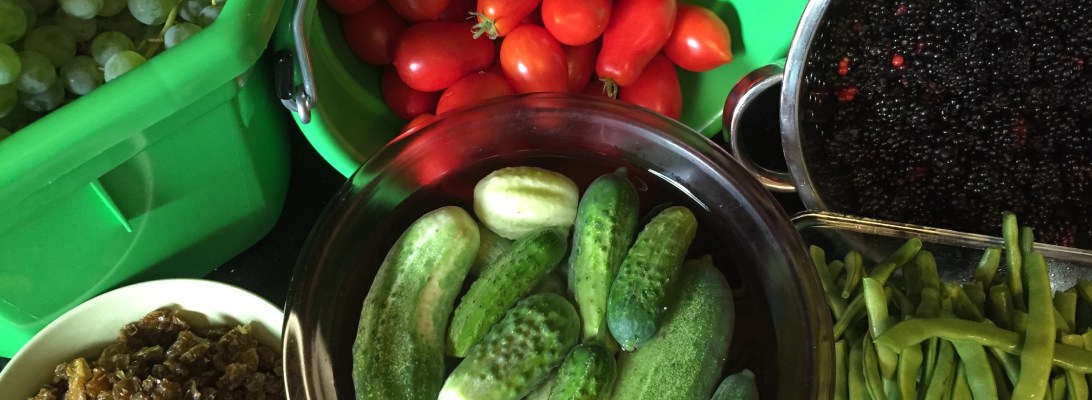
It’s all ripening. All at once. I am more pleased than I can say that this year’s garden is producing prodigiously, especially considering the late start we had due to seeds that didn’t germinate (Planted too early? Eaten by birds? Too old?) and other issues.  I’m delighted with the potential for delicious uses for all the produce. This year I planted far more Roma tomatoes than last year, hoping to be able to make salsa and soup to can, and considering the number of nearly-ripe tomatoes reddening on my windowsill and on the plants and the still-green ones that will be ready soon, I think I’ll have plenty. I’m making raisins from the seedless grapes, jelly from the wild blackberries, pickles from the cucumbers that my vines are suddenly producing in large quantities, and frozen and pickled green beans. With my mom here for a spontaneous visit, I actually have a better-than-usual chance of getting all of this done before the fruit and vegetables pass their prime.  

   
Still, I have to say, it would be really really great if I could set a timer on all my garden plants. If I could regulate summer vegetables’ and fruits’ behavior, things would be different. We’d kick off spring with blueberries and strawberries, three glorious weeks of each, then reducing the amount produced to a manageable cup or two per week thereafter for snacking. I could set the peas and lettuce to ripen with the carrots, along with cherry tomatoes and lemon cucumbers, so we could have fresh salad while freezing peas for winter. I’d time the Roma tomatoes, peppers (which are currently too small to harvest), and basil (which has now bolted) to mature simultaneously. The broccoli could provide three small heads and the zucchini a few small squash each week throughout summer, enough to eat some fresh and freeze the rest. The pickling cucumbers could ripen over a few weeks after the Roma tomatoes were done, with the dill (which I forgot to plant this year) ready to pick at the same time, and blackberries following soon after.  And the weeds? They wouldn’t get a timer. Nothing for weeds. 

 Yes, if I were in charge of summer, things would be much more orderly. None of these crazy amounts of fruit and vegetables all demanding to be picked and processed daily, lest they over mature and go to waste. No more weeks of waiting followed by weeks of frantic activity. No more vegetables rotting on the vine while others are being pickled and frozen. No more peas ripening to floury overmaturity while we frantically get weeds under control. No more! 


Perfect, Truly Magnificent Chai

For the past several months, I’ve been in pursuit of the perfect home-brewed chai. Chai is a word that simply means “tea” in several languages, but what we usually mean in America is an India-inspired strongly brewed spiced black tea made with steamed or hot milk. In coffee shops it’s often called a chai latte (though you have to use caution when ordering, because some baristas think you mean a chai made with both spiced tea and espresso, also known as a dirty chai). Chai has been a favorite drink since my first taste back in my early college years, when I daringly tried something new to impress my crush.

Living in Alaska, I contented myself with daily chai made from the boxed Oregon Chai concentrate available at Costco and local grocery stores. It wasn’t a mind-blowingly delicious brew, but it was sufficient to tide me over till I could venture out to our nearest Kaladi Brothers cafe and enjoy an Alaska Chai or Zen Chai. Those are two amazing drinks brewed in Homer, Alaska by Homer Brewing Company. The Alaska (sweeter) and Zen (spicier) chais are clearly heaven-inspired. No other chai has even come close to their perfection of flavors.

Well, almost no other — for awhile, Starbucks’s new Oprah Chai from Teavanah was a fairly close second. For about a year while we lived here in Oregon after leaving Alaska, I was able to enjoy a chai brewed by someone else on occasion on visits to Starbucks. Then they changed the formulation, and now it tastes like it was brewed using cinnamon-flavored Red-Hot candies. Yuck. So that left me stranded in Oregon with an okay but not amazing morning drink, and no weekend rescue from mediocrity.

One day I was grouching about my plight to my husband, Aaron, and he said, “Why don’t you just make your own?”

Why not, indeed? I started comparing ingredient lists from the chais I drink most often. Then I found a recipe for chai concentrate online by “thecatnipcat”, at tastykitchen.com, that had a good overlap of ingredients from my favorites. Concentrate, by the way, refers to the strongly-brewed, spiced tea that you make ahead and store until you’re ready to add milk for your morning cup.

We made a visit to a specialty spice and tea shop, which had most of what I needed and also had storage tins and a rotating nutmeg grater — a long-held secret desire of mine. The spice shop was a delight of scent and beautifully arranged shelves, but I’ll be honest: all of the necessary spices can be found in the bulk section of your local grocery store, for somewhat lower prices. Here in the Portland, Oregon area, I get most of it at my local Fred Meyer, occasionally having to search New Seasons Market if something isn’t available there. I strongly recommend using whole spices that are as fresh as possible. They’re pretty affordable in bulk, and the whole spices retain their flavor much better than packaged ground ones.

Having collected my spices, I began brewing small batches. I started by exactly following the original recipe I had chosen. Then I began tweaking subsequent batches, one ingredient at a time.

A dozen tries to reach perfection.
Over the next few months, I made batch after batch until I had what is, to my tastebuds, an absolutely perfect blend of flavors.  Aaron agrees: it’s perfect. I know he would enjoy a little more fresh ginger than I use, but too much upsets my stomach, so I was forced to dial it back a bit. I compensated by upping the black pepper and cloves for the spiciness he prefers. (Spoiler alert: If you scroll all the way to the bottom of this post, you can see a nice concise version of my recipe. You’re welcome.)

The reason I’m enumerating all these small preference changes is to highlight the point that you don’t need to get hung up on a recipe. If you hate nutmeg and love ginger, adjust accordingly. If you think you might like an earthy hint of chocolate (I didn’t — that was a dud of a batch), try adding carob to the brew. I do recommend following a recipe scrupulously the first time, though. Then, if you find it’s not exactly what you want, you can experiment by making just one or two changes at a time on subsequent batches.

However: I have it on good authority that this chai is perfect just the way it is. Twice I’ve brought my good friend Gini (who mentored our family through our very first ever trick-or-treating experience and has joined me in periodic sanity-rescuing play dates for our similarly-aged kids) a bag of the dry ingredients and instructions for brewing. And I don’t mind boasting: she raved about it. Then she shared some with a friend, who also waxed enthusiastic. That was the ego boost I needed, the final confirmation that yes, this is a GOOD CHAI.

So: First you’ll need sixteen teabags of plain black tea per batch (the traditional method involves loose-leaf, but in this case I’m happy to simplify). I get the three-packs of Lipton at Costco — I use tea a lot, especially in the summer, between regular batches of iced tea and chai. You’ll also need red rooibos tea, three bags per batch. (It’s an herbal tea from an African shrub, and it’s pronounced roy-bose.) Try to find an unflavored version, but if you can’t, a vanilla red rooibos will have less negative impact on your brew’s flavor than a chai rooibos.  Celestial Seasonings has a vanilla red rooibos. The plain red rooibos currently in my pantry is Fred Meyer’s store brand, for fellow West Coasters. I find it in the coffee and tea aisle in the grocery store.

Spices: Seven whole cardamom pods, fifteen cloves, three star anise, three cinnamon sticks. You can gently crush these with a mortar and pestle to help release their flavor, though it isn’t really necessary — but I can promise you that it is really, really fun. Black pepper, fresh or pre-ground, 1/4 teaspoon (if you have whole, you’ll grind them before you add them). Nutmeg, 1/2 teaspoon. Fresh ginger, chopped, grated, pounded, or whatever is your favorite method of preparing it: 1 tablespoon chopped, which turns out to be 3/4 ounce. If you can’t find fresh ginger or run out unexpectedly, you can use about a teaspoon of powdered  ginger — it won’t add as much fresh flavor or heat, but it’s definitely better than leaving it out. Orange zest (clementine or mandarin will work just fine, too), one teaspoon or more — I often just use the entire orange’s zest with no ill effects. Zest the orange by rubbing the washed orange firmly over the smallest grater teeth, if you don’t have a zester — covering the grater with waxed paper will help you free the zest when you’re done. I’ve used about three drops of orange essential oil a few times when I didn’t have an orange handy, too, though you have to be careful not to overdo it.

Boil ten cups of water in a covered saucepan. Once it’s boiled, turn the heat off but leave the pan on the burner. Add 3/4 cup of brown sugar, 1/3 cup of honey, the teabags, the assembled spices, and two tablespoons of vanilla extract. Cover the pan again and let it steep for twenty minutes. Enjoy the heavenly aroma as your house fills with the tantalizing scent of freshly-brewed chai. A small note: you can get away with using twelve cups of water if you want to make it stretch a little, but in that case I recommend brewing it just a little longer, and it still won’t have exactly the same flavor.

After twenty minutes, pull out the teabags — they’re compostable, by the way, if you’re into composting. Don’t squeeze the bags, or your chai will be bitter. Just let them hang over the pan for a few seconds to drip. Strain the chai into jars for storage, and yes, you can compost the spices too. I put a small strainer into a wide funnel to make pouring without spilling easier. This batch will fill two quart jars plus a half-filled mug to drink now, with sometimes a little extra that you’ll need to put into a small jar or share with someone. I know this vagueness is irritating the mathematically minded readers: ten cups of water going into the pan ought to equal ten cups of chai concentrate going into the jars, right? No. Some of the water will evaporate when it heats and boils, even with a lid, and especially if you didn’t listen to me and didn’t bother covering it. And the teabags will absorb some of the liquid, too.IMG_4405

You can enjoy the chai several ways. The easiest way, and the method I usually use, is to fill a mug halfway full of chai concentrate, then top it off with milk, and microwave it. You could also start with a mug filled halfway, microwave it (for a shorter amount of time), and top it off with steamed milk — yummier and more fun to drink, but more time consuming…and of course it requires having an espresso machine or milk foamer. Finally, you could drink it cold: fill a glass half full of concentrate and the rest of the way up with cold milk. Oh, and of course you could use it to make a citrus chai spritzer. You might find you want it a bit sweeter for the spritzer — just add a bit of honey or simple syrup.

I’m not exaggerating when I say that I put months of work into this perfect chai brew — but trust me, I won’t be offended if even my best friend confesses to altering the recipe a bit. That’s part of the joy of making this kind of thing at home. Brew away, change it however you want, and feel free to share this truly magnificent and amazing recipe with permission to adapt as needed. Enjoy!

Chai Concentrate

Thank You, Little Frog

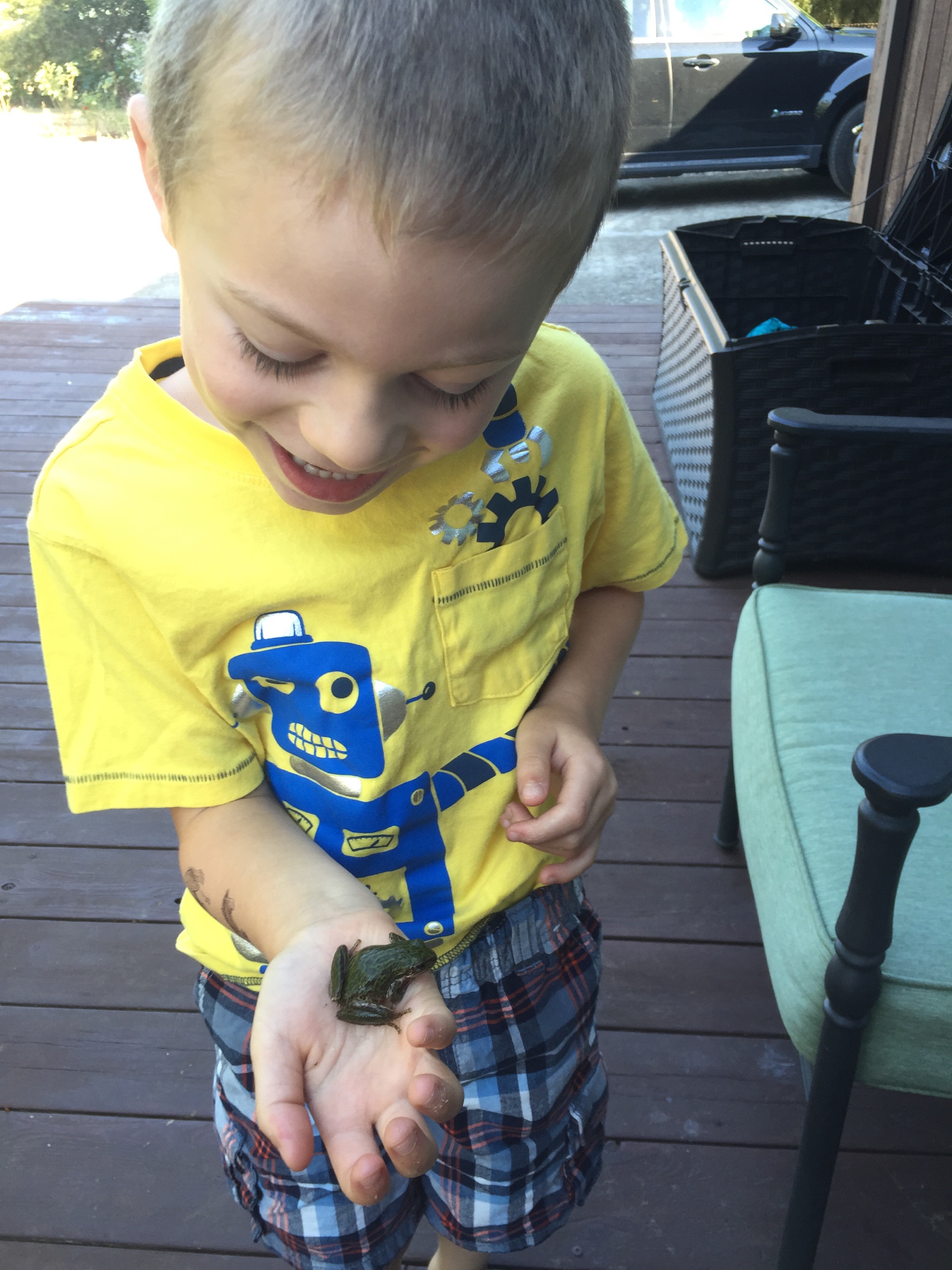
See this little guy?  

 He saved me today. 

Well, he saved me from turning into the dreaded Mean Mom. You see, for quite awhile now — maybe a month? Maybe two? I’ve been sick more and more frequently with migraine after migraine, till there was no real space between the end of one and the beginning of the next. I wasn’t the greatest mom during that time. I’m pretty sure Niko spent more than the maximum recommended two hours per day watching (usually) educational TV or playing (mostly) skill-building games on the iPad. He came to expect to spend large chunks of time inside, in front of a screen, because both the bright light of the hot summer sun and the movement necessary to keep up with both kids outside caused more pain, nausea, and dizziness than I could handle. 

The migraines came to a climax three Fridays ago — on Aaron’s birthday, no less — with a trip to the emergency room, my very first. If it hadn’t been so terrifying, it would have been great fun, being wheeled around and zipped down hallways and buzzed through a CT machine. At that point I wasn’t in pain, but I also couldn’t speak, had little strength or dexterity in my right hand, couldn’t write cursive or my usual script/print hybrid, could hardly move my right leg, and couldn’t remember how to navigate steps. My face felt like I’d just visited the dentist, numb and tingly. 

I communicated by writing on a notepad at first, taking long seconds to form each letter, sometimes agonizing in an attempt to remember the correct shape. (The nurse in charge of me, who hit an excellent balance between compassion and good humor, complimented me on taking the time to add the apostrophe to “can’t” despite it’s adding at least a full second to the time it took to write the word.)

 Later I got my phone and used my Notes application to type, which was much faster despite my continuing clumsiness.

It wasn’t a stroke. It was a hemiplegic migraine. They’re rare and debilitating. And scary. 

I got my speech back about four hours after I lost it. By that time I could walk on my own, very very very slowly, and could even, with great triumph, navigate two steps: one up and one down on a step stool. The doctor reluctantly let us go home, since all the tests demonstrated I really was okay. 

I didn’t lose my speech again, and I never got that weak again, but for the next week and a half I had some symptoms every day: tingling and numbness, weakness, difficulty walking. A few times I got a small stroller from the garage to use as a walker just so I could get around at a reasonable pace. I had trouble with forgetting words. Sometimes I couldn’t understand when people spoke to me — I knew they must be speaking English, just as clearly as they had been moments before, but I was as bewildered as if they’d broken out in ancient Aramaic. I continued having difficulty writing, especially struggling to manage my signature. I occasionally had trouble getting food into my mouth, and once I got it there, I sometimes couldn’t remember how to use my lips, tongue, and jaw together to get it off the fork and chew. Every day I was tired, so tired. And then there were the typical migraine symptoms: dizziness, vertigo, nausea, light/motion/noise sensitivity, periodic intense neck and jaw and head pain. 

Oh yes, I was a mess. For the most part, I managed. I had migraine pain most days, but usually only for a few hours; the seemingly endless symptoms I listed above were intermittent and only happened a few at a time. Generally I was just slow and dull, unable to do a whole lot beyond cuddle the kids and provide basic care. Niko, who is not yet five, didn’t really get that I was sick. Mostly, he just understood at first that he was watching more TV than usual. Then he came to expect to have the TV or iPad several times a day. 

Last Wednesday, four days ago now, we saw a neurologist to follow up on the ER visit. He prescribed a daily preventative medicine and a new, safer abortive (migraine-stopping) medicine. 

I’m delighted to say that the preventative medicine is working. I did have one migraine the day after starting it — but it had a distinct starting and ending point. I’ve felt entirely normal since. And poor Niko has been comparatively bereft of screen time. He’s been forced to play with toys, run in the yard, help pick vegetables, draw pictures. 

This morning, after breakfast, I was working on processing some of the zillions of zucchini we’ve harvested. I noted that the day appeared pleasantly sunny. I paused to put Sofie on the potty and lay her down for a nap. Then, with Sofie safely out of the way, I called Niko. “Go play on the porch for awhile.”

“Noooo! I want to watch Dinosaur Train!”

“No,” I said firmly. “It’s a good day for being outside. It’s sunny and not too hot. Come on, I’ll get you some bubbles.”

My TV-deprived son flopped on the floor and continued to whine while I headed out to the porch to get the bubble mix out of the toy box on the porch. 

That’s when I saw this little guy, a small green savior in need of rescue. His skin a shade too dry, his body chillier than was comfortable here on the shady porch, he awaited a helping hand. “Niko!” I called. “Come look!” He rushed out, excited to see whatever mystery I was advertising. The frog brought complete satisfaction. I let Niko be in charge of delivering him to the pond, where he wasted no time frog-kicking his way to a safe hiding place on the far side of the water.  

 
Yes, that little green peeper rescued me today. Having put the frog back into the pond, my son was more than happy to stay outside in the fresh air, blowing bubbles, hanging from the tree, and drawing with chalk. Thanks to a thumb-sized amphibian, I didn’t have to put my foot down and be Mean Mom just to get my screen-habituated son some fresh air. Thank you, green frog. 

Sweet Corn Harvest

Growing up, I always lived in areas with a short growing season.One year, when my family lived in a remote area of British Columbia, we planted a big block of corn, hoping to get a harvest despite our short, cool summers. I remember eating some fresh corn — but I also recall walking past frost-bitten stalks filled with immature ears, victims of a predictably early fall. As far as I remember, we didn’t try that experiment again. 

Now my husband and I live in Oregon, where the summers are long and warm — even hot and dry, though my Oregon friends say the arid heat these last few years is unusual. Last year, we moved to our new 2-acre home a little late for serious gardening. This year, we’re growing a lot more vegetables, including our very first attempt at growing sweet corn. 

If you research growing corn, the first thing you’ll read is that the corn should be planted in a fairly compact block several rows square. That’s because corn is wind-pollinated, and it doesn’t pollinate well when the ears are far apart. 

Our first attempt at growing corn was a complete failure. Not one single seed germinated. I don’t know whether I planted too early, in soil that hadn’t yet warmed, or whether the birds got them — my second batch of peas, planted at the same time, also didn’t  germinate, and I did see birds pecking up the peas. 

In any case, they didn’t grow. So, despite knowing that corn isn’t really meant to be transplanted, we bought several pots with two or three little plants each, and planted them out in rows at the end of our vegetable garden. I knew they were supposed to be in a block — but we had less than a dozen, and already-established rows. I wasn’t convinced they’d survive, let alone succeed, and reworking the garden seemed like a lot of work for these straggly little plants. I planted them in three short rows of three or four each so they at least had neighbors, rather than one long row. 

I suppose my half-hearted attempt at planting in a block helped. We actually got ears, and the first three or so ears to mature were mostly full of plump kernels — just a small area at the top was unpollinated. 

However, today’s harvest was an excellent example of why corn should be planted in a block. Observe:  

 All of them were like this, if not worse. 

So there’s today’s object lesson: Plant corn in blocks! Otherwise, THIS happens! 

On the other hand, though imperfect, the corn was sweet, juicy, and flavorful. And I can’t think of too many more satisfying activities than stepping out to the garden with small ones in tow, making a quick harvest of corn, zucchini, and cucumbers, and then lunching on freshly picked, buttery sweet corn.