Summer’s End Iced Tea

When I was growing up, I lived on a commune in Northwest Ontario (for those of you paying attention, this was both before and after the homestead/trapline but before being an Alaskan city girl). Anytime there was a gathering, there was iced tea. And, as I said, this was…a commune. There was always a gathering. By definition, we were, in fact, a gathering. I’m sure you can imagine we went through a lot of Lipton’s tea bags. We always made it the same way, starting with a great big metal pot half-filled with water on the back burner of the enormous stove. You had to carry the water to the pot from the faucet, both because it wouldn’t fit under the faucet and also because, once full, it was hard to carry. A big wad of tea bags floated on top after the water boiled, until someone judged it strong enough. Then, industrial-sized scoops of sugar stirred in with a wooden spoon. Haphazard squirts of lemon juice. Topped off with fresh cold water. Thoughtful tastes. More sugar. More lemon. Ooops…more water. Finally, perfection. That is, unless someone (who shall remain nameless – but it wasn’t me) accidentally scooped from the salt container instead of the sugar container, despite the black Magic marker label. Big oops.

I learned to make sun tea when I lived in Haines, Alaska (in, yes, another commune). I do recognize the irony of learning about sun tea in one of the greyest, dampest, chilliest (but also one of the most majestically beautiful) places in the world. When you live in Southeast Alaska, you take full advantage of every drop of sunlight you can get. And one thing that means is sun tea. Basically, you get a glass pitcher or jar – it needs to be clear – and put cool water and tea bags into it, and let it sit outside in the sun till it’s done. This has to be done in the summer, really, because you need the sun’s warmth to speed the process. You can make cold-brewed tea any time of the year, but if it’s cold out, you don’t bother with the sun or with putting it outside. You just set the pitcher in a semi-warm place and give it lots of time to steep.

Last week, we had weather in the 80s. I’ve never experienced this in October before. My Canadian/Alaskan soul thrilled with the warmth, and I realized that it was absolutely necessary to celebrate with iced tea. Now, I could have made basic iced tea with boiled water and Lipton tea bags, but where’s the fun in that? No, what I needed was something that tasted like a sunny day at the very end of summer. A little fruit. A little spice. This is my very favorite method of making iced tea:

Fill a clear glass pitcher with cool water. Clear, for the sun; glass, not plastic, to resist staining. Add 8 teabags for a half-gallon pitcher: one per cup. (If you’re making a whole gallon, you really only need 10-12 teabags, but for a regular pitcher I follow the one-per-cup rule.) Half your teabags can be plain black tea. Then, you need 2 bags of chai tea and 2 bags of peach or orange tea. Cover the pitcher to keep out bugs and dust. Put it in a sunny spot where rampaging puppies and preschoolers won’t knock it over. Let it sit until the water has turned a deep, rich red-gold color. On a really hot day, this can happen in under an hour.

I don’t sweeten my iced tea in the pitcher. I like to leave it plain, and let everyone choose their own level of sweetness. But if you’ve ever tried to stir granulated sugar into an ice-cold drink, you’ll know that this can be an exercise in refraining from flinging your glass to the floor as the grains swirl implacably round and round in the tea. So, while the tea steeps in the sun, I like to make a simple syrup. Really simple. Stir one cup of sugar into one cup of water. Heat it in the microwave until…well, until it’s hot. Let’s say 3 minutes. Give it a good stir and watch the last grains of sugar disappear. Pour the simple syrup into a bottle to keep in the fridge next to the tea. Depending on what I plan to drink it with, I like to add some citrus zest or fresh herbs to the bottle before pouring in the hot liquid. You get a lightly flavored sweetener that can be used in cocktails, too. (Ideas: fresh lavender, basil, mint, orange zest, a juniper twig…)

There you go. Perfect iced tea, sweetened however you like it, from a pretty bottle with a colorful coil of orange zest. Just what you need for an end-of-summer day. Below, some pictures of the procedure:

It’s amazing how something as simple as the whiff of a familiar smell from a yellow box with red lettering, or the glimmer of light through a dark amber liquid, can bring the memories rushing back. We always drank iced tea when we gathered… As I sat alone in my kitchen, looking at the sunshine through my glass, I remembered how far I’ve come and how much I’ve given up to be here. I don’t regret my choices. I have a good life. But when I lift a glass of iced tea, the memories rush back, and I so badly crave hugs from all the “aunts” and “uncles” and friends I left behind. I want to sit on the front porch of the big white house with whoever else happens by to snag a glass of tea before the crowds arrived, feeling the sun on my face as we gossip about who sat next to whom in church yesterday, who might possibly be expecting yet another baby, whether we might need to pick those peas again tomorrow…

Iced tea is the flavor of gathering, of family, of closeness. It tastes like voices raised in song, bodies swaying together like trees in a breeze as a family of over a hundred souls worship together. It tastes like the faintly scandalous square dances (“But the girls and boys will be touching!”), like bringing in the hay while dust hangs in the shafts of sunlight, like snapping beans in the kitchen while stories fill the air. It’s just a glass of tea. But for a minute – just a quick minute – I am so homesick I want to cry.

And I want to tell them all: I miss you. I love you. I promise I’ll come visit soon.

Save some iced tea for me, will you?

That’s it?

IMG_0544-1.JPG
So much anticipation. The chopping of a full gallon (measured post-chopping) of tomatoes. The stirring. The mouthwatering aroma. And… One lone pint of (incredibly delicious) tomato soup. Oh, and 1/2 pint that the kids and I will eat for tomorrow’s lunch. Note to self: don’t use cherry tomatoes for soup.

Oat Apple Pancakes

On Sunday, I made one of my new favorite breakfasts: oat apple pancakes. Niko and Sofia both love them, and the apples soften enough while cooking that my toothless wonder won’t choke. I’ve been trying these out on the kids for a few weeks, but this was my first time making them for Aaron, who said with pleased surprise, “These are really good pancakes!” Coming from a man who is a much better cook than I am and a tad picky about his food, that was all the confirmation I needed. These are good. They’re easy, healthy, and dairy-free. You can expect to get about a dozen smallish pancakes from this batch.

Dairy is not typically a concern for me, but we discovered soon after having Sofia that she has a milk protein sensitivity, and I’ve had to cut out milk while we’re nursing. So if you’re avoiding dairy too, these are the pancakes for you. If you’re not, feel free to use ordinary milk instead of coconut milk, and melted butter instead of oil. They’ll be very similar.

Making oat flour
Making oat flour

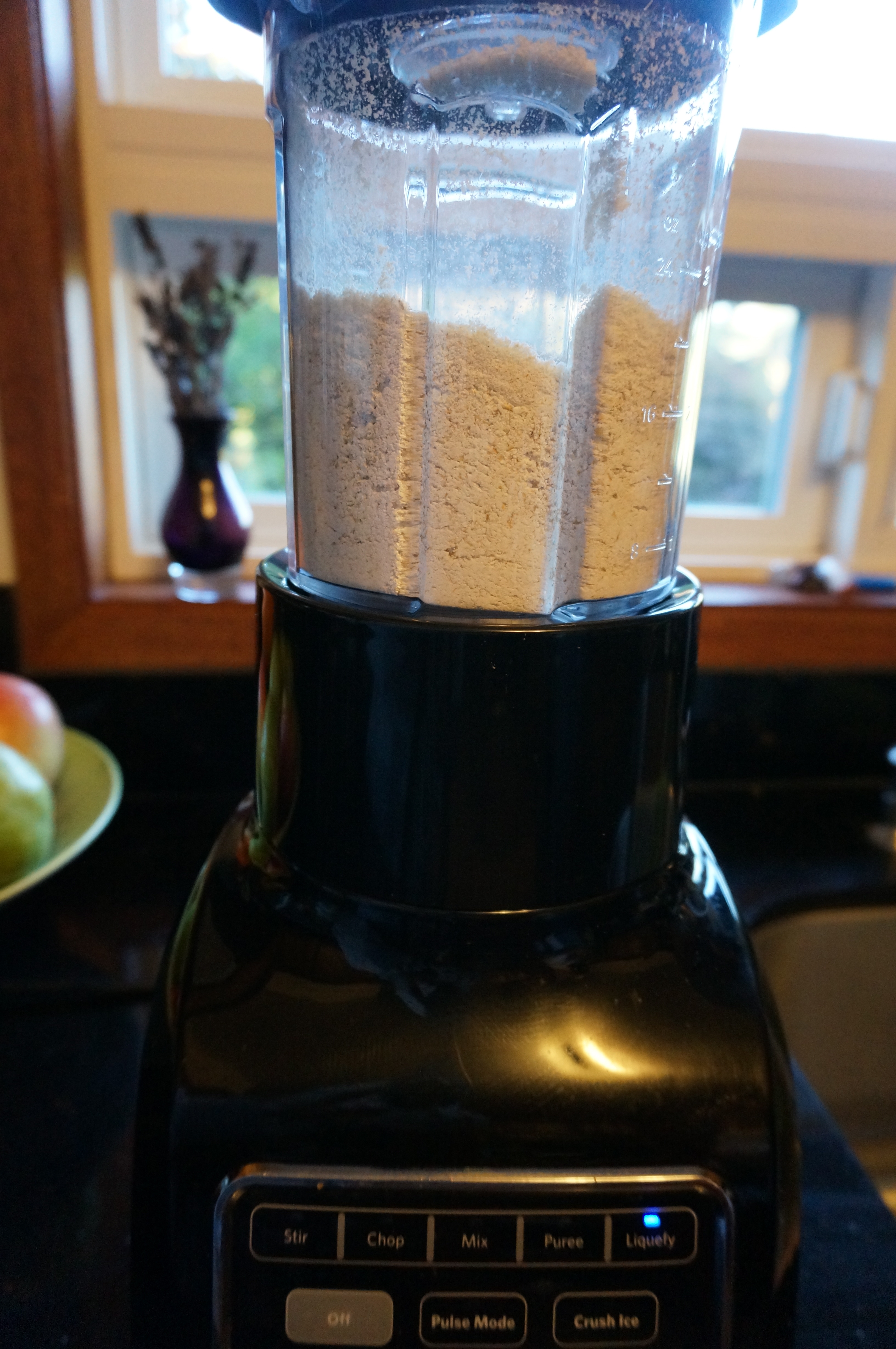
The first thing you need to do is make some oat flour, unless you have some on hand. I don’t really use it that much, and I find it pretty easy just to make it as I need it. To make a cup of oat flour, just scoop about 1⅛ cups of rolled oats into the blender. Blend it on the highest setting, pausing now and then to shake it down or scrape the sides. You can stop when it feels velvety-soft.

Pause here for a rant on heating your pan. When you read baking recipes, the recipe always says right at the beginning, Preheat your oven to… But no one ever says to preheat your pan for frying. Here’s a secret: You need to preheat. If your pan isn’t hot when you start, you get weird pancakes. They don’t rise properly, they stick, and sometimes they spread too far and fall apart when you try to flip them. Now, I know recipes always say to use a hot pan or griddle, but I find that it takes longer than one would expect to really get it heated properly. There you are, pancakes ready to go, bubbles gently rising in the batter as you slowly lose fluffiness potential, waiting for the griddle to heat. I say, no more! Preheat that pan! I always turn the heat on at this point (as I’m ready to start mixing) at a medium-high temperature, and spray it with cooking oil or coat it with butter. By the time the pancakes are mixed, it will be just the perfect temperature. I turn it down to medium just before I pour the pancakes onto the griddle. And no more tossing the first pancakes of the morning into the trash. End preheating rant.

Combine dry ingredients thoroughly.

Next, use a medium mixing bowl to thoroughly mix the following dry ingredients: the oat flour (of course), ½ cup of all-purpose flour, 1½ teaspoons of baking powder, 1 teaspoon of baking soda,

Thin slices will cook nicely.

and ½ teaspoon of salt.

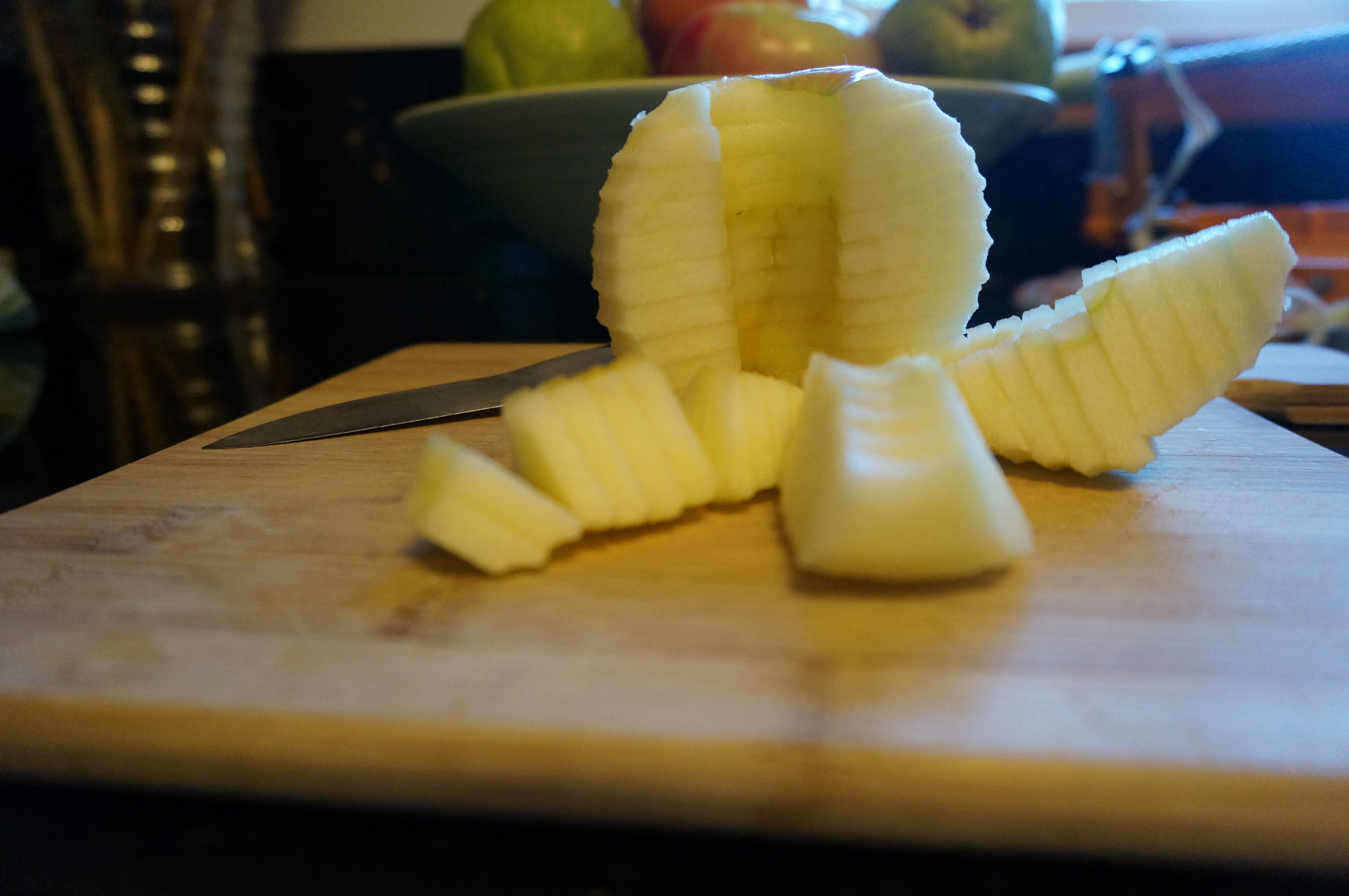
Peel, core, and chop an apple. Aim for thin chunks abut ½ inch square. Too thick, and they won’t cook through.

The next part works best in the blender. You could use a whisk in a bowl instead of the blender, but you already dirtied it making the oat flour, so why not use it one more time before you wash it? It’s always a good idea to beat your eggs when adding them to pancakes – especially oat pancakes, which can be a little on the dense side – because the extra air helps add fluffiness. The blender makes the whipping fast and easy.

DSC03270So. Dump all this into the blender: Two eggs, 1 cup of almond or coconut milk (I suppose you could use soy, but I find the flavor off-putting), 2 tablespoons of vegetable oil, 2 tablespoons of sugar, 1 teaspoon of vanilla, and 2 tablespoons of white vinegar. Why the vinegar? We’re imitating the effect of buttermilk. Buttermilk (and vinegar) is acidic and will react with baking soda, which is a base. The reaction creates bubbles of carbon dioxide. Translation: fluffy, crisp pancakes. Give it a whirl in the blender till it’s frothy and smooth.

Mix GENTLY so you don't get tough pancakes.
Mix GENTLY so you don’t get tough pancakes.

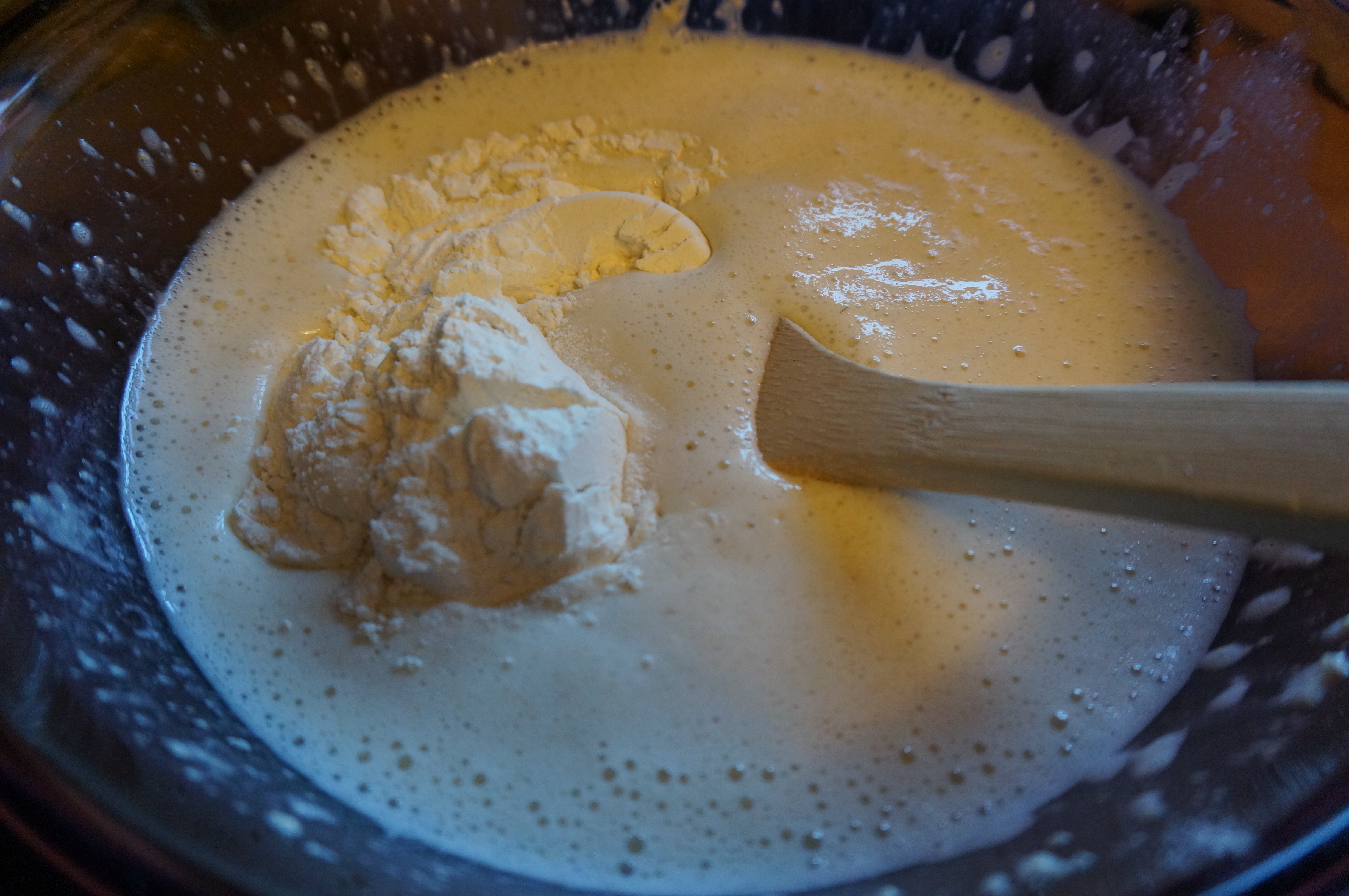
Pour the egg mixture into the flour mixture and stir it gently together. Add the chopped apples, stir gently again, and you’re

The edges should start to look dry when they're ready to flip.
The edges should start to look dry when they’re ready to flip.

ready to cook them. Use a ¼ cup measure or a small ladle to pour the batter onto your preheated, oiled baking surface. Let the pancakes cook until you see that the edges are looking set, almost dry. When you flip them, the backs should be golden brown and crisp. (If they’re not, just let them finish cooking on the second side and then flip them back to finish on the first side. No biggie.)

These are best eaten drizzled with honey. There’s just something about the way the sweet honey complements the nutty oat flavor, and the sweet-but-tart apples bring the flavors together like a bright ribbon binding a bouquet.

Here is a more concise format of this recipe.

Oat Pancakes

Time for tomato soup!

IMG_0469.JPG

I’ve had a hankering for a tomato basil soup lately, and with all our tomatoes ripening like crazy, I decided to make enough to can. I’ve been picking and refrigerating them for three weekends, and now I think I have about a gallon – enough to use the recipe I found at pickyourown.org, a site I’ve found extremely useful over the past year. I can’t wait to taste it! I’ll admit to being a bit nervous, though. Tomatoes have to be pressure canned, and I haven’t used a pressure cooker for that purpose (I use it for water bathing jam and pickles) since I was in high school and closely supervised by my mother or an aunt. Sofie has been sleeping more dependably the last few nights, so I’ll do the canning part after the kids are in bed. Pressure canning takes a bit of focus, something I’m a bit short on at the best of times, and for safety I’d rather not have small people underfoot. This should be exciting!

Making Dried Apples

Last spring, a year after moving to Oregon, we purchased our “forever home”: a 1979-built house on two acres of lovingly tended land. We were enormously excited to discover that we now own two apple trees. Neither of us had ever lived in apple country before. I had lived in northern British Columbia and Ontario before moving to Alaska, and Aaron had lived first in desert states and then in Alaska. Fresh apples from our own trees! Heaven! 

 
The day Aaron picked the apples, he harvested 300 pounds of usable apples, plus another 100 or so that had been damaged by worms. You can imagine we were anxious to find ways to use them all. Aaron used a lot of them to press for cider – that’s another story. I made what seemed like vast amounts of applesauce, apple leather, and dried apples. That is, the amounts seemed vast while I was toting around a 9-month-old, making frequent nursing breaks, and fielding endless questions from a curious 4-year-old. After the supply of apples was exhausted, of course, what I had made seemed far less than adequate. There’s always next year to make even more, right? (Yes, we’ll be getting much, much, much more this year.)

Learning to make dried apples was an exercise in patience, as I tried several approaches over three or four weeks. I feel that I’ve perfected the method now. I can’t get enough of those things – I could eat them all year and not get tired of them. (Hint: skim aaalllll the way to the bottom for a short-and-sweet recipe that will fill 4 dehydrator trays with apple slices.)

Step 1: Prep the apples.

When I started making dried apples, I left the skins on, used a cylinder-shaped coring tool to punch out the cores, and used a mandolin to slice the apples. The mandolin, being cheap and weak, didn’t work all that well — the slices weren’t all the same thickness, they were weirdly corrugated, and it cut aggravatingly on a slant — but it was much faster than slicing by hand. The corer was faulty too: it was difficult to aim correctly, and it was smaller than the actual apple cores, so I kept getting leftover core in the apple, and removing good apple flesh with the corer. 

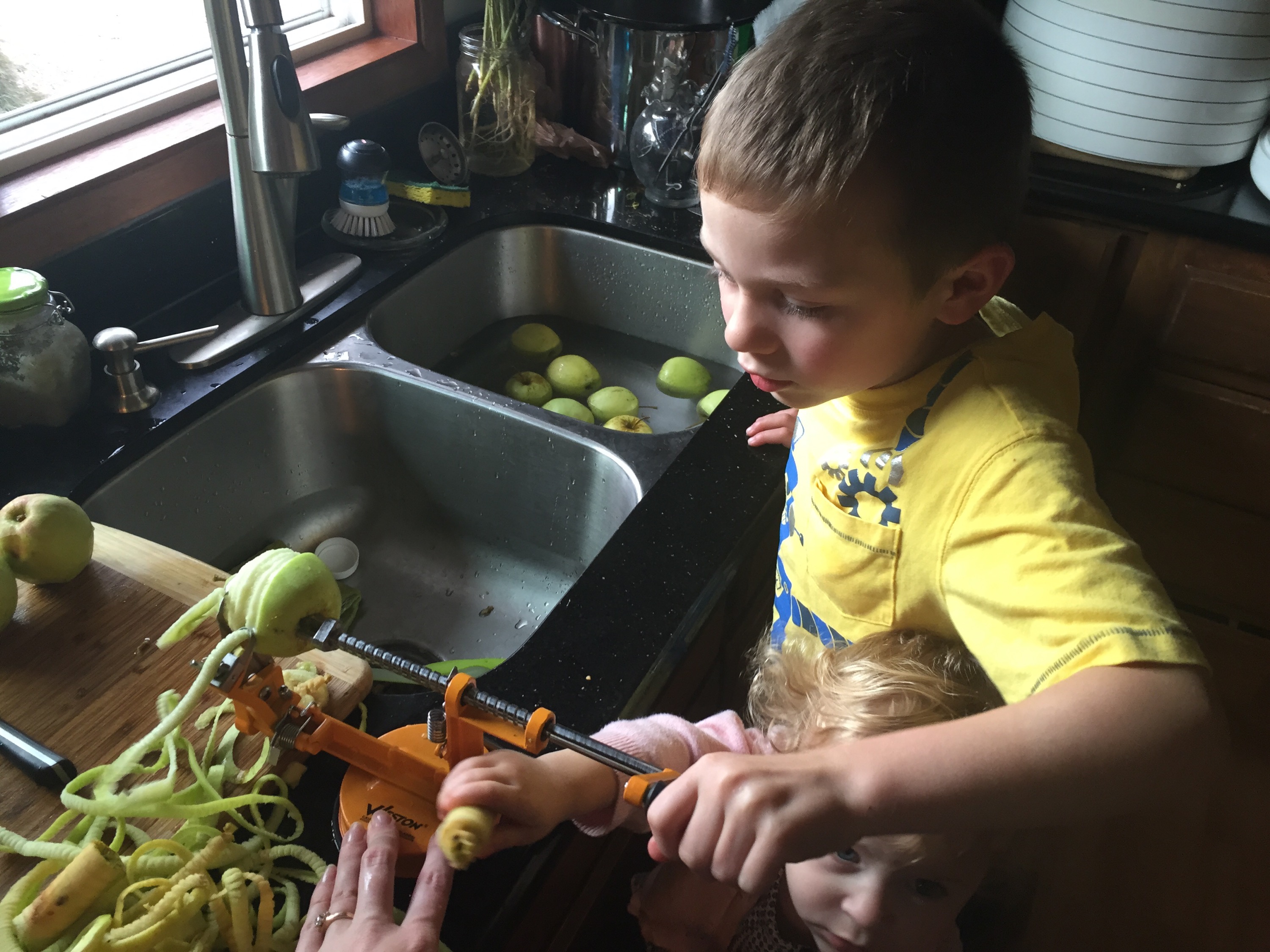
Then one wonderful day, I visited Wilco, a local farm store, and came across an amazing device: an apple peeler-corer-slicer made by Weston, a maker of sturdy and useful farm-kitchen products. I adore this tool – not, however, as much as Niko and Sofia do. Sofia can actually turn the handle herself given a crisp enough apple, and ohhhh the thrill! 


  You can see details on the slicer here. Using this delightful tool, I now know that dried apples have a better texture without the peels. It’s not enough of a difference that I’d hand-peel dozens of apples if I didn’t have it, though, especially since everyone knows (says my mother) that all the good vitamins are in the skin. Right? 

Anyway, the point is, for dried apples, you want fairly thin slices, around 1/8 inch thickness. Slice in rounds from end to end after coring. They need to be the same thickness so they dry at the same rate, so unless you have a very steady hand, slicing them by hand isn’t that great. Good tools: a mandolin (a high-quality one), a Kitchen Aid-type slicer attachment, a manual countertop slicer. If you use a peeler-corer-slicer like mine, the apples will be cut in a giant spiral, so you can just make a slice right down one side of the spiral to get a stack of neat circles. Start with about 6 apples to fill 4 trays on a dehydrator.

Step 2: Blanch the slices.

 Don’t skip this step. When I started, I thought I would make lovely unsweetened dried apples that were as close to their original state as possible, thus preserving all the natural goodness and removing unnecessary sugar from my children’s diet. They were…okay. Mediocre. Nothing to write home about. Actually, they were tough and much more tart than the original apples. I came to the realization that blanching is really helpful. Also, dipping them into sugar water doesn’t increase the amount of sugar in this snack a substantial amount. They’re still barely sweetened, very healthy, vitamin-rich, high-fiber food items!

Over the final weeks of last summer, I tried various blanching methods until I finally got it just right. 

Fill a medium stock pot with 8-10 cups of water, leaving room to add apple slices. Add  1½ cups of brown sugar, ½ cup of honey, ¼ cup of cinnamon (the bulk section at the grocery store is your friend here – or Costco), and a hearty sprinkle of nutmeg – let’s say 1 teaspoon if you like it as much as I do. That is a lot of nutmeg; I am a big fan of nutmeg, and you can distinctly taste it in the dried apples, so cut it back if it’s not your favorite flavor. Heat the mixture just to boiling, then turn the heat down low. On my JennAir range, circa 1985, this keeps the water barely moving. I wouldn’t even call it a simmer. But the point isn’t to cook the apples – just give them some flavor, and soften them a bit so they’re not tough once dried. And the sugar actually seems to improve the texture, too. Leave them in the blanching liquid for 1-5 minutes at a simmer till barely soft, 5-10 minutes if the water is merely very hot (a good idea if a toddler is helping you), then scoop out. You won’t hurt them if you’re distracted by a squalling toddler and leave them in there for ten minutes or so, as long as it’s really not boiling, but they don’t need that kind of time.  The reason I’m giving such a wide range of time for blanching? When I was making these, I was slicing a pile of apples, tossing them in, slicing, tossing…till the pot seemed full, then stirring for a minute and scooping them all out, and I found they all turned out about the same. This is the least scientific cooking I’ve ever done, but amazingly enough, they’re just fine! I use a wide mesh ladle for scooping, which also works well for distributing them around the rack. 

 This is a good place to add a piece of advice: If you plan to make more dried apples, don’t dump out your blanching liquid when you’re done. Cover it and refrigerate it until you’re ready for the next batch. You should have plenty to do at least one more. No need to waste all that lovely cinnamon!

Step 3: Arrange on the drying racks.

Spread the slices on dehydrator racks, or on cooling racks on cookie trays. The important part here is to leave room for air circulation, while maximizing space. Translation: Don’t let the pieces touch. 

 I have learned to put a fruit leather tray under the bottom rack in the dehydrator to catch drips. It makes the bottom rack a little unsteady, so be cautious if you’re moving the dehydrator after filling the racks. The tray makes cleanup much, much easier, since it — unlike the dehydrator base — can be immersed in water. 

Step 4: Dry.

How long you let them dry depends on how you like your apples. I like mine two ways: just barely dried, so they’re velvety-soft, and crispy. For velvet-textured apples, turn the dehydrator’s temperature setting on 135-140 and dry for 4 hours. Check them periodically. The apples at the bottom of the stack of trays, and the smaller circles, dry faster, so some might be done after only three hours while others may need five. For crispy ones, set it for 140 at 6 pm, intending to turn off the dehydrator at bedtime, and then go into the garage at 9 the following morning to do laundry and discover it still running. That worked just perfectly for me. 

If you don’t have a dehydrator, place the baking sheets that you filled in step 3 into an oven set to “Warm” (unless the temperature setting on your oven goes all the way down to 135 – mine doesn’t) for about four hours, checking periodically to see how the texture is. It might be useful to first use an oven thermometer to see how hot “Warm” actually is, since you would need to adjust your time if it’s over 140.

Step 5: Devour.

            Eat them by the handful. Put them into school lunches. Cut them up into granola or cook them in hot oatmeal. Mix them with pretzels, cranberries, and nuts for a fall time snack. However you eat them, expect them to go fast. You’ll be lucky if they last a day. They’re that good!

Here’s a less chatty format for those who want to read a recipe the traditional way:

Dried Apples jpeg

This post has been updated with current photos, corresponding dates so readers who know me aren’t confused, and slightly improved information. Enjoy!

Oatmeal Bath Soak

Sofia is suffering from her first-ever real diaper rash. She’s 9 months old and, unlike her brother (who had some incredible rashes that would have had me in a panic if my NICU-nurse husband hadn’t known exactly what to do), has always had soft, smooth skin. She’s had temporary redness on occasion, but never full-blown rash – until now. And, true to the old adage that it never rains but it pours, Niko is having a now-rare eczema outbreak – he had them frequently in Alaska, but his skin has cleared up significantly since moving to Oregon. It’s pretty mild, but I’d like to take care of it before it escalates.

So, it’s time to whip up a batch of oatmeal bath soak! My recipe is based on the ingredient list from a number of (ridiculously expensive) soaks I purchased or was given back when Niko was just tiny. Mine is actually a bit more effective, I think, than the ones I purchased, and costs me quite a bit less. I used it with a lot of success when Niko was in the diaper rash stage, as well as when he was breaking out frequently with eczema on his face.

The first step is to visit a store with a good bulk section to stock up on some herbs and other ingredients. For a small batch like I’m doing today, I use about ½ cup each of calendula flowers, comfrey leaves (you could also use the flowers), and lavender buds. Usually I also add about ½ cup each of powdered goat’s milk and powdered buttermilk. I’m not putting them into this batch because Sofia is very sensitive to dairy in her diet (well, my diet, since she’s nursing), and I’d rather not find out the hard way if she’s also sensitive to it on her skin. I always have oatmeal on hand, but if you don’t, look for it in the bulk section too. Get some baking soda in bulk as well – you need about ¼ cup of it, and it costs much less in bulk than getting it in the grocery section. (I use it in so many things, like room freshener and laundry stain remover, that I always keep lots on hand.) Finally, I like to add a few drops of lavender essential oil. You can find it fairly easily in the “natural” section of many grocery stores. It gives the soak a pleasant smell, and it adds to the healing effect.

Ingredients for bath soak

Next, it’s time to get the ingredients into a workable form. I start by dumping about 2 cups of oatmeal into a blender. It needs to be processed until it’s a fine powder, known as colloidal oatmeal. To make sure it blends evenly, I stop the blender periodically and shake it down. When it is soft and silky feeling, it’s done.

Now I blend the dried herbs. I pour them all in together, about ½ cup of each, and give them a good whirl. They blend more easily than the oatmeal, but it still takes some time to get them to a fine powder. It doesn’t work well to process them with the oatmeal, because the textures are so different. You end up with big chunks of dried herbs, which is unattractive and tends to clog the drain.

Finally, I mix the oat flour, powdered herbs, and ¼ cup each of baking soda and corn starch together, as well as the buttermilk and goat’s milk powders if I’m using them. Shake 4-5 drops of lavender oil over the mixture and mix again. Store it in a sturdy ziplock bag or a glass jar that seals. Don’t overdo the lavender: it can be quite strong, and you don’t want your home to reek like a perfumerie for the next six months.

There are two ways to use it in the tub. When I was first making it, I would dump it right in to the water. It made a sludgy mess, and I would have to scrub the tub afterward, but it worked just fine.

Then I got the idea to use cheesecloth sachets. I just toss the bag into the water as the tub is filling, and leave it in during the bath. The tub still needs to be rinsed, but it’s not nearly as messy. It is a good method for Niko in particular, because his eczema is always on his face, and I can use the sachet like a washcloth and apply the bath soak directly to the problem areas. When the bath is over, I squeeze the water out of the sachet, open it up, and turn it inside out over the trashcan. Then I rinse it in the sink, and it’s ready to use for the next bath. After a couple of baths, or if you know you won’t need it again for awhile, wash it in the delicate cycle. If you don’t want the trouble of washing it out, you could probably use paper tea bags. I’ve seen them in cooking supply stores and in spice and tea shops. They’re easier to find in the fall, when stores are marketing cider spices to simmer in apple juice. I feel like they would be less effective because they wouldn’t allow the oatmeal to disperse as well, and oatmeal is one of the main soothing factors. I haven’t tried it, though.

Soothing bath soak in a cheesecloth sachet

Here is the recipe in a more traditional format.

Oatmeal Bath Soak

Ingredients:
2 cups oatmeal
½ cup calendula flowers
½ cup comfrey leaves
½ cup lavender buds
½ cup powdered buttermilk
½ cup powdered goat’s milk
¼ cup cornstarch
¼ cup baking soda
4-5 drops lavender essential oil

Instructions:
1. In blender, process oatmeal until it is a fine powder [known as colloidal oatmeal]. Pause frequently to scrape or shake down the sides.
2. Use blender to process calendula flowers, comfrey leaves, and lavender buds into a fine powder.
3. Combine powders with remaining dry ingredients in a mixing bowl or large ziplock bag. Add lavender oil a little at a time to desired scent, mixing thoroughly each time you add some.
4. Store in zipped plastic bag or tightly closed container. Add generous scoop to bath to soothe itchy skin or rash.