I'm a temporarily staying-at-home mom of two living in Oregon, learning all over again (after 15 years of city life) how to garden, harvest, and put up food. You might see posts about baking, parenting, crafting, organization – anything that strikes my fancy!
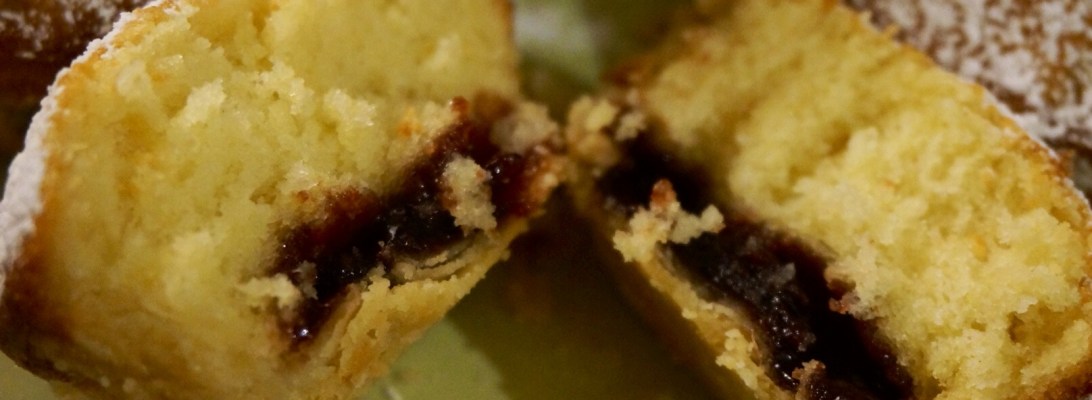
I came across these delicious muffins in a blog post from Cooking With Craic a couple of months ago. The author, a Canadian living in Ireland, had fallen in love with the popular Irish pastries, and had developed a delicious recipe. She says,
The bakewell. You can find these at most bakeries around the country. They consist of shortcrust pastry bottoms, jammy middles and Madeira sponge tops.
I’ve been waiting for a good opportunity to make these, and yesterday I finally found the perfect timing. I had planned an easy dinner: throw a slab of meat on the grill for an hour, toss some yams into the oven, make a salad, warm some sourdough bread. Done. And Valentine’s Day seemed as good a time as any to make a sweet treat. So while the meat was cooking, I rolled out some of the Pioneer Woman’s Perfect Pie Crust that I’d had conveniently waiting in the freezer, whipped up a Madeira sponge batter (I’d never heard of it before this recipe, but I’m very happy to have experienced it), and popped the buns in the oven just as the meat was coming out. We sampled some after dinner and saved the rest for today’s breakfast. I’m thinking they’d be best for brunch or for a mid-afternoon snack, not so much as dessert. So yummy! Here are some pictures:
Circles to line the cupcake tins
Piecrust bottoms
Raspberry-cherry jam filling, made last year from our own fruit
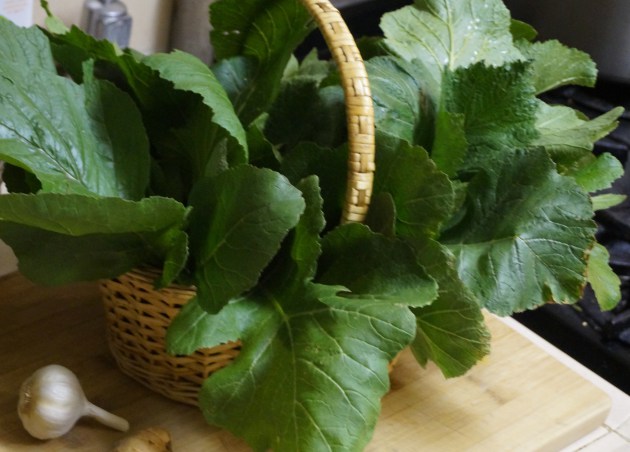
We gather wild greens from the field daily, and mustard is currently the star attraction– buds as broccoli, flowers and young greens in salads, and cooked older leaves. I think these hold up even better, in flavor and texture, to sauteing than does spinach. We often mix with dock leaves for a bright lemony accent.
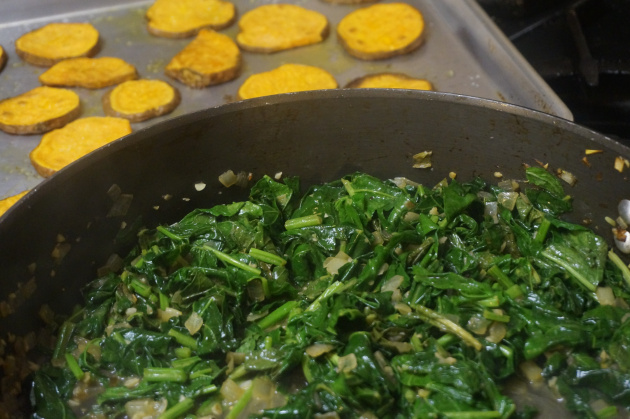
Mustard greens are easy to prepare, incredibly healthful, and delicious. They are a wonderful side to all sorts of meat, fish, polenta, or grain. We enjoyed them last night with fried pork chops and sweet potatoes.
Sautéed Wild Mustard Greens with Dock, Garlic and Onions
The dash of hot sauce adds no heat to speak of– only a bit of vinegar and spark of extra flavor. Serves 3-4.
2 T butter
1 white onion, chopped medium
4 cloves garlic, minced
1/4 cup dry white wine
3 large handfuls of large mustard leaves, stems trimmed…
Aaron is brewing! Last week he started a hazelnut brown ale, and this morning he bottled it. Today’s project: racking (transferring) this week’s lemongrass lime Kolsch into a new carboy for its secondary fermentation. Even this early in the process, the hazelnut ale has a smooth, warm flavor, and the Kolsch has a light, citrusy, summery taste. They’re going to be a superb addition to our collection of home-brewed ales.
Sofia turned one during the second week in December, and we decided to do a cake smash celebration with her, like we’d done when Niko turned one. I wanted a cute cake for her to smash that would coordinate with a perfect outfit for marvelous pictures. Aaron suggested that I make a polka-dot cake. I was mildly hesitant, because it seemed complex, but when he showed me a cake pop pan he’d found, I decided it seemed doable.
It was simultaneously easier and harder than I’d expected. First, of course, I did a search for how to make a polka-dot cake. I found a blog called “Once Upon a Pedestal,” by Deborah Stauch, which featured a tutorial for a polka-dot cake. Later on, after I’d gone through the whole process of making the cake, I found another blog, “Easy Baked,” which had a polka-dot cake tutorial that included some troubleshooting ideas that the original post didn’t have. This one was actually referenced by Ms. Stauch, and the author used Ms. Stauch’s instructions for her own cake. I wish I’d seen it when I was originally looking, because I ran into some problems.
Basic steps: Use two cake mixes; color one batch however you want your polka dots; bake your cake pops till they’re just done; surround them with the second batch of batter in layer pans; bake them a second time. Simple. Easy-peasy. Right? Ha.
The tutorial I followed suggested adding pudding mix to the cake mix. The idea was that this would make the cake denser, and the circles would be less likely to float. Unfortunately, what I thought was pudding mix in my cupboard was, in fact, Jell-O mix. Then I realized that my cake mix was a pudding cake. Problem solved! I thought. Ha.
Another instruction I didn’t follow was to use two cake mixes. I only wanted to make two layers in itty-bitty pans, not the three layer pans that the original tutorial suggested, so I thought one mix would be just fine. Incidentally, upon measuring (later, of course), I discovered that my mini pans were the same size as the pans Ms. Stauch used: six inches across. So one mix wasn’t enough even for my two pans. My guess is that if I’d done two, I’d have had enough to do seven balls per layer, rather than six, and also cover them more thoroughly in the pans.
I mention these errors just in case someone else reading this thinks taking shortcuts is a great idea. I think the cakes would have been MUCH easier, and looked better, if I’d just followed the instructions. What actually happened: the batter didn’t sufficiently cover the cake balls, and they floated up above the surface of the cakes. I salvaged them by covering them with a damp paper towel and setting another pan on top. It worked okay, but it could have been better.
Anyway, the end result was surprisingly pretty, considering all my mistakes. I measured out enough batter for the balls and tinted that batch with Wilton Moss Green gel coloring. I tinted the rest with Wilton Creamy Peach gel coloring. I baked the balls first, of course. Using my 12-ball Nordic Ware cake pop pan, I baked them for exactly 12 minutes at 350 degrees. This was the one thing that worked perfectly. They came out a beautiful soft green with not even a touch of brown, and all but one popped out of the pan without a hitch. You can see how they looked in the photos below.
Gel colors give a richer, more vivid effect than liquid food coloring.
Moss green batter for the cake pops.
Each section is filled right to the top.
Just a tiny bit has to be scraped off after baking.
Beautiful green cake pops, with no brown at all!
Then I poured a little bit of the peach batter into the 6-inch baking pan (actually too much batter — it pushed the balls upward as it rose), arranged 6 balls in each pan, and poured the rest of the batter over. As you can see in the photos below, it really wasn’t enough batter to thoroughly cover them. A little more would have been better. I then baked the cake just like a normal cake. Afterward, I had to weigh down the top for 10 minutes, using a damp paper towel topped with another pan, to press down the round top with protruding green balls. This wouldn’t have been necessary if I’d just followed the directions.
Not nearly enough batter on top of the balls.
They floated to the top! Oops.
Weighing down the top to push the polka dots down.
I used whipped cream for the topping and filling. I used the peach for this, too. I used a flat metal spatula (like a giant butter knife), dipped in hot water, to smooth the sides. I’m not an expert; it didn’t turn out perfectly smooth, even though I spent an inordinate amount of time in the attempt. But it looks a lot better than it did before Aaron, who’s actually got some experience with cake decorating, suggested the hot-water method. Then, for the top, I used a flower tip on a pastry bag to make little flowers all over, and I dropped a pale-green sprinkle into the center of each flower. For a final touch, I poured more sprinkles around the bottom of the cake to make an irregular band of pale green.
It was a bit of an anxiety-causing process, doing all this work decorating a cake that I couldn’t be sure would look pretty when I cut into it. And I had no backup plan, of course. When I finally cut into the cake just before getting Sofie dressed for the cake smash pictures, I was so relieved at seeing how well it turned out. Polka dots in more or less appropriate places, colors complementary to each other, no horribly obvious flaws, and it looked adorable with the tutu and birthday banner I made for the occasion. Whew!
The cake, covered with peach-colored whipped cream.
It was about ten or twelve years ago: newlywed, I had just made my favorite apple pie, my own recipe, for Aaron. “It’s pretty good,” he acknowledged, “but next time you should make my mom’s apple pie.”
I was a bit insulted. After all, I’ve been making apple pie ever since I was tall enough to reach the kitchen counter, and I’d like to think I’m pretty good at it. Over the years, I’ve tweaked it, finessed it, and let me tell you, my apple pie recipe is GOOD. I was not about to ask my mother-in-law, excellent cook and kind woman though she is, for her recipe.
That is, until we visited one day when Kay, Aaron’s mom, was making pie. I helped peel apples while she mixed filling. Sugar…flour…sour cream. Sour cream? I’d never had an apple pie with sour cream. I was respectfully doubtful, but after all, she generally knows what she’s doing in the kitchen, so I just bit my tongue and kept slicing apples. The pie smelled incredibly good while it baked, of course, as any apple pie does in the oven. And then she pulled it out…sliced it…served it…and it was HEAVEN. Pure heaven. It beats my original recipe hands-down. (And that’s a pretty good recipe, so you can imagine that this sour cream apple pie is really delicious.)
During my in-laws’ visit over Christmas, my mother-in-law recounted again the story of how she found this amazing recipe. About forty years ago, she was working with a woman who was a student at the University of Arizona. This woman was in possession of a recipe that had come from the culinary school there, and she shared it — with an admonition for Kay to keep it to herself. However, since it’s been forty years, and the recipe has been altered a bit, she willingly gave me permission to share.
I made it for Christmas this year, my third or fourth attempt at this recipe over the years. The first time, I had followed my carefully-copied recipe exactly, not knowing of her adjustment — she made twice as much sour cream sauce as the original recipe called for — and it was a little bit of a disappointment. This time, more experienced, I made her adjustment and added one of my own, too, increasing the amount of apples by about 60%, doubling the sour cream filling as she had done, and adding cinnamon (which was, oddly, omitted from the original recipe) and nutmeg too, which I love but my father-in-law doesn’t. So the recipe I’m including here is quite similar to what you’d eat if my mother-in-law were making it, but different by several incarnations from the original recipe from the University of Arizona.
Start by making or defrosting a pie crust. I use the Pioneer Woman’s Perfect Pie Crust recipe. It’s horrible to work with after being frozen, stiff and almost brittle after it’s rolled out — sorry, Pioneer Woman, but it is — but once shaped and baked, it makes amazing crust. Because of the mouthwatering results, I continue to make it ahead and freeze it to use whenever I make pies. I’ve just come to accept that it will fall apart, and I just piece it back together in the pan…or, alternatively, I start with the ball of dough in the pie pan and press it into shape instead of rolling it out. It’s worth the extra effort. Best pie crust ever, seriously. Below are some pictures of the crust so you can see I’m not exaggerating at all when I say it is REALLY REALLY HARD to work with:
Shreds and crumbs. Just awful.
It comes together eventually.
Now, on to the pie filling. The original recipe called for three cups of apples; I increased it to about 5 cups, which juuuust filled my large earthenware pan. You could do 6 cups and it would fit fine, but then you’d need to make a corresponding increase in sour cream and flour. Choose fairly tart apples; other than that recommendation, I just buy whatever is on sale. To make my life easier, I use a peeler/corer/slicer I found this summer. I peeled all my apples in under 5 minutes.
Peeling, coring, and slicing all at once with just a few whirls of a handle.
Perfect apple slices.
Next, make a mixture of 2 cups of sour cream, 1 1/2 cup of sugar, 2 teaspoons of cinnamon, 2 teaspoons of vanilla, a pinch of nutmeg, and 4 tablespoons of flour. As you can see in the photo below, a 2-cup measure isn’t the best tool for the job. That’s what we call a negative example. Get a bowl, for heaven’s sake. When it’s thoroughly mixed, add this deliciously creamy mixture to your apple slices, then pour it all into the crust.
Mix sour cream, vanilla, flour, sugar, nutmeg, and cinnamon.
Nice, creamy mixture.
Apples and sour cream in the crust.
In a small bowl, make a streusel topping: Mix 1/3 cup of brown sugar, 1 teaspoon of cinnamon, and 1/4 cup of flour. Blend in 1/4 cup of firm butter until the butter is incorporated into the sugar and flour in evenly sized, pebbly chunks. I have the best success when I use a pastry cutter, but I know people who do it with a fork and never use a fancy tool for it. Sprinkle the topping onto the apple mixture in the pan, and you’re ready to bake. Use strips of tinfoil or a crust shield to keep the crust from becoming too brown during the long cooking time. The pie sometimes bubbles over, so to be safe, put it on a baking sheet or spread tinfoil underneath the pan. Bake the pie for 45 minutes to an hour at 400 degrees.
Blend all the streusel ingredients.
It should look pebbly, with all the butter pieces about the same size.
A pie crust shield keeps the crust from burning during the long baking time.
When it’s done, the whole pie will be bubbling, the top will be browned, and a fork or knife plunged into the middle will slide easily into tender apple slices. Let it cool a little before serving so the filling has a chance to set slightly. And there you have it. Best pie ever.
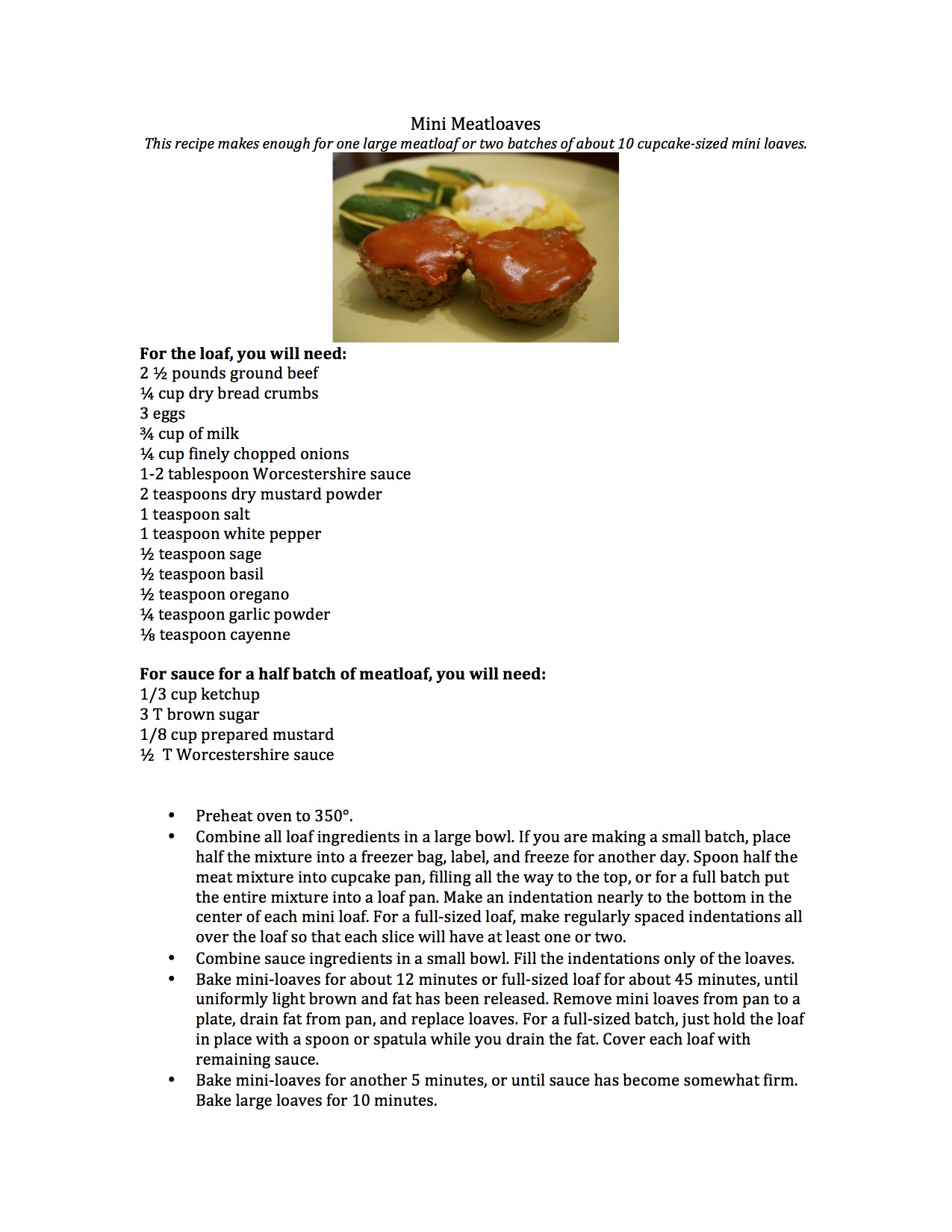
When I cook meals that traditionally tend to be large, I like to find ways to make them more manageable for a small family. Meatloaf is a good example of that. I love a good meatloaf, but once Aaron and I have had a serving and Niko and Sofia have nibbled a bit, we still have to deal with the rest of the loaf. It ends up sitting in the fridge for a week, at which point Aaron decides it’s probably contaminated with botulism or invisible mold and throws it away. On the other hand, meatloaf is one of those meals that’s just as easy to make in a large quantity as a small batch, and it seems like a waste of energy to spend that time making just a little bit.
So I compromise. I make a full batch, turn half of it into individual cupcake-sized servings, and freeze the other half for later. It’s really nice to be able to just grab it out of the freezer and have a hearty meal forty-five minutes later… and still be able to claim it as home-cooked. The cupcakes cook quickly, store easily and make an easy-to-grab quick bite later. If you’re cooking for a larger group, you could just use two cupcake pans, or you could put the whole batch into a loaf pan. You really can’t do a half batch in a loaf pan – unless you use tinfoil to partition off half of the pan, and put the meat into one half while the other stays empty. That works fairly well, if you’re absolutely committed to the traditional meatloaf shape. It’s hard to keep it moist if you use the whole pan to do a half batch – it’s just too thin of a layer.
I’ve used the Better Homes and Gardens cookbook’s recipe as a gauge for proportions for some time now. Unfortunately, that meatloaf recipe is as bland as vanilla pudding when you’ve run out of vanilla. So I always tweak it a bit, add my own seasonings, spice it up. Nothing fancy. Just enough to make it taste like meatloaf instead of like some ground beef someone tossed into a pan and cooked for an hour. I also increased the amounts proportionately from the original recipe, because the Better Homes and Gardens version never fills my loaf pan as full as I’d like.
A few notes:
The recipe asks for milk – if you’re avoiding dairy, don’t just leave it out, or the meatloaf will be miserably dry. Use almond or coconut milk. Almond has a milder flavor, but this recipe uses a small enough amount that even coconut milk won’t change the flavor.
For the onion, I use a chopper I bought years ago at a Pampered Chef party. I like my onion chopped really fine so it doesn’t disrupt the texture of the meatloaf. A quick pulse or two in a food processor should give similar results.
Herbs: For this recipe, I just use dried herbs. If you want to use fresh, just use about two to three times the amount and make sure they’re chopped very fine.
Bread crumbs: You can make your own, but if what you need is dry crumbs like I use in this recipe, it’s easiest to just buy them. Otherwise you have to go through the tedious process of cubing bread, drying it slowly in the oven, using the blender to turn it to crumbs, and then realizing you drastically misjudged how much you’d get out of the slice of bread you used, and have to start the process all over again because you’re a tablespoon short. Not that that’s happened to me, of course. It’s just a thought I had.
For the loaf, you will need:
2 ½ pounds ground beef
¼ cup dry bread crumbs
3 eggs
¾ cup of milk
¼ cup finely chopped onions
1-2 tablespoon Worcestershire sauce
2 teaspoons dry mustard powder
1 teaspoon salt
1 teaspoon white pepper
½ teaspoon sage
½ teaspoon basil
½ teaspoon oregano
¼ teaspoon garlic powder
⅛ teaspoon cayenne
For sauce for a half batch of meatloaf, you will need:
1/3 cup ketchup, 3 T brown sugar
1/8 cup prepared mustard
½ T Worcestershire sauce
In a largish bowl, dump all the ingredients for the loaf. You might have a slightly easier outcome if you beat the eggs first and combine the seasonings before adding them; I never bother, and mine turns out just fine. Use your hands to mix everything. This is one of those things for which, unfortunately, hands are just the best tool. I say unfortunately because I detest the sensation of cold meat and slimy eggs. It is my biggest deterrent to making this meal.
Spoon half the meat into a lightly oiled cupcake pan. Put the rest of the meat into a freezer bag, label it, and freeze it for later. Each one should be pretty full, since the meat will shrink as it cooks. Use the end of a wooden spoon, or your finger, or a chopstick…something cylindrical and blunt…to make a little well in each cupcake, making sure it doesn’t go right down to the bottom of the pan. If you’re using a loaf pan, make enough indentations that each slice will have one or two.
Divide the batch in half.
Freeze half for another day.
Make an indentation in each loaf.
Fill the center with sauce.
Spoon sauce into each indentation. Don’t cover the tops with sauce just yet; only fill the little wells.
Bake them at 350° for about 12 minutes, and then take the pan out of the oven and drain the fat from the loaves. The easiest way to do this is to lift the mini loaves out of the pans and set them onto a plate, then carefully tip the pan over a container for disposal. Replace the loaves, spread them with the rest of the sauce, and bake for another five minutes or so, until the sauce has thickened and browned a bit.
Lift the loaves onto a plate.
Drain the fat away.
Replace the loaves and top with sauce.
Delicious!
Two loaves makes a good serving for an adult. Niko, who is four, is stuffed after one, though one-year-old Sofia – who is a carnivore – can make it through nearly a whole one on her own, even with just two teeth.
My blog has got incredibly popular of late. This is a good thing, right? Sadly, no. Very wrong. It’s not my regular visitors and friends at all points in the free and not so free world that have me exercised. It’s those hard-hearted, vexatious, spotty people who spend their time spamming my virtual home here on WordPress. I checked today and have 475 spam comments in the darned efficient spam catcher used by WP. That means that of the time I spend here on the Internet, more of it is spent clearing out the dross and less is spent on the stuff you are here to see.
At this time of year, as holiday traditions are being hauled out and dusted off, I feel the distance from my Canadian family with an extra pang. I miss the joyful sense of celebration, the gathering of a big, noisy group, everyone talking over each other, fielding a dozen hugs in ten minutes. Our little family is building its own traditions, and they’re good ones. But still, at this time of year, I miss my childhood home and my family in Canada.
For me, “family” includes a hundred or so people distributed across three small communes within a five-mile radius in Northwestern Ontario, but especially the residents, current and former, of the West Farm. (Generally I try to keep location and name details out of my posts to protect the privacy of my loved ones on the farm. In this case, it officially goes by a different name, so you won’t find it on a map should your curiosity prompt you to look.)
Even in our secluded community which refrained from worldly celebrations, Thanksgiving was a big deal when I was growing up. It had the benefit of being neither Halloween (the Devil’s own celebration, as I mentioned in a previous post) or Christmas (a worldly holiday of pagan roots marked with prideful indulgence). It was one of the “Big Three”: Thanksgiving, convention, and graduation. Convention was a yearly long-weekend event. The important leaders of our network of communes and churches, known hierarchically as the “Traveling Ministry” (the lesser traveling preachers and teachers) and “Father Ministry” (the ruling class who handed down decisions both religious and practical), would arrive in March. Visitors would come from all directions to attend all-day revival-style services, causing our group to double or triple in size for several days. High school graduation was nearly as exciting: families of the graduating seniors of our little school would travel to congratulate them, the formally dressed seniors would present speeches, everyone would enjoy a big celebratory meal, and the seniors would open stacks of gifts. It was as close to prom as we ever got — pretty dresses, suits and ties, and lots of excitement, balloons, and confetti, though without dancing or limousines or clandestine make out sessions.
But Thanksgiving was the big one, the special one. It was just us — no out-of-town visitors, no preaching, no speeches. Just good food, family, and after-dinner games. Sometimes we’d invite a few families from outside the commune, or some single police officers or a nurse on assignment at the nearby nursing station, without family nearby. But just as often, it would be only familiar faces.
The women would bustle around the kitchen all day, cooking up a storm. Six or so pies would materialize by dinner time: two or three apple pies, at least one each of pumpkin and pecan, maybe a blueberry pie for good measure. Someone would usually whip up a batch of butter tarts. (For the non-Canadians reading this, butter tarts are a bit like the good part of pecan pie with all those nasty big pecans taken out. This one from Canadian Living looks like a good recipe, though I haven’t tried it.) We’d start fresh rolls in the morning so they’d come out of the oven, crusty and fragrant, before the pies had to go in. One of the cooks would invariably make a sweet potato casserole topped with brown sugar or marshmallows or both; someone else would comment that it looked awfully sweet, whereupon the maker would suggest that perhaps another of the many side dishes might be a better choice for the complainer. And this was certainly a good point, because there would be more than enough side dishes. Stuffing — made with bread cubes, of course, not cornmeal. Huge steaming pots of mashed potatoes, which had been peeled and diced by the younger cooks to keep them out of trouble and spare the adults the tedium of peeling dozens of potatoes. Green beans with bacon. Occasionally roasted sweet potatoes, a concession to the objections of a few to the sweetness of the marshmallow-topped casserole. There would always be cranberry jelly… the real, clear jelly, from a can, of course. Sometimes someone would make cranberry sauce from scratch, but that never replaced the jelly.
Cooking took all morning and afternoon, but for us younger girls, there might be time to enjoy the day off school. We’d race out of the kitchen, grateful for the reprieve from peeling endless piles of potatoes, and pull on heavy snow pants and coats, thick mittens, warm hats. Sleds jostled behind us from the sheds of houses as kids made a beeline for the big hill. We’d swoop down on sleds or on slick snow-pants-covered bottoms, some daredevils trying to ride the sled down standing up, others swearing that going belly-down made the ride faster. The sleds rushed down with solo riders or crammed with as many bodies as could fit, with arguments erupting at the bottom over whose job it was to pull the sled back up. Noses would turn pink, eyelashes frosted over, fingers and toes froze as the afternoon darkened to a blue twilight. Finally, we’d trudge inside, trooping into the kitchen to see if anyone had made hot chocolate. If there was enough stovetop space and anyone had had some spare time, there might be a big pot of made-from-scratch hot cocoa waiting on the range. Maybe one of the ladies had made banana or zucchini bread to snack on, or maybe we grabbed a leftover muffin from breakfast, while one of the moms poured mugs of hot cocoa for all of us. There might even be marshmallows bobbing in the mugs.
Dark came early in a Northwestern Ontario October, so it wouldn’t be dinner time yet, but people would be wandering into the main building early anyway, setting up board games on empty tables and pulling out musical instruments. A Crokinole game would occupy the place of honor at one of the round tables — it didn’t take long for eight people to claim places around the board while others gathered to watch, and a game as competitive as any at our peaceful commune would commence to the tune of guitar strings tuning up next to the piano. (Crokinole, by the way, is another Canadian tradition. It’s usually played with two or four people, but the board can accommodate up to eight.) A few more cerebral types would gravitate to the Scrabble board, while a game of UNO broke out in a corner.
Meanwhile, kids busily put out stacks of plates and baskets of silverware on the big island counter in the kitchen, filled water pitchers, and carried drinking glasses to the tables. Iced tea, which had been sequestered away in a back refrigerator lest teenage boys down it all before dinner, was brought out into the open and distributed to tables in pitchers, because even in the winter no celebration was complete without iced tea. An aunt bore the giant turkey triumphantly from the oven while the mouthwatering aroma swept the rooms. Rolls were tumbled into baskets while girls scooped potatoes out of the big pot into glass bowls, and two women attacked the turkey, carving it into neat slices. Finally, the food was all arranged on the counter, buffet style, and we flocked to our places at the table for a blessing before we dug in.
When we were stuffed with as much food as we could manage, a guitar would softly strum, the piano would echo the notes, and we’d sing songs together: our after-dinner daily tradition. Songs about giving thanks, about love, many of them written by people sitting there in the room.
Cleanup wasn’t too much of a chore; at the tables, dishes were stacked at top speed and quickly scraped and carried into the kitchen. Dads wiped tables and grabbed brooms to sweep the floor of the big dining room, while the kids manned the dish tubs and dried clean dishes. Moms and aunts swiftly wrapped food for the refrigerators. Then, cleanup complete, it was back to the board games and cozy visiting.
My dad would bring out a few new jokes, his sober joke-telling face carefully prepared in advance, always hopeful that the punch line would take the listener by surprise. His brothers would gently jeer — “I heard that one three months ago!” — while they competed with their own stories, others chiming in. Occasionally, a few people would present a skit: nothing serious, just a sketch designed to draw laughter, usually involving costumes we’d thrown together from our collection of old or silly clothes, wigs, and odd accessories. A piano player might wander over to the instrument and run her fingers over the keys, and teenagers would migrate to the piano corner like iron filings to a magnet. Somebody would add a guitar, then another, maybe a mandolin or banjo or hand-made fiddle or classical violin, and we’d sing one song after another while others visited or tried to best each other at the Crokinole board.
Thanksgiving was a day for family time. It wasn’t anything exciting, I suppose. No family feuds, no drunken quarrels. No Black Friday — in Canada, Thanksgiving is on a Monday in October, too far from Christmas to be dragged into the holiday shopping chaos. Besides, we didn’t celebrate Christmas (although we did love finding good deals). It was pretty simple: good food, music we made ourselves, family. And this time of year, I find myself thinking more than usually of my family.
So, to my American friends and family, let me wish you a wholehearted Happy Thanksgiving; and to my Canadian family, thank you for giving me these warm memories of simple traditions. I love you. Happy Thursday.
It haunts me with unrelenting persistence, this pursuit of laundry perfection.
My laundry list: Niko’s mud-stained, grass-stained, who-knows-what-else-stained jeans and shirts emerge from the washing machine victorious, pristine. Sofia’s grubby-kneed pants and sticky sleeves are as new when the laundry is done. Unspeakably soiled diapers? Pure as the Snow Queen’s gleaming white hair. And then come Aaron’s work shirts. They’re nearly perfect when they go into the washing machine, really. He’s a tidy, order-loving person who never spills food or smudges ink. But the collars, of course, after being worn all day in the heat of a California drought (he travels often for work), are – forgive me, Aaron – not quite as flawless as they could be. And, since moving to Oregon, when they come out of the wash, they remain not quite flawless.
Back in Anchorage, I would spritz the collars with laundry stain remover, toss them into the washer on the delicate cycle, and pull them out again, spotless. It was one of my few areas of housekeeping pride. Dishes may have been unwashed, the floor may have had a bit of dust, laundry remained unfolded for days, but by golly, those shirts were clean. Every time. I would hold one up, note the gleaming white collar, and feel a warm glow of pride. Did it again! That is one clean shirt!
In Oregon, the laundry routine has been the same, and the washing machine is an updated version of the same model. But the shirts no longer have the incandescent whiteness of a beautifully laundered shirt. And my pride has suffered as a result. Oh, how it’s suffered.
When this began, I turned, naturally, to Google, and discovered that hard water can lessen the effectiveness of laundry detergent. Borax, I read, can soften the water and get clothes cleaner. Naturally I rushed to Target and bought a monster box of the stuff. I started shaking some into each load. It helped, but not enough. Aaron’s shirt collars were still notable for their imperfection. But I was out of energy. I was pregnant with Sofia, growing more uncomfortable every day, and miserable in the unfamiliar summer heat reaching past the 90s and into three-digit temperatures. Grudgingly, I settled for almost good enough. But it still disturbed me.
I know, of course, why this bothers me so much. This one area of housekeeping success has been my token of the Virtuous Woman.
I remember joining the other teenaged girls in a chorus as we recited Proverbs 31, demonstrating our willingness to embrace virtue as well as our skill at memorization: “Who can find a virtuous woman? For her price is far above rubies. The heart of her husband doth safely trust in her, so that he shall have no need of spoil…Her husband is known in the gates, when he sitteth among the elders of the land…She looketh well to the ways of her household, and eateth not the bread of idleness.” We were relaxing in our Sunday School teacher’s living room on a Sunday morning, preparing to read from our slim navy hardcover book — Beautiful Girlhood, it was called — about staying modest, wearing hose at all times, being sure our knees (better yet, shoulders and ankles in addition to knees) were covered, and — above all — being sure that, should our vanity lead us to wear makeup, we be sure to remove it each night, lest unsightly leftover makeup mark us as undesirable.
We didn’t take most of it too seriously — while we lived in a Christian commune, our style was as modern as budget and the knee-and-cleavage-covering dress code allowed. After the requisite reading from the book each Sunday, the rest of our 45-minute pre-church session was mostly spent giggling and chattering, mostly about the old-fashioned suggestions in our book. But the virtue part — that stuck, for me, anyway. We heard it in so many ways as we grew up. None of us doubted that we’d someday have a husband. Each of us firmly believed we’d be an excellent wife. Hadn’t we been cooking for scores of people at each meal since we were old enough to reach the counter with a stepstool? Didn’t we take frequent sewing classes? Spend untold hours each summer gardening, harvesting, canning? Yes, we would be the epitome of Virtuous Women.
Of the girls in that group, only one remains on the commune. Our beliefs have evolved — even the beliefs of the one who’s still there, though her beliefs probably look a little more commune-traditional than mine. We no longer feel anxious if our knees are revealed; we know our virtue isn’t dependent on marriage. And yet, for me at least, the need to prove my womanliness remains.
If this were an inspirational novel or memoir, I’d have had an epiphany accompanying my realization of the source of my obsession with those shirt collars. I’d have realized that an obsession rooted in an over-religious upbringing might not be what I need for a guiding life principal. But I just can’t let those shirt collars go. How can my husband be praised in the gates, if his shirt collars are grimy?
Now that Sofia is nearly a year old and has fewer tummy troubles, thus being less needy and giving me a bit more time for frivolous obsessions, the urge to assert my status as a Woman of Virtue is rising again. Over the last month or so, I’ve tried a couple of solutions. One week, I tried making a mixture of borax, Spray & Wash, and a bit of water to combine them, and I spread the paste over the collars. It actually left the shirts less white than before. Not the desired outcome.
The next week, I sprayed the collars with stain remover first, then spread the same paste over the damp cloth. Victory! Well, almost. I could still see the shadows of stains, but it was so much better than it had been that I decided cleanliness had been satisfactorily attained. All I needed to do was to write a post and hit “publish”, and I would officially be a Virtuous Woman again. I wasn’t entirely pleased, but it was… well, it was close enough, right?
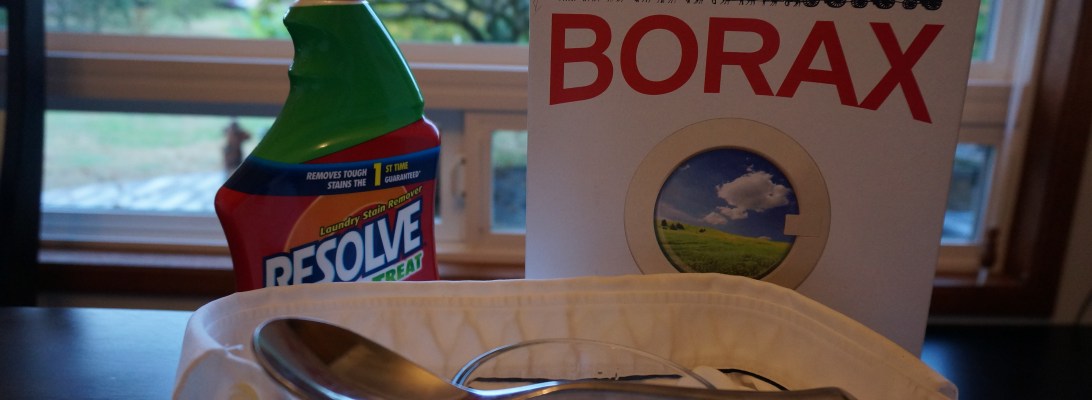
Assembled ingredients, including this week’s shirt
Borax with Resolve Spray & Wash
Borax, Resolve Spray & Wash, and a little water, mixed into a paste
Paste spread on a pre-sprayed collar
Then, Aaron’s aunt and uncle came by for an overnight visit. Over dinner, I happened to mention my search for the perfect stain remover. “You need Nicole’s recipe,” our aunt said. “It’s like magic. It will get absolutely anything out. She used it to get three-year-old paint stains out of a jacket.” And, because she could see how excited I was over this magical concoction, she texted her daughter Nicole, who promptly texted back with the recipe.
I can’t even tell you how ridiculously thrilled I am about this new stain remover. In my next post, I’ll give the recipe and tell how effective it is. (Spoiler: It’s VERY effective.) And the best part? I’ve re-established my standing as a Virtuous Woman. Now that my husband’s shirt collars glow with cleanliness, there is absolutely no reason to confront that deeply rooted, unhealthily lingering need for personal perfection.









 A Bright Ray of Hope