Sparkle

A few days ago, I was driving home from dropping off Niko at preschool, and I drove into a fog bank that was shot through with rays from the rising sun. And suddenly, out of the blue, I was swamped with nostalgia.

Here’s the truth: I hate most of the things about Alaskan winter and don’t regret abandoning them all for the mild, really-more-like-prolonged-spring Oregon winter. Some of the key elements I’ve always disliked: Walking through snow. Slipping on ice. Driving on icy, badly-plowed or not-yet-plowed roads. Waiting all morning for my cold, damp pant legs to dry after dragging them through a snowy parking lot. Shoveling driveways. Driving through a blizzard. Brushing snow off windshields, scraping ice off windshields, dealing with ice buildup on windshield wipers. The terrifying, unstoppably glide as your vehicle fails to stop on a patch of ice. And that’s only the snow and ice problems. Don’t even get me started on the darkness and short days and the cold….

But there’s one thing that Alaskan winters do better than anywhere else, and for it to happen, there has to be fog and sunshine. That one amazing thing is hoarfrost. We call the fog that comes before the frost an ice fog, for the obvious reason that it causes the frost, but also because the fog is actually filled with tiny, suspended ice crystals. When the sun finds a way through and lights up the fog, the air is filled with glitter and sparkle. It’s breathtaking in its beauty. You can’t help but stop to stare around you.

The morning after an ice fog, everything is coated in thick, intricately patterned frost crystals. Trees are as white and sparkly as an artificial Christmas tree. The frost turns the world into a magical land of beautiful possibilities. On mornings like that, you suddenly realize that Alaska actually is as incredible as tourists think it is.

A frosty Anchorage afternoon.

Driving through that fog the other day, I remembered. And, believe it or not, driving on the ice-free road in a car that hadn’t had to have its engine run for ten minutes to be drivable, looking through a windshield with full visibility instead of semi-clear streaks scraped through ice, I discovered that I missed Alaska. Just for a minute. It didn’t last long. But for that minute, it occurred to me that I might like just one day of waking up to a fresh snowfall. Just one day to see the world covered in white. One day to see everything shining with jagged-edged, lacy, fragile frost crystals. Just once.

That night, the fog thickened and hung low over our home as the temperature dropped. I’d already forgotten the nostalgia, but Oregon must have heard my wish, because the next morning I awoke to a magical world of white. Not snow, but frost. Everywhere I looked, there was a thick coating of crystals. The grass, the trees, everything was shimmering white.

As I started to get breakfast ready, Niko ran to the window. “Wow,” he breathed, and I agreed. The sun was just starting to shine through the trees, lighting up the frost. On impulse, I asked him, “Would you like to go run in the frost for a few minutes?” He was thrilled, and ran outside, stomping and jumping up and down as he discovered the crunch of the frost.

Exploring a frosty morning

My nostalgia is gone now. I know that if we’d had the snowfall I wanted for that brief moment, we’d be shoveling a porch and a long, long driveway to make sure we could get out if necessary. We’d be cold, and wet, and probably lose our footing and fall a few times. Instead, what I got was the sparkle and glitter I’d been craving, without the added stress of dealing with snow.

Thanks, Oregon. You rock.

What They Don’t Tell You

Last week we took a morning to do some last-minute Christmas shopping. At the mall, Aaron took Niko one direction while I took Sofia elsewhere, so I could check off my list for Aaron and get Niko some books.

We’d been shopping about half an hour when I got a text from Aaron: “Niko just did the craziest thing!” Turns out Niko’s bottom had started itching. Right there in the middle of Nordstrom, he shed pants and underwear to get at the itch. Aaron glanced down and was horrified — “What are you DOING?”

“I had an itch,” Niko explained. “That’s what I do when my bottom itches.”

No one tells you to anticipate this sort of thing when you start parenting. I’m sure the parents of one of Niko’s friends didn’t expect to have a conversation with her teacher after school about how she lifted her dress to show Niko her pretty undies. You don’t really think ahead about what you’ll respond should your child shout, upon seeing a pretty Filipino lady, “That lady is BROWN like my friend Jonah!” (“We don’t use people’s skin color to describe them,” you hiss, sinking as low into your seat as possible.)

Nobody tells you to be prepared to have your hand covered in slimy yellow poop while holding your munchkin as you peruse the clearance rack in an upscale department store. No one warns you that you may walk out of a mall bathroom holding the hand of a toddler wearing too-short pants and navel-baring shirt because he peed himself thirty minutes after your last potty stop.

I could continue, ad nauseam, listing all the surprising things about parenting. However, it occurs to me that a) it’s been done before — repeatedly — and, b) many of these “things no one tells you” are actually things that people DO tell you. Read a few articles on a parenting site and you’ll be so overwhelmed by all the “things” that you’ll decide to never have a child…unless it’s too late for you, as it is for me.

No, I’m realizing that there’s no secretive society of parents, all refusing to tell of their embarrassing, disgusting, even hilarious stories. Get us talking, and we won’t shut up. It’s more a matter of listening and applying the stories to oneself — both important factors. The childless listener thinks, “But I have a degree in child development and a background in education. MY children will never push a container of bouncy balls to the ground in a rage and then fling themselves on top of the rolling balls while shrieking ‘I WANT A BLUE BALL!’ My children will always appear well-groomed and happy, and their faces will always be clean, because how hard is it really to manage a child or two for an hour or two in a store?”

Here is what no one wants to believe before having children: Every child is an autonomous being. You can train, you can discipline, you can practice, but you can not control. Children aren’t robots. Trust me. Your child WILL embarrass you. If no one has told you this yet, it’s only because — as my mother told me — this is a universal truth, and those of us who’ve gone through it believe it’s obvious. We can’t tell you the specifics of how this embarrassment will happen, because children are unpredictable, but it will occur. It’s only a question of how.

IMG_1553.JPG

Niko’s Princess

Early last week, as I was dropping Niko off for a morning of preschool, a dark-haired little girl rushed up to us and stood in front of Niko, swishing her long purple princess costume dress back and forth. “Hi, Niko!” she gushed. “Do you think I look pretty? I feel soooooo pretty!”

The little girl was familiar to me. I knew her due to her adoring Niko so much that she’d once tackled him to the ground for a hug. I’d noticed that she’d been wearing the same princess costume the last four times we’d seen her — that’s over a week, since we do preschool just three times a week. The first time, Niko was upset because she’d worn the dress “with just underwear!”

“You’re supposed to wear clothes FIRST,” he’d told her. I could tell this was a serious infraction in his mind.

“I have clothes,” she insisted. “I have UNDERWEAR.” This did not satisfy, even when she demonstrated the presence of the underwear, at which point their teacher hastily intervened.

That day, as she swished her dress in front of Niko, she held out one leg. “Look, Niko,” she said. “I’m wearing pants with my costume.”

“Oh,” said Niko, a little flatly. “You look so sparkly.” He seemed a bit puzzled by the whole thing, but willing to admire anyway.

After the two walked away, his teacher, laughing, whispered to me that the child’s mother had explained the reason for the princess costume. “She dresses herself every day. She wears that costume for Niko! She calls herself Niko’s princess.

I laughed too, shaking my head. But even though it was funny, it bothered me a little. Not the insistence on one particular garment — we’ve been fortunate enough to escape that battle so far, but I understand it. No, what triggers a little alert light in my mind is the idea that she’s choosing her clothes based on what Niko likes… or what she thinks he likes, anyway. It’s a little worrying to see a small child so fixated on another person that she adapts her clothing choices to suit his preferences.

I somehow feel that I’d like to blame society or the media or a faulty family model for this willing sacrifice of a girl’s preference for a boy’s. I feel strongly about a woman’s right to her own body, including what she puts onto it. It’s possible that this little girl may be witnessing a situation in which an adult in her life is modeling some kind of self-imposed personality smothering, or being actively smothered. Or maybe she sees it on some grown-up TV show. It ruffles my quietly feminist feathers to see this tiny girl already changing her entire approach to clothing based on what she believes a little boy likes. If I were more committed to social justice, or a more aggressive champion of women’s rights, I might find myself writing an impassioned plea to society to free our little girls from the burdens of male expectations.

However, while such scenarios are entirely possible,  life is rarely so easily categorized. It’s not always feminists against the world, no matter what it sometimes feels like. An equally likely explanation for her extreme behavior is that maybe she just really, really likes Niko and wants his attention. In her little mind, wearing what he likes could be a perfectly logical method of attracting and holding his typically fleeting interest. After all, her mom seems like a confident, self-possessed woman, not a timid, self-effacing mouse; it’s doubtful that she is modeling being stifled by the patriarchy.

In fact, despite my puzzlement over her daughter’s obsession with my son, I sympathize with her mom and feel that we might have a bit in common. I’m holding to a tiny bit of hope that she might be my very first preschool parent friend. Unfortunately, this may have been jeopardized by Niko’s reaction to his friend’s attire last time we saw them. The two were being dropped off at the same time, and Niko and I walked in to see her dressed in a charming outfit featuring sparkly leopard print — the first non-princess clothing in, I believe, three weeks. I recognized the gargantuan effort the mom must have expended to get her into a different garment. It was apparent that a pinnacle in parental persuasion had just been reached; I knew I was looking at a milestone of mothering achievement. My mouth opened to compliment the little girl on her pretty outfit, reinforcing her mom’s triumph, but Niko was too fast. His eyes widened in outrage as he demanded indignantly, “WHY AREN’T YOU WEARING YOUR PRINCESS COSTUME?” Little girl’s head and mom’s shoulders drooped simultaneously, and though the teacher and I both rushed in with positive reinforcement, I fear the damage was done.

I can hardly wait to see what Niko’s princess is wearing today.


(The featured photo is not mine, but since I grabbed it from an anonymous eBay posting, I don’t know who to credit for it. Sorry.)


Guilt Trip: In Search of Perfection

Guilt. I can’t seem to escape it. I’m not talking about shame, the sense of sorrow and regret that comes with specific wrongdoing. No, I’m talking about, in the words of Merriam-Webster’s online dictionary, “feelings of culpability especially for imagined offenses or from a sense of inadequacy : morbid self-reproach often manifest in marked preoccupation with the moral correctness of one’s behavior.” (A tip of the hat to my mother/English teacher for forcing us to write all those definition compositions.) In other words, I’m constantly pursued by a sense of culpability…even when I’m doing the right thing.

Example: Right now I’m writing this post, having just finished loading and starting the dishwasher, doing some much-needed photo editing work in preparation for a project, and getting lunch for the kids. I should be enjoying this short-lived bubble of peace while both children eat and I don’t have to nurse anyone, change a diaper, or field a thousand questions. But no, even though writing is my most fulfilling personal indulgence (maybe because?), I can’t truly enjoy the moment. Instead, the back of my brain is filled with a jangle of accusations. You should be finishing that tablecloth you started for the Christmas village table. Aaron’s gifts aren’t wrapped yet. The bathroom mirrors are still smudged. Why haven’t you cleaned that smear on the wall next to the high chair yet?

Even when what I’m doing is a useful chore, I’m followed by the guilt. It’s like a persistent toddler clinging to my leg, unreasonable and impossible to nudge away. Did I choose to spend some time hanging clean clothes in closets? The guilt tugs — “What about the baby clothes you still haven’t finished organizing?” Maybe I walk down the lane to retrieve the trash bins — “But look at the weeds in that garden bed! What is WRONG with you?” If I’m not careful, the million demands, each choice accompanied by anxiety about all the other undone things that I didn’t choose, can become so overwhelming that I retreat, usually into a book. Then I simply don’t finish any of it.

If possible, it was even worse when I was teaching, before I put that on hold to focus on being a mom. For one thing, I was responsible for twenty-five or thirty people, and responsible TO even more. For another thing, every choice I made to accomplish something meant that I was neglecting not just other tasks, but other people. If I spent six hours scoring my students’ writing assessments on a 6-point rubric and entering their scores into a spreadsheet that calculated their progress from the last time I did this same activity, that was six hours that I wasn’t spending with my son and husband. If, on the other hand, I spent just half an hour grading spelling tests and math timed tests and then went for a snowy walk with my family, that walk was two hours I wasn’t using to plan the next week’s lessons. There was no winning. Ever.

I’m sure that my ADHD is in part to blame for the constant awareness of ALL THE THINGS! that need to be done. But there’s more to it than that, and today I’m going to venture into the dangerous land of theology to talk about that extra dimension of anxiety and guilt. The more I think about it, the more I believe this needs to be said.

You see, I grew up in a highly religious setting, in one of a network of Christian communes, known as the Move, scattered across North America (there are a couple on other continents, as well). Some of this religious upbringing was beneficial; some, not. I’m thinking of two particular doctrines that are a common thread throughout all the groups and, I think through other fundamentalist-type churches as well: the doctrine of perfection, and the doctrine of death to self.

Perfection. It sounds so innocuous. So desirable. To the devout, the lure of being perfect in God’s eyes might be irresistible. It sounds so … well, so godly. It sounds like a worthy pursuit. “Be perfect, as your heavenly Father is perfect,” said Jesus (Matthew 5:48), and it’s hard to argue with that. Those living in the Move, and perhaps those in similar churches, hear the message preached regularly. I heard it more times than I could count as I grew up. Here are the words of one of the church’s leaders, Buddy Cobb, taken from the same Wikipedia page I linked to above: “Therefore, what are you saved by? His life! What are you saved from by His life? Saved from living your own life; and when you live your own life you are always living in sin.” The idea is that every single aspect of a life ought to be given over to the pursuit of God; one ought to be entirely immersed in God, leaving nothing of the original sinful human.

It might be hard to see how embracing a doctrine of perfection could be harmful. But I’m here to say clearly and loudly, though with love and apologies to my family, that it is a poison. It creeps into every aspect of an otherwise healthy life, tainting good and pure choices with fear. Fear that this activity does not bring sufficient glory to God. Fear that what I’m doing might be too self-celebratory, too lacking in the edification of the spirit. Fear that the new skirt that looked so appropriate in the dressing room might be a fraction of an inch too short for the high standards of modesty, that my friendship with someone might override my “relationship with God,” that my pleasure in a school assignment done well might be a source of sinful pride. Once you become convinced that God demands absolute perfection, every action comes under scrutiny lest an accidental sin slip past, darkening your soul with a stain that must be scrubbed out through prayer and invoking of Jesus’ blood. Every choice has to be held up to the light and examined: Could I be doing something more godly, more useful, less selfish? The fear becomes all-consuming, blotting out the joy of a well-lived life.

But here’s the thing: This is not the life that Jesus lived. Jesus did not second-guess his every action. Nor did he recommend that his followers do so. He preached compassion, kindness, and living a life of purposeful goodness. Here is the context of the “Be perfect” command: Rather than adhering scrupulously to the law passed down over the course of two thousand years from Moses, Jesus asked his followers to fulfill the spirit of that law. Instead of being satisfied with refraining from murdering, his followers were told to not even insult another person. If an enemy sues you for your coat, give them your shirt also; if someone hits you in the face, offer them the other side to hit as well. Love your enemies. Be peacemakers. The whole point is not to live less of a life, but to live more. It isn’t about being restrained by a series of religious prohibitions; it is about accomplishing the original purpose of the law, to be guided toward God. Yes, Jesus said we ought to be perfect. And when, like a well-brought-up church-school student, we check Strong’s Concordance to see what the word “perfect” originally meant, we see that it means brought to its end, finished, complete, mature. Jesus was telling his followers that they should be living to fulfill their potential. I’m sorry, but Jesus did not once tell his followers to stop making their own decisions. Jesus did not say that living your own life is sin. That is a twisting and a perversion of what should have been a freeing message.

It’s especially damaging when combined with a second doctrine, that of “death to self.” This doctrine explains that the human self is miserably sinful. The only way to achieve rightness with God is by constantly denying oneself. A good rule of thumb when adhering to this doctrine is that if you like something, it’s probably your “flesh,” or human nature, guiding your desire, and you should quickly abandon it and go read your Bible for awhile. Of course, it’s a bit problematic if you happen to be a teenaged girl reading The Message, a uniquely down-to-earth and clear translation of the Bible, and you stumble upon the Song of Solomon. What could be more spiritual than reading the Bible? And what could be more fleshly than this beautiful and erotic love poem? That’s a dilemma, for sure. Anyway, the idea here is that to be perfect, we must deny ourselves. Constantly.

If you take these two doctrines seriously, you end up starving your soul of the good and beautiful things that God put into this world for our enjoyment. You like chocolate cake? Go on a chocolate fast! Feel like lingering outside to watch a lovely sunset? How trivial! Go wash the dishes and pray for stronger commitment to God! Have eyes for that cute boy? Pray all night for purity of mind. Enjoy a good romance novel? Better burn those books…No, who am I kidding, just tuck them under that loose floorboard, you can writhe in miserable contrition tomorrow when you’re done reading the last one. My point? We aren’t meant to be starved of earthly enjoyment. God did not create the earth as one giant temptation, to see how long we could go before giving in and enjoying something. I find it hard to understand how some Christian sects ever came to embrace that doctrine, considering that our founder (I’m talking about Jesus) was known for being a “wine-bibber,” enjoying a good party, and being frequently found in the company of harlots and other people of low repute. But somehow they did. I grew up being told routinely that all personal desires were wrong, and that God demanded utter perfection from me.

I know my mother will protest that she didn’t teach me this, and she’s right. My mother is an excellent example of a person who takes all this with a great big grain of salt. My parents don’t live a life of constant self-denial, nor do they fret endlessly over whether each choice they make is godly. They just live. But, as I tell them, when a child is raised communally, parents are only one source of input. When you attend three to four devotional times per day, two or three church services per week, and Scripture-infused classes at school, your parents’ practical example fades into the background and is overwhelmed by the desire to live up to all that goodness you’re bombarded with throughout the day. I know, logically, that most people, even in The Move, don’t actually take the dual messages of perfection and death to self literally or even all that seriously. If you ever stop in to the farm for breakfast when the world’s best Danish pastries are being served (crisp, light, melt-in-your mouth deliciousness), you’ll know that self-denial is not a big part of everyday life. But that doesn’t mean that the messages aren’t damaging. They are. For someone who’s grown up immersed in those messages, they’re inescapable. They are part of the blueprint of my brain. They’ve imbued my soul with a persistent stain of guilt that no amount of rightdoing will eradicate.

Of course, I’m well aware that I’m responsible for my perception of the teachings, for my own internalization of them, and for my inability to shake loose from the effects. I’m not out to point fingers of blame or to minimize my own culpability here. I am here to ask that we carefully consider the end results of teaching people that one’s own desires are wrong simply by virtue of being their own desires; that God demands literal perfection and absolute freedom from sin; and that the only way to achieve perfection is to sacrifice individuality on the altar of God’s will. If the logical consummation of following a doctrine is a life tormented by anxiety and formless guilt, then there’s something wrong with that teaching. It’s time to stop systematically telling children that the only way to please God is to reject everything that makes them happy.

Photo credit: Wikimedia Commons

Siren Call

I saw the flashing lights up ahead, beyond my turn: an ambulance and a fire truck. I craned my neck to see what had happened, but the emergency vehicles blocked any view of details. I parked at my bank and got out of the car, walking carefully on the ice in high heels as I hefted Sofia in the car seat carrier. As I stepped onto the sidewalk, I heard the spine-chilling sound of sirens approaching, heading toward the incident that was now out of sight. Pausing, I turned toward the highway. Police car? Another ambulance? I wavered, hesitant to go about my business when an emergency was occurring just down the road.

Reluctantly, I pulled my focus away from the sirens and turned back toward the building. As I did, I noticed several people in the parking lot. All were doing normal people things. Walking with a cup of coffee to their cars. Wrestling children into car seats. Talking to a friend while maneuvering along the icy sidewalks. Chatting on a phone. One man glanced curiously at me, his expression indicating mild concern. Nobody looked toward the sirens; it was my own interest, not the life-and-death drama nearby, that was causing puzzlement.

I find this attitude hard to adapt to. When I was growing up, I lived in a small town — a really small town. Three hundred people, approximately, including the one hundred or so distributed across three communes that made up the core of the town’s only regularly-attended church. At a guess, I’d say a quarter of the men and most of the high school boys (and a couple of girls) in the commune, as well as quite a few from the rest of the village, were members of the volunteer fire department. Others were paramedics and ambulance drivers. Whenever these volunteers weren’t at work, a pager would ride belts and jacket pockets. It wasn’t terribly unusual for a church service, communal meal, or morning devotions to be interrupted by the high-pitched jabbering beeps of several pagers in chorus, followed by a staticky announcement of the location and nature of the emergency. The room would go still as everyone froze to hear what was happening. And then, mass exodus ensued as people rushed for jackets, grabbed keys, and hurried to cars, some to man the fire truck or ambulance, others to go directly to the scene of accident.

The volunteers in the commune’s high school obtained permission to carry pagers in class because the fire department was so short-staffed. Depending on volunteers for the entire staff, except the chief (at that point, my youngest uncle; he now trains other emergency responders), meant that it was hard to hold on to able-bodied members, so the high school kids added valuable bodies to the ranks. The first few times the pagers went off in class, the students on the department exchanged excited, slightly smug grins as they made a dash for the door. Skipping class for an exciting event — what could be better? But those expressions of anticipation and glee didn’t last through too many calls. Soon they were replaced by a businesslike squaring of the shoulders and a hint of grimness around the mouth and eyes. Once you’ve helped cut another human’s mangled remains out of a crushed car, or sprayed down flames on a derailed train and semi truck containing  a charred corpse and a beheaded man, you realize that this isn’t a party. This is harsh, gritty reality. My friends were in the front ranks of the battle against highway hazards. Each pager signal was the starting bell of a race to save a life.

And always, the pager signals were followed by the sound of sirens. Those sirens were personal. They were meaningful. We could tell the difference between the ambulance siren and the fire truck. If police sirens were added, that was an added layer of gravity. If we heard a siren go by, we’d instantly start analyzing: What direction was it going? Which vehicle was it? We’d mentally list the people we knew who were ill, or pregnant, or doing a dangerous task. At times, the sound of sirens was a signal to pick up the phone and start making calls. Hello, Julie, I heard the ambulance. Sounded like it was going north. Is Nana okay? Or, Is Connie having the baby? Do you need a ride to the hospital? Or maybe, I just saw the ambulance turn into West Farm’s driveway. Is someone hurt? You couldn’t hear a siren and remain detached. Every siren meant that someone you knew and loved could be in danger — either having had an accident, or responding to a dangerous emergency.

It’s been years since I left the commune and village to join the rest of the world. Now, when sirens go by, the victims and drivers are unknown to me. It’s no longer personal. But I can’t act as if nothing is happening. I can’t avoid the knowledge that a siren might mean someone is dying, or hurt, or in fear of their lives. When I hear a siren, I turn and look. Even though I can’t take action, I can pause for a moment to send a thought of support for the emergency response team, for the people who might be in need of help, and for the people I love at home who are still volunteering their time and bodies to help others.

I realize most people haven’t had the experience I have. But just for a day, do me a favor. When you hear a siren, pause and think about the people involved. Take just a moment to be human, to react to the sound of danger. Just for a few seconds, stop and send your thoughts out to the men and women risking their lives to drive ambulances and fire trucks. They could use the good energy.

Photo credit: commons.wikimedia.org, by Michael Gil from Toronto, ON, Canada.

Operation: Dessert Storm

Haha!

The Byronic Man's avatarThe Byronic Man

It will be a great day when schools have all the funding they need, and the military has to hold a bake sale to buy a new bomber. – bumper sticker.

Excuse me, sir?  Sir?  Would you be interested in some shortbread?  Lemon bar?  The lemon bars are fresh, sir; why, private Williams here got them out of the oven and sprinkled the sugar not 30 minutes ago.  It’s for a good cause.  Sir?

Thank you anyway, sir.  Maybe next time.

Corporal Jackson!  Front and center! What in the hell, I mean what in the holy living hell did you do to this apple pie!?  For God’s sake, son, it’s the all-American dessert!  The Belgians are pounding Twin Falls, Idaho, and you’re giving me apple pie with no crust on top?!  No cross-hatching?!  This is not how to win a war, damn it!  Son, you better get your head in this…

View original post 421 more words

Wallet Drama

Ooohhhhh my goodness. I feel like shaking someone till their teeth rattle, but I know I’m the only one at fault. Anybody feel like smacking me upside the head for being such a dummy? It might help me feel a bit better.

On Sunday, we were out running some errands. Our last one was a traditional pre-Christmas stop: Pier One, for our yearly ornament purchase. We found two lovely ones and headed home.

It wasn’t until Monday morning, when I sat down to pay a bill and then, I hoped, take advantage of some Cyber Monday sales, that I realized my wallet was gone.

I searched. Oh, how I searched. I looked inside my boots. I checked the freezer and refrigerator — those of my readers who know me know those were totally reasonable places to look. I dumped everything out of Niko’s toy box, just in case a wandering small person had dropped it in — but nothing. (And made HIM clean it up, because that was one messy toy box.) Under the beds, behind the shoe rack, inside the couch, behind the changing table, inside the bathtubs — I looked everywhere.

Of course I called everywhere I’d been, between my frantic searches. Everyone was politely sympathetic but assured me that my wallet wasn’t there. I checked account activity online. All quiet. No illicit purchases. The wallet was safe — but where?

On Tuesday, I finally caved. I called our bank and the credit card company and cancelled the cards. But I knew, still, that the wallet was safe. I was absolutely positive that it was going to turn up any minute. Still, having our bank account and credit card in the wrong hands is not a chance I was willing to take. So, despite my reluctance, I called.

That’s why I wasn’t really surprised when, two hours after I’d finished the last cancellation, Aaron texted. Pier One had found the wallet. Though they had my name and number, they followed what was no doubt a perfectly reasonable protocol but had the end result of being vastly inconvenient for me: they called the 800 number on the back of the credit card. The credit card company called the number they had on file, which was Aaron’s. Aaron, of course, was in a meeting, so didn’t get the voice mail until two hours later. Yes, that’s right. At exactly the same time as I was canceling my cards, the wallet was being found and safely stored.

On my to-do list: Add my number to the credit card company’s contact information. Oh, and stop abandoning my wallet.


So Organized. So Thrifty. So…Locked In.

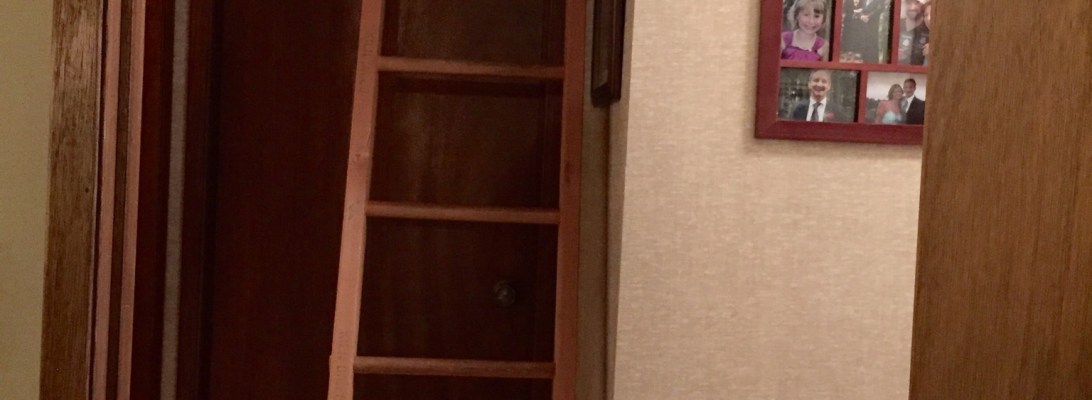
The ladder to the attic room.

I don’t know why my brain picked the day before Thanksgiving to go on an organizing spree. It needed to happen, though. Sofia’s box for too-small clothes was piled with enough clothes to fill more than another box of the same size. On the shelf in her closet, Niko’s too-small clothes were threatening to topple down onto the floor (I keep them in Sofia’s room so that Niko doesn’t have a panic attack when he can’t have the clothes). I had maternity and too-big nursing tops cluttering the floor in our closet. And I was pretty sure that there was a tub of clothes in our tiny attic room that should fit my amazing shrinking body by now. The job needed to be done, and today was the day the clutter suddenly became more than I could handle.

While Niko was at preschool, I leaned the ladder against the wall and started carrying up tubs of baby clothes from the garage. When we moved to Oregon, I’d been pregnant with Sofia, and we didn’t yet know her gender. So most of Niko’s baby clothes had made the trip with us. My plan was to use the little attic room to sort all the baby clothes into boy/girl and summer/winter so I could take a load to the nearest Kid to Kid, a store that buys used baby and children’s clothing and resells it at extremely reasonable prices. I’ve been passing Niko’s bigger clothes on to a friend whose little boy wears clothes a year or two behind Niko’s sizes, but they don’t need the baby clothes. Time for the clothes — and me —  to move on.

After lunch, Niko and Sofie napped while I carried up the rest of the clothes. That is, Niko continued to nap while Sofia woke up. After determining that she wasn’t going back to sleep, I carried her up the ladder with me. There’s no barrier around the opening to the attic, so I dropped the rectangle of sheetrock back down over the opening. It dropped a little lower than I was expecting, but that didn’t worry me too much; I had other things on my mind. I busily rearranged boxes, moved clothes from their temporary home in a laundry basket into a more permanent box, and tried on old clothes, while Sofia explored her new surroundings.

The feeling of having pre-baby…pre-FIRST-baby… clothes from five years ago slide comfortably back onto my body was enough to make me dance. I was pretty pleased with myself. Here I was, getting ready to contribute to a community of thrifty clothing-swapping families, making a little money on the side. My old clothes fit again. Downstairs, a nice box of clothes was ready to give to a friend. I was so organized. So thrifty. So… Hmmmm. Where was my phone? Shouldn’t I be photographing all this thrift and organization? For that matter, was Niko REALLY still sleeping, or could I just not hear him? Maybe it was time to go back downstairs, find my phone, confirm the continuation of the nap, and then finish organizing.

I reached for the sheetrock.

Oh.

Well, that was inconvenient.

The rectangle fit perfectly into the opening. This was not a problem when coming up the ladder; I could just give it a push and lift it out of the way. Getting out? Well, that was a problem. There were no finger-sized gaps. I tried prying at it with an old driver’s license. The license bent; the sheetrock didn’t budge.

I began analyzing our survival chances. No window up here; pretty warm and stuffy. We wouldn’t burn through the oxygen, though, would we? Surely there must be some ventilation somewhere? I hadn’t brought up any water. I could nurse Sofie…but only for so long, without water. I knocked tentatively on the sheetrock. Aaron was home, but probably not in hearing range. How long before he came looking for us? I knocked louder. Sofia stared expectantly at me.

I decided to think a little more proactively. Aaron had no way of knowing we were stuck. I needed to get that sheetrock up myself. What I needed was not something to pry, but a hook. Surely, in this still-cluttered room, there must be something usable. Something…like…Of course! A hanger! I grabbed a hanger with a metal hook from a nearby box, stuck the hook into the slim crack, gave it a half turn, and lifted. The sheetrock rose as if it and the hanger had been practicing this routine for years. And there, looking up, was Aaron’s puzzled face. “Did you lock yourself in?” he inquired.

The whole ordeal took maybe two minutes. All I can say is, thank goodness for clutter in the right place at the right time, and for a husband who notices when his wife is missing — though I’m pretty proud of rescuing myself this time.

C’est La Vie…

All summer I’ve been bemoaning my lack of cooking space. Our home was built in 1979, and it still has the original appliances. The sink in the master bathroom has some accessories dated 1985, so I’m not sure of the exact date of the JennAir range, but it’s probably between thirty and thirty-five years old. Possibly older than I am, if anyone was wondering.  And it has two burners. They’re set pretty close together, too, so using the big pressure canner is challenging — the canner overlaps the second burner, so I always worry that the food I’m heating prior to canning won’t cook evenly. It also has a griddle above an odd-looking heating element. The griddle can be switched out for a pair of grills, which I have assumed are intended for using to cook meat. I’ve never used them because we have a nice barbecue of which Aaron is very proud, and even on chilly days it’s not a big deal to fire it up and cook on it.

A JennAir range. Not mine. Mine is too grimy.
A JennAir range. Not mine. Mine is too grimy to be featured in its own post.

This weekend, Aaron’s aunt and uncle were in the area and stopped by for a quick overnight visit. “In the area and stopped by” is Alaskaspeak for “They were in Seattle and thought they’d drive three hours to see us.” In Alaska, three hours isn’t an unusually long drive, though it’s long enough that we were grateful and delighted they’d thought of us. It turns out that Aaron’s aunt had once had a JennAir range of her own. I told her how difficult I was finding it to work with only two crowded burners, and she said, surprised, “But there are two more burners.”

I think my response was a highly articulate “Huh?”

She went on to explain that the heating elements across from the burners were designed to heat pots, too. You just put the sturdy grills on instead of the griddle, and away you go.

I hadn’t had a clue. I’ll admit I had thought of it, in the irritation of trying to heat a pot that was only resting 2/3 of its bottom on its heating element, but I dismissed it as a silly and impractical idea. I still can’t believe I never looked it up online — or asked my mother-in-law, who has also used one of these ranges. But there it is. A whole summer’s worth of struggle, ended in one brief conversation.

Ah, well. C’est la vie — that’s life. There’s always next summer.

Small note: The photographs you see on my blog are generally my own, with the exception of my post “Remembering…Drying Fruit,” which features a stock photo of a sales model of a cast-iron range and an ad for an wringer washing machine. For this post, rather than photograph my own range (which needs to be cleaned with more elbow grease than I currently have available), I also used a photo of an identical range that I found online. Salvaging my pride, one tiny step at a time. Sorry.