Is Sharing Fair?

There’s been an opinion piece from the Scary Mommy blog floating around the interwebs recently, entitled “9 Reasons Why I Won’t Make My Kids Share,” by Joelle Wisler. I’ve seen it several times, and it’s irked me from the beginning. Each rereading (yes, I’m a compulsive reader, so I’ve read it at least four times now) causes my ire to grow. I have several reasons for being irritated by this mom’s description of what sharing means and why she wants nothing to do with it.

First, Ms. Wisler opens her piece with this analogy:

You have just settled yourself down at your favorite coffee shop with a hot drink and you open up your laptop. A stranger walks up to you and says,

“Hey, let me have a turn on that thing.”

You say, “Um, no. This is MY laptop.”

He says, “No fair! It’s my turn!”

And then he goes and tells on you to the barista. The barista comes over and says, “OK, I think you’ve had enough time on the laptop. It’s time to give your friend a turn.”

And then she takes your laptop away from you. That’s crazy, right?

But, you see, that isn’t sharing. That’s a very strange case of enabled entitlement. Her analogy sounds crazy because it is crazy. If your child takes his personal Etch-a-Sketch to the playground and sits quietly on a bench using it, nobody expects him to hand it over to some other kid — because it belongs to him. It’s not public or common property. But here are some real-life examples of when an adult might, in fact, be expected to share.

  1. You settled down at your favorite cafe and plugged your laptop in to the one available outlet an hour ago. Another customer, who’s also using a laptop and has been unplugged for 45 minutes, politely asks if he can have a turn with the outlet. You are a decent human being, so you quickly unplug your cord as you apologize for monopolizing it.
  2. You’re at your local gym. Your favorite piece of weight equipment for toning your abs just happens to be the only one of its type in the place. In the zone, you pound out set after set until your vision blurs, but suddenly you’re interrupted by a polite voice saying, “Are you almost finished here? A few other members were hoping to use this.” Because you learned manners as a child, you feel embarrassed as you realize you’ve used it for fifteen minutes, and you apologize to the waiting gym members as you quickly vacate the seat.
  3. On a lovely sunny day, you visit a local park. You see a bench in the perfect spot to bask in the solar glow, so you stretch out with a contented sigh. A few minutes later, a shadow falls across your face, and you open your eyes to behold a hugely pregnant woman with her elderly grandfather leaning on her shoulder, both out for a summer afternoon’s stroll. Since you’re a considerate soul, you quickly sit up and offer a friendly smile, in case the duo wishes to take a short rest in the course of their perambulation.

Ms. Wisler’s #4 point was just as odd. It literally made my jaw drop — I mean, my mouth opened and shut as I tried to form words, but all that came out was “Whaaaaaa?” She says,

It’s weird. Sharing is weird. As adults, do we share our cars? Our ottomans? Our husbands? Last I checked, I wasn’t a sister wife.

But…but…YES WE DO! We do share all of those things, routinely, without even thinking about it. What kind of  alternate universe is she inhabiting? I share my car with my husband, both my kids, and any assortment of friends or family who might be present and requiring transportation or companionship. If I had an ottoman, of course I’d share it. My family and visitors would use it if sitting in a chair near it. In fact, I might even use it at the same time as someone else, since my son has an odd habit of climbing onto my legs and lying down on them every time I put my feet up. Yes, I would share my ottoman without hesitation. And my husband? Well, first of all, though I’m married to him, my husband isn’t my possession. But I do share him. Besides being my husband, he’s also the father of my two children, the son of his parents, the brother of his siblings, the colleague of his co-workers. He has numerous other relationships. I don’t get him all to myself. Wanting him to spend all of his time with only me would be a sign of a dangerous level of codependency.

Number 5 and number 9 just solidified my belief that Ms. Wisler is approaching this issue from a perspective vastly different from that of most socialized humans. She says,

I’m not interested in fair. Contrary to popular belief in the grade school set, life actually ISN’T fair. And it won’t ever be. Good luck out there, little people. Yes, that kid has had the toy for longer than you. That’s rough, but I think you’ll make it through.

And,

Maybe if children learn that they can’t have everything they want right when they want it, there will be a lot nicer people growing up in the world. You know, people who don’t throw a temper tantrum at every little provocation…

But, you see, fairness actually is important. Regularly making the attempt to act with fairness (or, better yet, kindness) is what makes society run smoothly and pleasantly. Childhood is the ideal time to learn to take the feelings, needs, and desires of others into account.

No, life isn’t always fair, but you can be. Fair means if there’s one available swing on the playground, you use it for a reasonable amount of time. Fair means taking turns, or figuring out a way to play together. And no, fair doesn’t mean having what you want right when you want it. You might need to wait. But should my child miss out on using that swing altogether because your child refuses to give it up for half an hour, despite the growing crowd of disappointed kids who all hoped to play on it?

As an adult, sharing fairly includes returning those library books when you’re done, or leaving the extra-wide parking space near the entrance for people in wheelchairs. Just because the book is in your possession doesn’t mean you get to keep it for the rest of your life; just because you don’t feel like walking doesn’t mean you should make the store inaccessible for those who need maneuvering space.

Learning to share as a child makes you more bearable as an adult. It makes the world more pleasant. It helps to ensure that limited resources continue to be available. Learning to share will not damage a child’s psyche. True, life isn’t always fair. I think most of us agree, though, that attempting fairness whenever possible will help us all enjoy this world a little more.IMG_3229.JPG

Worried About the Avocado

Glancing down at a questionnaire Niko’s doctor had handed me on the way out of the office today, one item stood out: Frequently worried or afraid. I was supposed to select the degree to which the description might be true: Not at all; Somewhat; A lot, or some similar scale. I sighed as I checked off A lot.

Worried or fearful aren’t words the average observer might immediately think of as descriptors for my ebullient son. He is curious about absolutely everything, full of questions about life, death, dinosaurs, the solar system, you name it. His questions are thoughtfully designed to extract every possible drop of knowledge from the mind of his conversational partner. Nothing makes him happier than learning that Deinonychus’s teeth were sharp as steak knives, or North American porcupines have barbed quills.

But give him two minutes of silence in the car, or the peaceful quiet of his bed at night, and his mind begins roiling with the ramifications of all these facts. Will a porcupine’s quills HURT us? But why? It’s not nice to hurt people. Why did that bird die? Will I die? When? Will you still love me if I die… or if you die?

Tonight, nearly two hours had passed after putting Niko to bed…after hugs, kisses, cuddles, reassurances, tucking in yet again, soothing the panic of the realization Stuffy had been left in the car, rescuing Stuffy, more hugs, more kisses, ditto for Stuffy too… After all that, I was thinking yearningly of my own bed when I heard a small, anxious
voice. “Moommmmmmyyyyyy!”

I opened his door. “What’s wrong?”

“I need you. I really really neeeeeeed you.”

Usually I can withstand even the most heartfelt neeeeeed, but this one sounded more urgent than usual. I climbed onto his bed and cuddled beside him, any hope for an early night vanishing. “Why do you need me?”

We talked about loneliness, about how far away Mom seemed at night. I reminded him that really I was very close, just a few steps away, and showed him how close his sister was, too — just right next to him, on the other side of the wall. He seemed to relax for a moment, and then in a rush the real problem came out.

“When I was brushing my teeth in the bathroom” — and here his voice wobbled, grew thick with tears — “I almost started to cry.”

“Why did you almost cry?”

“I didn’t want to go to school tomorrow. I was just nervous.”

“What part of school made you feel nervous?”

“Dramatic play. I was worried about dramatic play.”

Dramatic play is not typically a concern for Niko. He loves costumes, always has, and this winter, after a huge amount of effort from his preschool teacher, he had a breakthrough: he discovered his imagination and the joy of pretending. His excessively literalist tendencies make those ventures into make-believe all the more delight-filled. And he often mentions the dramatic play center as one of his favorites. So it was with growing puzzlement that I dutifully asked, “Why were you worried about dramatic play?”

“It’s the wooden food. I’m worried about the avocado.”

Don’t laugh don’t laugh don’t laugh… “The…the avocado
is worrying you?”

“I just don’t want to eat it. I really don’t like avocados.”

Avocados. This child was lying awake for two hours worrying about the possibility that he might have to pretend to eat a wooden avocado. TWO HOURS. It turns out that it was a social dilemma: he wanted to participate and be a server, but what if — oh, the horror! — what if someone asked for the avocado? “If someone else asks for the avocado, you don’t have to eat it, do you?” I pointed out. Not that simple, of course: what if they offered him a bite? “It’s pretend. So you just pretend to eat it, and pretend you like it. Or you say no thank you. Or you take a pretend bite and say it’s not your favorite and you’d rather try a, a, a tomato.” Problem solved. Whew! After two…well, now almost three…hours of obsessing over a toy avocado, his mind was finally peaceful enough to sleep.

Yes, if a toy avocado can cause such havoc, I think it’s safe for me to check off “A lot” beside Frequently worried. Lying awake for three hours, pondering the social implications of pretend serving a toy food he himself does not care for…
What a boy.
IMG_3090.JPG

Waiting So Long

It was a routine Wednesday morning drive to preschool. I kept my eyes on the road, fielding happy chatter from the back seat while listening to our special “Wake Up” playlist, carefully crafted to appeal to Mom, Dad, and Niko.

As I slowed to pass the big high school on our route, Niko asked, “Did you go to this school when you were a little girl?”

“No, I didn’t live here then.”

“Where did you live?”

“I lived in Canada, with Meemaw and Grandpa.” He knows this, but I guess he likes to hear it repeatedly.

“But were you still my mommy?”

I had to think a moment. In a four-year-old’s mind, past, present, and future are not separated as clearly as in an adult mind. Finally I explained, “I wasn’t your mommy yet because you weren’t born yet.”

To my astonishment, the long pause that followed ended with an anguished wail. “What’s wrong?” I asked him.

“Why weren’t you my mommy yet? I really wanted a mommy! I needed you! I missed you when I was so little I wasn’t borned yet! Why did I have to wait so long to get a mommy?”

Um. Hmmmm. Okay.

Sometimes I wish I could just open up that boy’s mind and take a good look around in there.

[Photo by Garrett Beatty of Nuro Photography.]

Malapanis-19.jpg

Suzy, My Love

Lately, the kids and  I have been going for an occasional walk down the road to the field in which Niko’s favorite cow, Suzy, lives. Of course, Suzy isn’t her name. That is to say, it easily could be, but as far as I know, the cow was nameless before we encountered her.

It was Christmas, and Aaron’s parents were here for a visit. We’d walked down that road for the first time that day. It’s a winding country road with no shoulder, and until that day I’d never walked it in the eight months we’d lived here. Despite the lack of paved shoulder space it turned out to be a pleasant walk. We walked about half a mile, until we ended up next to a pasture with three young heifers.

Niko started life as a city boy, and he’s been a bit unsure about cows, especially since last summer when a  startled young steer trampled a barbed wire fence and got stranded in our yard. Frightened by its unfamiliar environment, made anxious by its separation from its buddy on the other side of the fence, and in pain from a barbed-wire gash, the steer abandoned its formerly gentle nature and gave way to panic. It marauded about, lowering and shaking its head, pawing the ground,  trampling the grape vine, devouring the lettuce, and bellowing. Neighbors and the animal’s owners helped return it to its field, but after that Niko was a bit nervous about our bovine neighbors.

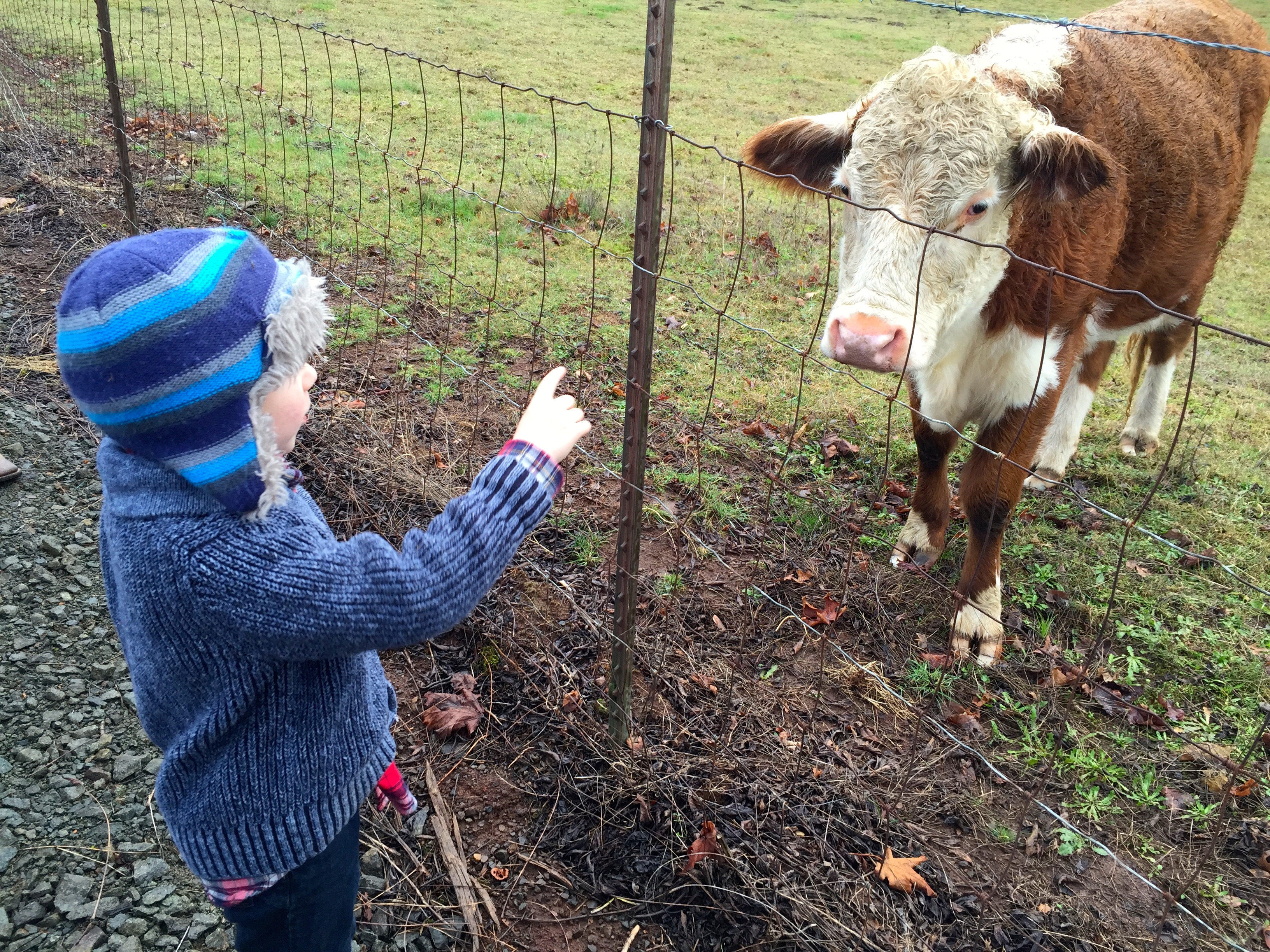
But in this new field there was a small, pretty, brown-and-white cow with gentle eyes. Niko’s eyes widened as he looked at her. He stared long and hard. Then, with no precedent at all that I know of, he lifted his hands to his mouth and began to moo. To our astonishment, that little cow lifted her head, uttered a long moo in return, and walked directly to him.

Of course, then he didn’t know what to do. Even a young heifer is pretty big next to a four-year-old, and despite his pleasure at her response, he was a bit intimidated. His grandma, Kay, tried to encourage him to stroke her nose through the fence, but the slime streaming from it was a bit of a deterrent. Still, love is not love which alters when it alteration finds, and despite Niko’s disgust, he clearly loved this cow. His eyes rested on her with adoration, and it took some convincing to get him to leave her when the time came to walk home. She was distraught as well, stretching her neck out and mooing as we walked away. “Goodbye, Suzy!” called Kay, and Niko echoed, “Bye, Suzy!”

Almost convinced to pet her nose. Not quite.

Now, every time we drive by that field, Niko waves to Suzy, and each time we walk that way, she ambles over to greet us. Niko still avoids the slimy nose, but still gazes adoringly at her. And every time, we call, “Goodbye, Suzy!” as we leave.

It’s nice to have a friend, even of the bovine ilk.

Revenge Is Scary!

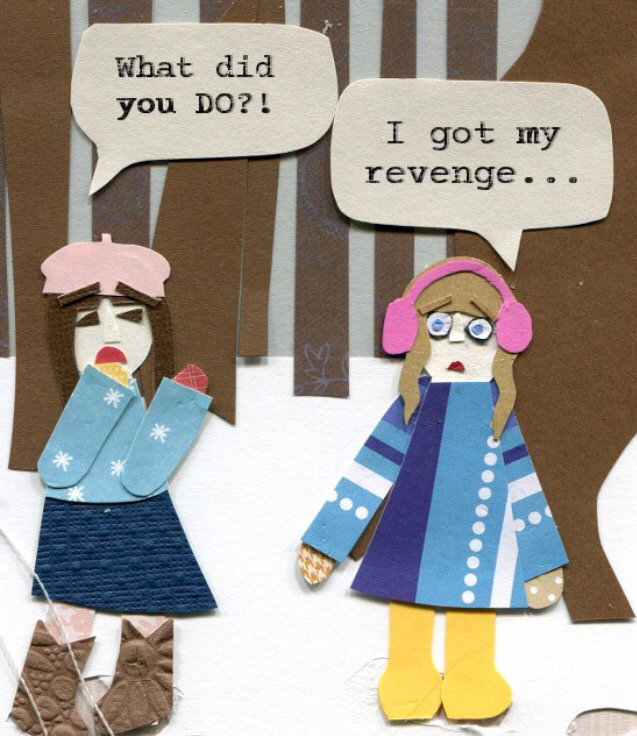
I’ve been following this blogger for a little while, and I absolutely love her sense of humor as well as her skill with a pair of scissors! She uses cut paper to create gently humorous comic strips, usually featuring her daughters. This one made me chuckle. Revenge can be scary…especially when you have sisters. Click here to see the whole story.

IMG_2355-3.PNG

My Father’s Hands

Sofia’s hair has recently become long enough for tiny pigtails and dainty barrettes. It’s wildly curly and needs to be thoroughly wetted in the morning so that it transforms from a crazy collection of fluffy cowlicks to an adorable set of tightly curled ringlets all over her head. I love combing it and watching the curls bounce into place.

A couple of days ago, I came across a little tangle in her hair. Tugging to get it out, I lost control of the comb, and it slid down across her ear. She flinched away, of course, and I chuckled. I couldn’t help laughing — I’d suddenly remembered my own experiences with ear-combing.

When I was four, my parents, residents of a Christian commune in Northwestern Ontario, decided to join another family who’d recently moved to a trapline in Northern British Columbia. It was a remote, beautiful place next to the Stikine River. Our family lived in a tiny cabin right next to the river, and we used the larger cabin up the hill as communal headquarters as well as living space for the other family.

Back on the commune, making breakfast was a chore shared by all the women in turn. Around the time we left, the population of the commune was about 200, so there would have been somewhere between 20 and 50 adult women to shoulder that task. On their mornings to cook, they would get up early, tiptoe out of their individual family homes (or dormitory, if they were single back then), and go to the main building to prepare the meal, which was served at seven. With so many women sharing the job, each woman only had to make breakfast once every couple of weeks. But on the trapline, there were only two women, so my mother would leave the house early about every other day, leaving my dad to get my brother and me ready for the day.

My dad is a gentle, creative man with craftsman’s hands. Those hands can achieve just about anything. Chopping down trees, smoothing the bark off the logs, building them into a shop. Creating his own lathe inside that shop, spinning wood on the lathe into delicate shapes: handles, round picture frames, jewelry boxes, a family of dolls for me. Those hands could sketch wildflowers, create an embroidery pattern, and make delicate stitches on fabric. They can execute a skilled pen-and-ink drawing, form a silly comic, make a detailed charcoal scene. His hands can coax music out of any instrument he picks up — a guitar, a recorder, a banjo. He made his own fiddle, mandolin, dulcimer. Truly, my father’s hands can do anything. Anything except comb a four-year-old’s hair without combing over her ears.

It would start off well. He’d ask my mom for pointers. She’d show him how to hold the hair in one hand, combing tangles out of the ends first, working upward. He’d try so hard to be gentle, starting on one side, successfully avoiding the first ear, working around to the other. We’d be almost done. I’d finally relax, positive that this time my ear would be safe. And then, RIP! The comb’s teeth would scrape over my sensitive ear, I’d wail, and he’d slump in defeat.

The rare times that my dad would manage to get all the way through my hair without combing my ear, he’d succumb to an even worse pitfall. Just above my ear on the right side of my head, hidden under my hair, is a wen. It’s a bump that used to be small, before it was built up with all the scar tissue from having its top ripped off with a comb, over and over. My dad would be so focused on avoiding my ears that he’d forget about the wen. The comb’s teeth would catch the top and rip off the fragile skin. Blood would seep out, matting my hair. We’d arrive at breakfast with one side of my hair still bedtime-fuzzy, stuck together with blood, and my mother would sigh and shake her head. And then for days I’d flinch anytime a comb came close to me, because while combing my ear was painful, combing the top off the wen was agonizing.

It’s funny, though. Having my hair combed by my dad hurt back then, but now, that sudden memory is heartwarming. I’m so glad that I have the memory of my father’s strong hands cradling my head, working a comb through my hair, making my hair shine despite the awkwardness that came from the unaccustomed task. And now it’s my turn to do the same for my daughter, feeling her baby hair spiral around my fingers, finding tricks to get her head in the right position, gently easing tangles out, and remembering how hard my father tried to be just as gentle with me as I try to be with my own little girl.

“White Couch Feeding”

Every now and then something comes along that’s too good not to share. Today my aunt, the mother of six children who are nearly all grown now, shared this delightful collection of ridiculously serene stock family photos that have been realistically captioned by moms. My aunt had a good laugh at it and then shared it with me, remembering that I’m in the middle of parenting my own rambunctious kidlets (though I doubt I’ll ever be able to match her collection of six of them).

My favorite captions:

You were right! Ever since we started White Couch Feeding with Emmett, he’s been eating like a champ.

And this one: IMG_2317.PNG

Click here to see the whole collection.

Sweet Funny Valentine

At four years old, Niko’s understanding of “Valentimes” Day is pretty sketchy. “Why is there an arrow in that heart?” he demands. I tell him that there’s a story about someone named Cupid who had a special arrow that he would shoot into people, making them love each other. “But that’s not nice. He shouldn’t shoot people. That hurts.” I explain that it’s a SPECIAL arrow that doesn’t hurt. He’s not convinced. “He shouldn’t hurt people,” he insists.

He feels a certain sense of power, I can tell, selecting Valentine cards for first his classmates, his teachers, then a few family members. He takes the responsibility very seriously, pondering each choice as if it will change lives around the world and through all of history. I have to practice my slow breathing in order to keep myself from ripping the cards from his hands and snarling, “Just let me do it!” I know my impulse is wrong. Bad mom. But I do let him make his choices despite my impatience, so there’s that.

I never experienced this holiday as a child, though I do remember looking forward to February because of the bags of cinnamon hearts you could buy. I grew up in a Christian commune, part of a group known as the Move which held as a minor part of its flexible, ever-shifting doctrine the concept that holiday celebrations were worldly and sometimes pagan and ought to be avoided if one wished to truly dedicate oneself to God. Valentine’s wasn’t actively frowned upon like Christmas and (Lord preserve us) Halloween, but neither was it encouraged or promoted in any way when I was a child. So I never decorated Valentine shoeboxes or prepared cards for an entire class or fretted over whether I, too, would receive candy and cards from friends. I don’t feel I missed anything, particularly — but it’s one more point of connection with my son that’s missing. It’s not an essential one, but sometimes I wonder how many of these disconnected experiences can build up before we have so little in common that we can’t communicate. A silly worry, maybe, but it’s there.

This anxious thought buzzes around in my head, along with Are these cards too big for the shoeboxes? Will other families send candy, or will we be the Bad Parents handing out sugar? Will Niko be able to stay calm during a classroom celebration?  and Did I remember to turn off the oven? as Niko painstakingly scrawls his name in each card. I can never think about just one thing, never truly focus on the task at hand — always my mind is busy with many ideas, questions, worries, plans, all bouncing in different directions until I simply can’t continue. Partly ADHD, partly motherhood, I guess. Luckily, I’m working with a four-year-old, and our attention spans run out at about the same time. We put the stack of cards carefully aside while he colors in another card and I help his baby sister hold a crayon on a piece of scrap paper. He peppers me with questions. “Why do we love each other on Valentimes? Is today Valentimes? Will it always be Valentimes? Can I make a card for you? I want a card that says Niko.”

I try to explain that yes, ValentiNNe’s Day (stress on the NNNNNN as a tactful pronunciation correction…) is a special day for loving each other, but really we always love each other, and that he will have lots and lots of cards that say Niko once all his classmates bring their cards to school. He isn’t entirely convinced, but he’s enjoying writing the cards, so he accepts this for now.

After school Wednesday, the day of his class’s Valentine celebration, his face shines with the aura of a child who’s had an excellent time. On his head is a red heart-festooned headband, with heart-tipped antennae bobbing on the front.He didn’t make it; he wasn’t feeling especially participatory, but he wanted to wear one, and a kind friend made one for him. He touches it carefully, with pride, telling me about his antennae that he can smell with, pointing out the heart cutouts, adjusting it on his head. Then he shows me his little mailbox, crammed full of tiny cards. His face reflects his amazement. “Look at all my cards!” His amazement grows when we open them at home, and he discovers that some of them have special treats: a deconstructable little hamburger, a Spiderman and a heart eraser, sticky gel clings, a lollipop.

My love bug
My love bug

Clearly, this holiday is going to be a favorite. Love, arrows, antennae, candy…how much better can a day get? I don’t miss celebrating it when I was little, but at the same time, I’m glad I get the chance to see the pleasure on my son’s face as he looks over his little cards and gifts, evidence that another child was thinking about him, too.

Happy almost-Valentine’s Day!

Hugging a Butterfly

Today a friend shared a link to an article on the Scary Mommy website, on my Facebook page. I read it with tears in my eyes. The author writes about the slow process of realizing their son had needs that weren’t being met; diagnosing him with ADHD; and, finally, reluctantly, starting medication for him. His reaction after his first day of medication was what made me tear up. This is what his mom wrote:

For the first time in … well, maybe his entire life, Colin seemed truly relaxed. But not in a stoned, disconnected way; more like a relieved way. Like someone who has finally been unburdened from the baggage that has unfairly saddled them for so long.

“I feel so much better, Mom,” he told me. “Why couldn’t we have done this from the start?”

His reaction was very much what my own feeling was, when I started ADHD medication. Relieved. Unburdened. And so much better. Why did I wait so long to admit I needed help? Pride, fear, and inability to see clearly and objectively from the haze of my condition. Medication isn’t for everyone with ADHD, but this story struck home to me. Beautiful.

– See more at: http://www.scarymommy.com/hugging-a-butterfly/#sthash.ZCAANp23.dpuf