A Novel Idea

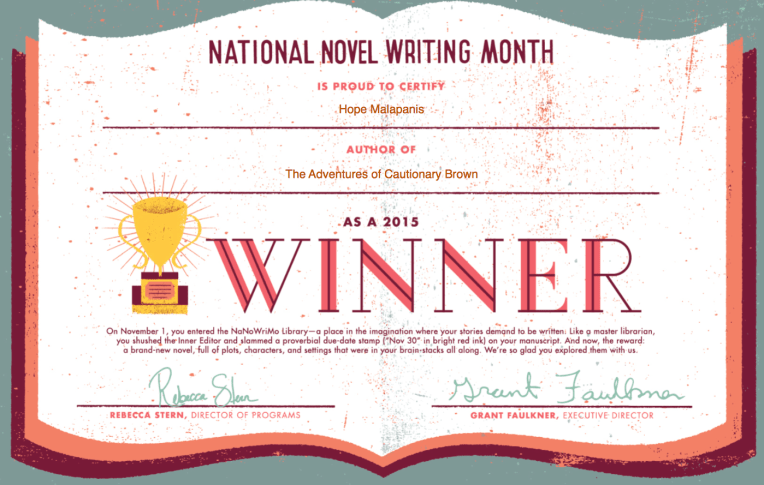
Screenshot 2015-11-30 21.49.54.pngNaNoWriMo. Heard of it? No? Let me enlighten you. The month of November is designated National Novel Writing Month (though, in fact, it’s an international endeavor). There is an organization dedicated to NaNoWriMo. They recruit published authors, professors, publishing venues, text editing programs, et cetera, and employ them via their web site (NaNoWriMo.org) to encourage YOU, the average literature-loving human with a secret desire to write, in your quest to complete a novel. The goal is to complete 50,000 words of your novel during the month of November.

Last year was the first time I took an interest in the idea. I’d heard of it the previous year, I think, but dismissed it. A novel in a month? I thought. Insane. There’s no way I could do that. 

By last year, I had shifted in my mindset. I now found the idea tantalizing. I probably had a book in me somewhere, I realized. After all, I’d been threatening to write a book for years; surely I could translate some of that energy into some sort of book. I tossed a few ideas around tentatively. But by the time I realized NaNoWriMo had rolled around again, the month was half gone and I had yet to even begin writing. I abandoned it before I had even started.

This year was different. I was plagued by the awareness that I hadn’t yet finished a photo story book I’ve been making for Niko, entitled Niko Picks Raspberries, starring (obviously) Niko himself. I had planned it for Christmas last year — didn’t finish it. Thought I’d do it in time for his birthday this year — didn’t get it done. As I tried to buckle down and finish this little story for Niko, I got to thinking — there is a wealth of story potential in that boy. What if I turned him into a book?

And then, the inciting moment. Mid-September or so,  I was editing a paper for Aaron, who is working on his master’s degree. He is excellent at researching and analyzing and synthesizing the material for a paper, but he doesn’t have as strong a grammar sense as I do. Recognizing my delight in editing, he kindly allows me to take over once the paper is written, editing to my heart’s content. For those of you who don’t personally know me, let me assure you that I actually mean this with no snark or irony. Editing relaxes me the way running on a treadmill works for other people. It brings me to my happy place.

One evening, I was proofreading a paper, making small adjustments using Word’s “Track Changes” option. I rarely even look at the citations, since I was taught to cite sources generally using MLA, while Aaron’s courses require APA formatting, and there’s a good chance I wouldn’t recognize a citation error even if he were to make one. On this particular day, though, I noted that a citation credited “Cautionary Brown, et al.” Huh, I thought. I didn’t think APA used first names. And then, Seriously? Cautionary? Impossible. I scanned nearby lines. Above was a similar citation for “Brown, et al.” On a line below, a reference to a cautionary example of… something, I don’t remember now. Aha. A simple typo. I fixed it and moved on.

Still, the name stuck with me. Cautionary Brown. It was the perfect name for a mischievous child in days of yore. I could just picture him. In fact, I could picture him doing many of the things Niko has done. For example, running through a patch of burr-covered weeds until his clothes were completely full of them, in order to help the plants spread their seeds. It occurred to me that a boy in 1890 wouldn’t be that different from a boy in 2015.

So a spark of inspiration was lit, and when the month of November arrived, I realized I’d never be able to forgive myself if I didn’t sit down to write Cautionary’s story.

Mind you, the story didn’t turn out quite how I expected. It moved itself to 1933 or thereabouts. Cautionary’s name will have to change — charming as it is (as I think it is, anyway), it simply doesn’t work for that time period (quite possibly not for any time period). Still, there it is. A brand-new story, created by me, and inspired — very appropriately — by a typographical error. And it came to be thanks to NaNoWriMo, which created a necessary illusion of an impending deadline and periodic goals.

It’s not done. Not by a long shot. I have perhaps 2/3 of the story actually written; the rest is rough outlines and half-written story ideas. Once the entire thing is complete, it will need a complete overhaul. It will need to be smoothed, connected, expanded, inconsistencies fixed. There’s a good chance entire sections will need to be rewritten to make it readable for my target age group. After that, the book will be about the length of three young-reader novels for that age group, so I’ll then need to work in introductions and conclusions for each section, and then ensure that each can stand alone as its own book. In short, reaching my 50,000 word goal, as tremendously satisfying and exhilarating as it is, is just the beginning. I’m not even close to finished.

But. But. But, I have written 50,000 words of a novel. And I like what I’ve written. I’m as proud and excited as a first-time pregnant mother, full of anticipation to show the world my beautiful baby. Full of terror, too, at the thought of the work that awaits me, at the thought of the process of getting the book ready to be viewed by others, at the idea of actually presenting it to a publisher. Which leads, naturally, to absolute terror at the thought of having my beautiful baby be rejected.

Want to see the cover? Of course you do. Here it is.FullSizeRender

I need hardly add that this is a working cover. I grabbed a free stock photo, added text using a phone app, and color-adjusted slightly. It’s not exactly a professionally-designed book cover. Still, it works for now.

So, there it is. This is what I’ve been doing all month. It’s occupied all my waking moments. When I wasn’t writing, I was thinking about writing. The story ran through my head as I strung Christmas lights, swept floors, washed dishes, supervised bath time. It pursued me through pulling weeds and planting fall bulbs. It kept me up late and occupied me when I should have been folding laundry. It has consumed me — and, I have no doubt, will continue to do so for some time. But at least now I can rest knowing I’ve met a pretty significant goal.

A Zombie Pie Thanksgiving

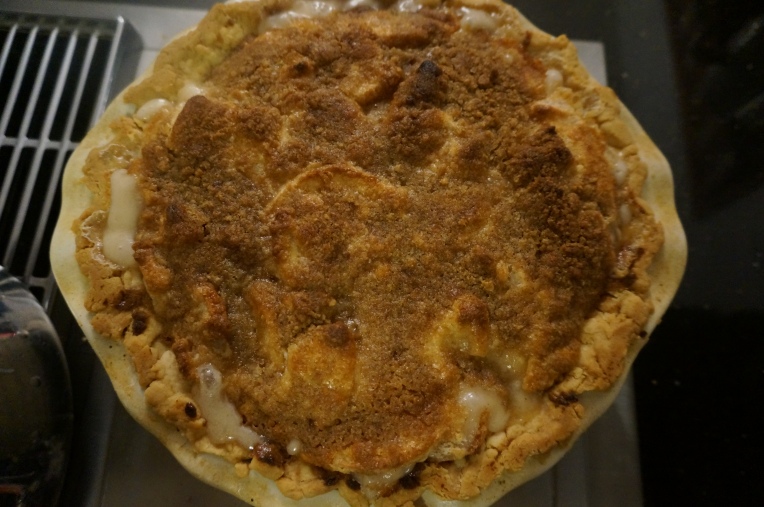
Today, the day before Thanksgiving, has been filled with dinner preparations. With our home already filled with the sparkle and glimmer of Christmas decorations, I’m in the holiday spirit. Fruitcake a la Alton Brown (our family’s kitchen god) rests on the counter, sealed into a bag, awaiting its next soaking with brandy. The turkey is soaking in a salty, herbed brine, Alton Brown’s cranberry jelly is setting up in the fridge, and this year’s pumpkin pie looks perfect.Well, nearly perfect. The blank surface is evidence that I lost track of time and forgot to add a pretty leaf-shaped pastry garnish.

This quiet day of cooking in an empty kitchen is a contrast to the busy Thanksgiving preparations of times past. Having just made a trip home last month to the commune where I grew up for an Ontario Thanksgiving, the difference stands out strongly in my mind. This year was the first time I’ve celebrated Thanksgiving with my Canadian family since I left home at the age of 18 to go to college.

My husband and our two small children and I took a two-leg flight from Portland, Oregon to Minneapolis, Minnesota, then drove up along the coast of Lake Superior to the three-farm commune where I grew up in Northwest Ontario. It was a long trip, especially the 45-minute flight from Portland to Seattle, which culminated in both children throwing up simultaneously as we descended after a turbulent journey through high winds.

By comparison, the four-hour flight to Minneapolis and the nine-hour drive up the coast the following day were blissful. The kids were cooperative and calm, the roads were clear of snow, the iPad fulfilled its role of providing soothing entertainment, and the scenery was breathtaking. Oh, and — no one threw up. The only drawback was that, as usual, we forgot to calculate how much longer everything takes with two small children, so we didn’t arrive at my parents’ house till 9:30 in the evening… their time… which was only 6:30 Portland time, so we weren’t as tired as we should have been.

Anyway, we arrived in the dark, and had a delightful pre-arrival welcome from a friend who was leaving the farm on her way home as we were pulling into the commune’s driveway. She recognized first an unfamiliar vehicle (the commune is part of a small town, the entire population of which — including the three communal farms — is about 300, so an unknown car is notable) and then our faces, and we slowed the vehicles to call a hello between cars. Pleased that she’d achieved the very first viewing of our family, she went on her way and we pulled on up the driveway, already feeling thoroughly welcomed.

As we stepped through the doorway of my parents’ home and into the living room, Niko skidded to a halt as his face lit up with an incandescent glow. “Awe…some!” he breathed. There, covering a good two cubic feet of the living room floor, was a magnificent tower of wooden blocks, consisting of all the blocks in the bin that my dad keeps on hand for just such occasions. Welcome complete.

The following morning was Thanksgiving, celebrated on the second Monday in October in Canada. We took the opportunity to zip over to another of the three farms, to see a cousin and her two children who were there just for the day. They would leave before the early holiday dinner, so we abandoned my mother and the other ladies of my home farm to dinner preparations and skedaddled off for a lightning-fast visit. Niko and Sofia were in seventh heaven, playing with cousins near their age, flinging just-raked leaves at each other, and exploring the brush near my aunt and uncle’s home. Other visits had to wait for another day, but we did manage to get in the essentials before we had to return to Oregon.


As we visited at my aunt and uncle’s home Thanksgiving morning, the phone rang — my mother, asking if I wanted pie crust made ahead for the pie I was planning to make later. Then again, asking how many apples I needed per pie. And one more time, asking if I wanted apples peeled and cut, and if so, should they be sliced or chopped? “At this rate,” I told my aunt, “the pie will be made by the time I get there, and I’ll just take credit for it!” The machinery of a communal kitchen runs smoothly, and with an abundance of cooks bustling about, I wouldn’t have been all that surprised if the pie had, in fact, been finished without my lifting a finger. As it turned out, the pie — a recipe I adapted from my mother-in-law’s amazing recipe — turned out to be the very ugliest pie I’ve ever made, so perhaps I should have left it to them.

I arrived in the farm kitchen after lunch and was cheerfully greeted by half a dozen busy women, all intent on one or two tasks, all moving easily around each other without friction. This is one of the things I really, truly miss — a communal kitchen. If you grew up in a large family with a big kitchen, you might know what I’m talking about. Cooking is a social activity, a companionable endeavor. It’s rare to cook alone for any significant amount of time. Someone is always wandering in to get a snack, check the mail, help out, or just say hello. If one person is in charge of dinner, likely someone else will be baking bread for the week, another person making cheese from fresh milk, and a fourth somebody putting on the coffee for everyone else.

Thanksgiving is no exception to this rule. People drifted in and out of the kitchen and dining room, sneaking samples of the feast, sharing stories, reminiscing, and, of course, drinking coffee. Women tossed cooking questions out to the group, each one triggering a rousing discussion as five different people offered opinions. As I helped wash up some of the cooking dishes, I overheard a discussion that is more or less a requisite at a farm Thanksgiving: creamy yam casserole with marshmallows, or without, or roasted? One young woman, a relative newcomer who married into the community, was preparing a marshmallow-free casserole that was traditional in her French-Canadian family, and the women were spiritedly voicing their own favorites, without rancor. “You know,” my mother said, “this kind of thing is really what makes this farm the best place. On other farms, people would argue about which one is best forever, and then they would take a vote and choose one to make, and only about a third of the population would really be happy about it. Here, we just make them all!” Sure enough, one of the other women was cutting large yams into manageable chunks for roasting, and I’m pretty sure I saw a bag of marshmallows somewhere.

Between helping with a few dishes and making my pies, I wandered the main house, taking pictures of items I’ve seen my whole life as well as the festive decorations. Here are a few of my favorites from a nostalgic stroll down memory lane:

And a few images of the autumn decor:


My priority was to make the apple pies. I used my own recipe, which makes delicious pie… that is, it has every other time before this. As I added ingredients, I found myself almost falling into a familiar rhythm. I’ll find spatulas here in this drawer — Hey! What happened to the spatulas? Oh, here they are. When did you change that? And sugar — aha! Right here in this giant bin where it’s always been. (I took a precautionary taste before adding it in. It wouldn’t have been the first time salt and sugar got confused.) A bit of flour — yes, right where I thought it would be. Cinnamon… nutmeg… vanilla? Didn’t the vanilla go here with the spices? “Are you looking for vanilla? I have it over here, sorry!” (The apology made me feel right at home. This is Canada, after all.)  And no,  the vanilla didn’t belong where I was looking for it…  those 15-plus-year-old memories can only do  so much.

It felt good, working with the women who taught me to cook, in the big familiar kitchen. My pleasure was somewhat tainted, however, by my observation that the pies’ filling was a little runny. And there was too much of it.  The pies were full, very full, even though I left out a couple of cups of filling, and they sloshed menacingly when they moved. What had gone wrong? No idea. There was nothing to do but to bake them off anyway. As the ovens were full with turkey and rolls, I carried them out of the big kitchen and down the hill to my parents’ little house, where I prudently placed them each on a flat pizza pan before baking them.

I’d like to pause here to point out that my reputation was on the line here. Did I mention that this was my own recipe? Published here, on this very blog? And that it had been nearly two decades since I had cooked for a farm gathering? Did I mention that everyone knew that I was the one baking these apple pies (no hiding in anonymity)? Have I pointed out that the aforesaid “everyone” also  knew that I was using a recipe I’d published on this blog, an endeavor that has been followed with mild interest by various members of the community? Oh yes, I was very conscious of the vulnerability of my reputation, as I slid the sloshing pies into my mother’s oven.

Forty-five minutes later, I cringingly opened the oven door. My fears had come true. Let me assure you: this was the ugliest pie known to cuisine. Never before have I seen, nor do I wish ever to see again, a pie this ugly. The crumb topping had been displaced by bubbling filling, and patches of it had slid off the pie onto the pizza pans underneath, and some had dripped off the pans and onto the oven floor. The weight of the sliding filling had broken the edges of the crisp and flaky crust, destroying any chance they had of looking like ordinary pies. With the missing patches of topping, the crumbled edges, and the bubbled-over filling, my pies looked like pastries that had died violently and then been returned to a semblance of life by a misguided cook. Undead pies. Zombie pies. They were horrific. I was so ashamed, I didn’t even take a picture. This is what they were supposed to look like, although even this pie’s crust could be prettier:Featured Image -- 823

(They didn’t look like that.)

I was writhing in humiliation as I carried the pies back up to the main house and deposited them with the oher desserts, every one of which was more attractive than my sad apple pies.  I tried to sneak them in, hoping everyone would forget who was responsible for them, but in vain: one of the ladies sitting in the big dining room, working her magic on flower arrangements with preserved leaves, called out as I entered, “Hope! Are those your delicious apple pies? I can’t wait to try them!” I felt like dumping them into the trash, but instead I dutifully thunked them down next to the butter tarts and chocolate roll and cherry pies awaiting dinner.  I can’t even begin to tell you how much I hated seeing my dilapitated desserts next to everyone else’s lovely food.

But the thing is, this was a family Thansgiving. Nobody cared, really, what those pies looked like. They were there to visit, laugh, fill up on turkey, munch on soft, freshly-baked rolls, and sample as many desserts as possible.  Sure, my pies weren’t the first to disappear. They may even have been the last to be devoured over the next few days of leftover feasting. But nevertheless, they did get eaten, and, despite their imperfect texture, they were delicious, especially eaten alongside the homemade maple ice cream that was served with dessert.

Those pies shredded my reputation, but my sense of belonging and family wasn’t hurt one iota. As I visited with folks I haven’t seen in years, watching them valiantly attack my soggy apple pie, I felt perfectly happy. It was good to be home.

Fuzzy Aliens

Recently, we made a trip to visit my Canadian family for Thanksgiving, which very sensibly takes place in early October rather than late November in Canada.

One afternoon while we were there, I took a familiar stroll with my parents and Niko down the gravel road that leads down a long hill to the Canadian Pacific railroad. The road and the railroad border the farm where I grew up, so I used to walk that way nearly every day, alone or with my cousins and our friends. We used to time our walks to coincide with the passing of a freight train. We’d wave to the engineer, who would wave back and sometimes give a couple of friendly hoots of the train’s whistle. Occasionally there would be a small boy (and one memorable time, a very hunky teenage boy) in the cab of the engine, and the little boy would lean out the window as he waved in his excitement at seeing friendly faces.

I was mildly disappointed that the train didn’t pass during our walk.  I had wanted to share with Niko the experience of watching and feeling a huge train thunder by, as I’d shared with him the memory of lying in bed, listening to the comforting lullaby of a routine train whistle. He thought it was amazing that I used to wake up in the middle of the night if the train didn’t pass at its usual time. My story relieved his bedtime anxiety of the fearsome train roaring past, but I wanted to also share the exhilaration of the nearness to the giant metal beast. We didn’t get to see that this time, though.

However, we did find something fascinating. As we walked down an old road that runs parallel to the railroad, we paused periodically to look at items of interest — purple asters, dainty white asters (probably some sort of fleabane, quite possibly Lesser Daisy Fleabane), the seed heads of black-eyed Susans. Niko occupied himself harvesting flower seeds to “plant” later.

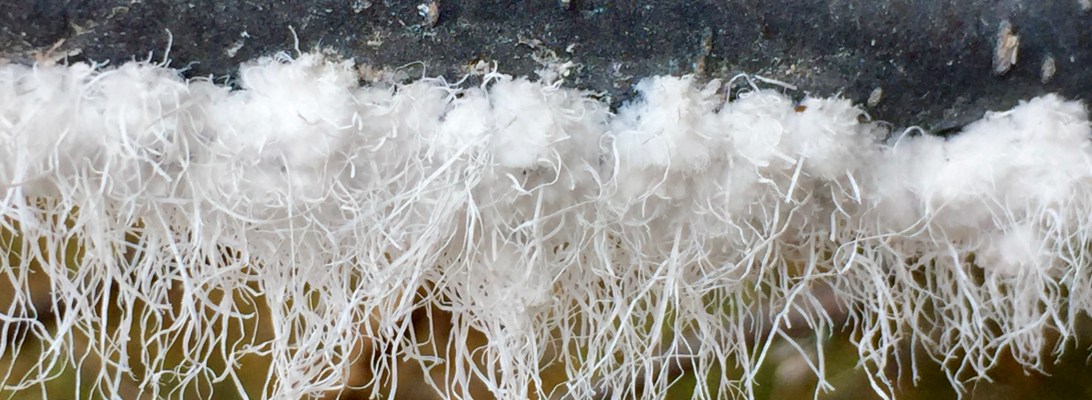
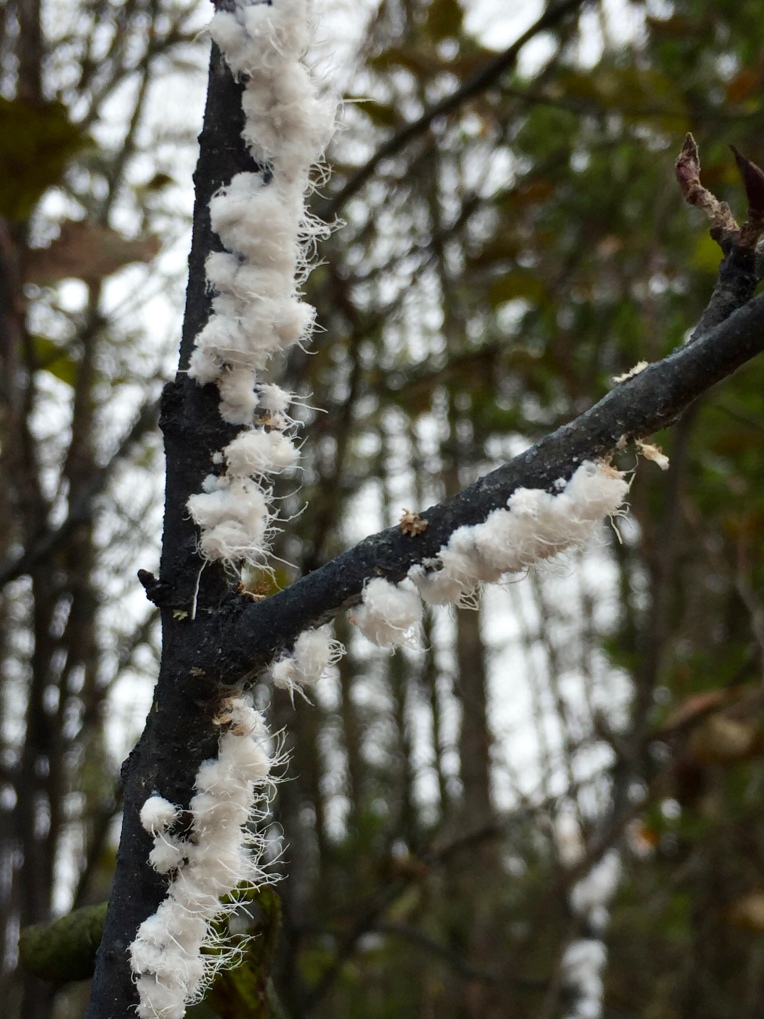
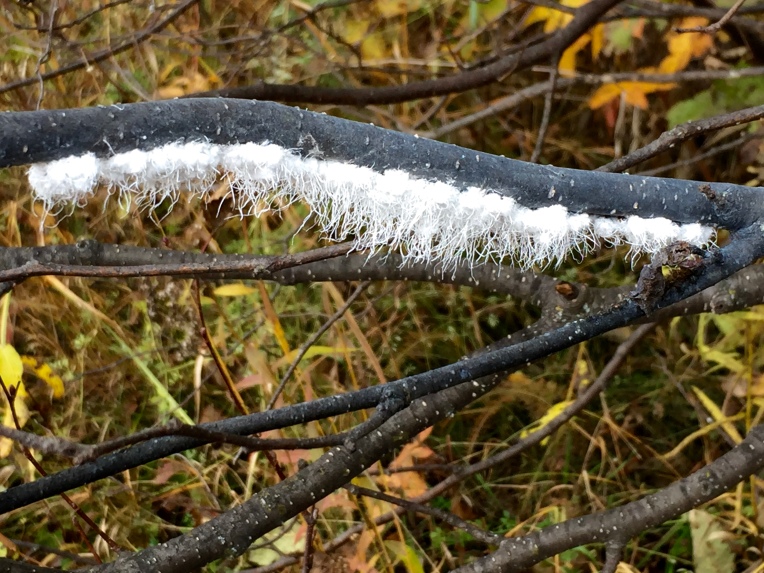
As we meandered along, I spied an odd, white, fuzzy growth on twigs of alders growing along the road. I waded through the brush beside the road to get a closer look. The growths were made up of rows of fuzzy bumps, each sprouting long hairs along its top. I’d never seen anything like it.

Mystery white growth

As I snapped pictures on my phone, my mother came over for a closer look. “They look like scale insects,” she said. I’d never heard of scale insects, and those motionless fluff balls didn’t look like any insects I’d ever seen. However, my mother is intelligent, well-read, and experienced in the realm of most things plant-related, so as soon as we got back to the house I started doing searches online to attempt to identify the weird, alien-looking hairy bumps.IMG_5873

It took my mother and I at least an hour to identify them. We started on the assumption that they were, in fact, some sort of scale insect, an assumption that made sense once I saw a few examples. But we didn’t find a scale insect that looked quite like our white hair balls.

I got a break when I read an article that mentioned the fact that aphids and scale insects were closely related. Aphids! I changed my search parameters and brought up images of hairy white aphids. Bingo! None of them were identical to our critters, but I felt I was getting closer.

I found an article on wooly apple aphids, with photos showing hairy white growths very similar — but not quite identical — to ours. Of course, ours weren’t on apple trees. It turns out, however, that these creatures often migrate between two species of tree, like apple and elm, or apples and alders. Alders! Aha! I thought, and did a search for wooly alder aphids. And there they were, in a very useful article from the University of Minnesota. They are, it turns out, overwintering on the twigs, and they’ll lay eggs that are clones of themselves. This generation is wingless; the next generation may have wings, and will migrate to a different tree, often alternating between alders and maples.

So there you have it. You learn something new every day, as my parents say — or at least you do if you keep your eyes open and maintain a little healthy curiosity. I doubt I’ll ever need this particular little piece of knowledge, but I enjoyed the discovery nonetheless.