I'm a temporarily staying-at-home mom of two living in Oregon, learning all over again (after 15 years of city life) how to garden, harvest, and put up food. You might see posts about baking, parenting, crafting, organization – anything that strikes my fancy!
This morning, I was delighted to see a small slithery creature, some sort of salamander — about the length of my hand from nose to tail tip — swimming in our tiny pond behind the house. This is the pond in which the goldfish carnage in November occurred, so not only was I pleased to see the mystery creature for its own sake, I was happy to see that the pond seems to be a healthy environment again.
Peeking out of the water
On the bottom of the pond
Slithery pond creature
After taking a few pictures, I started to worry that it wasn’t actually happy there. The pond has steep sides, and the water level is a little low, so it would be quite a climb to get out. It kept swimming to the edge and scrabbling at the sides with its tiny feet, but making no progress. I called Niko over so he could look at the creature, and then I reached in and lifted it out. I expected to have to chase it around, but it didn’t attempt to evade my hand. I set it gently down on a rock, where it sat and looked around. It ventured to the edge and peered over but didn’t try to climb down. So I lifted it again, and set it down in the garden. The salamander then proceeded to crawl back to the rocks at the edge of the pond, trying to fit through a far-too-small crevice. I gently directed it to a larger crevice, and it slithered through and rested there, looking down at the water. At this point Sofia realized she’d been abandoned in her bouncy seat, so I never got to see if the salamander decided to go back into the pond. I didn’t see it later when I looked, though. I suspect it was hiding among the rocks that make up the little waterfall.
Not satisfied with its rocky perch…
Contemplating the water.
Peeking through the rock.
Admiring the mysterious pond creature.
I spent far more time searching for an identification than I should have, but I still don’t know what kind of salamander this is. I’m pretty sure it is a salamander, not a newt (a rougher-skinned subgroup). But none of the salamanders I found pictures of quite matched. I found a couple that were the right color and size, but they all had wormy tails, not flat ribbon-like ones as this salamander does. Any ideas?
I love watching the birds that visit us as they eat, flutter, hop, and interact. Abiding by a policy of cautious tolerance, they mostly ignore each other: at the feeder that hangs at the edge of the porch, while dipping into the surface of our largest pond or making a crazy spray of water by beating their wings in the little waterfall, and as they stroll across the lawn in search of favorite snacks. Occasionally a big scrub jay or Steller’s jay will bully the little birds away from the feeder, and once a kingfisher swooped across the porch and scared everyone away. But usually the view from our kitchen window is peaceful.
Over the last month or so, we’ve had some new birds at our feeder and splashing in the pond. I was excited to see my old friend, the black-capped chickadee, whom I knew from living in more northerly places. I had thought that the presence of the chestnut-backed chickadee meant we were out of the black-capped chickadee’s range, but a month ago I glanced out my window, and there he was!
I love this cheerful little black-capped chickadee.
We also have a pair of varied thrushes. I thought at first they were two different types of birds, but ten minutes or so searching the Cornell Lab of Ornithology’s “All About Birds” site revealed that the bright orange male and the soft peach female are the same species. There’s also a robin in the (embarrassingly pixellated) picture with the female — they stayed all winter, but their numbers seem to be increasing over the last month, at least to my inexperienced and unscientific eye.
Female varied thrush taking a bath, with a robin perched in the background.
A more showy male varied thrush.
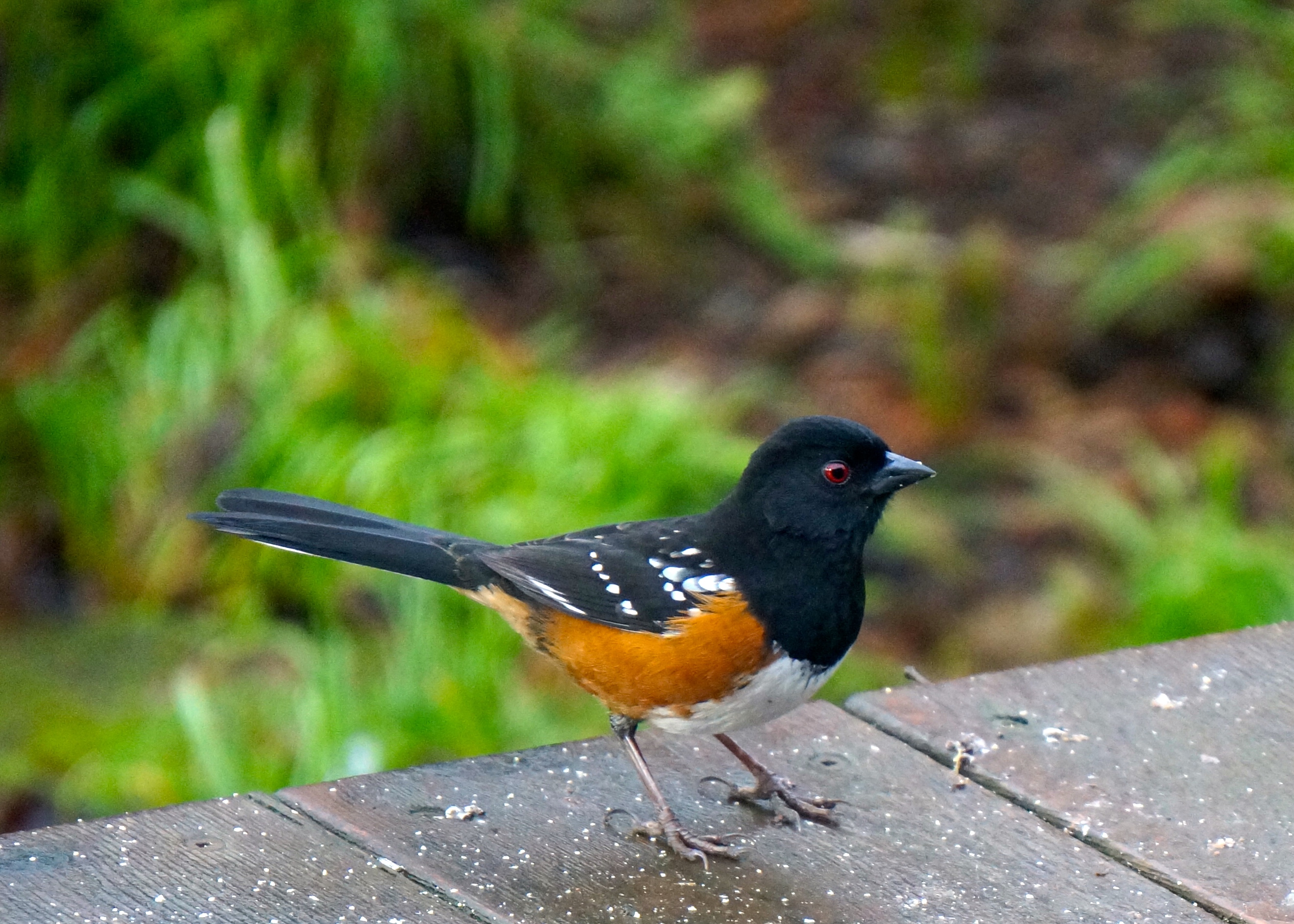
Another new feathered visitor, first seen about two months ago, is the spotted towhee. It’s an attractive bird with a bright orange-red breast and glossy black head and neck.
Spotted towhee
This little guy might not look exciting, but I was happy to see a familiar bird — a common sparrow. I’ve seen lots of golden-crowned sparrows at the feeder through the fall and winter, but this was my first time seeing this modest little bird.
Common sparrow.
Golden-crowned sparrow.
And I’ve been seeing this Northern Flicker for some time now, but for some reason his bright red teardrop cheek markings are unusually vivid right now — or maybe I just haven’t been too observant lately.
Northern flicker with bright red cheeks
My most exciting photo triumph isn’t from a new bird, though, but from birds I’ve consistently failed to get a photo of for nearly a year now. We have a family of California quail that roam our property and the adjacent fields. They’re really shy, and though they’ve visited our porch to get dropped seeds, I’ve never managed to get a picture. Until this moment a week ago, when the whole family came strolling up the lawn to idle around the pond and snack on the seeds fallen from the hanging feeder, as if they were visiting a favorite cafe. Finally, finally, finally, I captured them! Aren’t they beautiful?
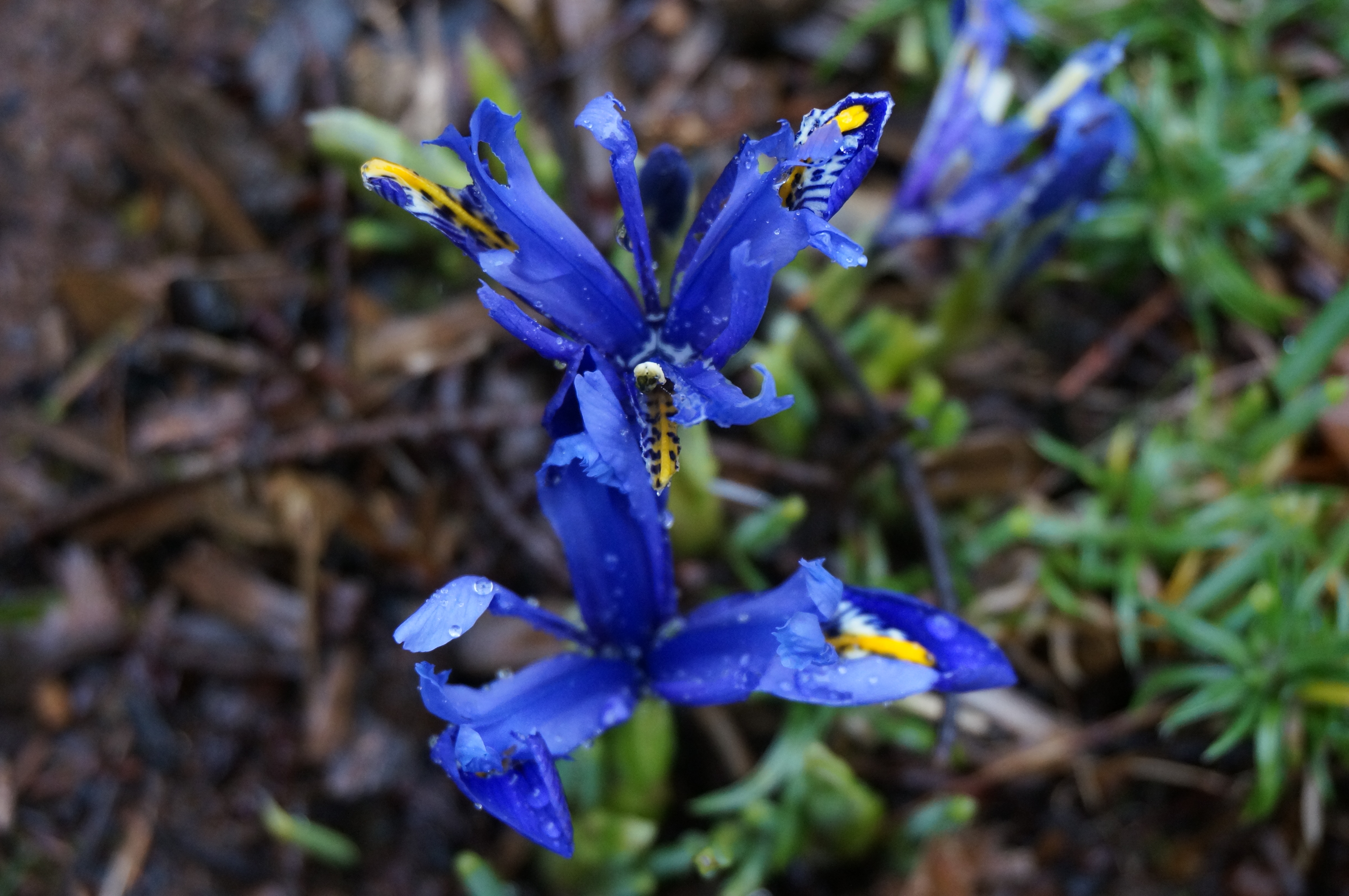
We have a slug problem. I first noticed while doing a pre-spring weeding in the flower and vegetable bed, when I kept turning up the slimy little nibblers in the soil. Then I noticed chunks bitten out of new shoots. Recently, I saw flower buds with bites. But Thursday’s transgression was the worst yet: dwarf iris’s first delicate blooms, the year’s second flowers (hellebore beat them by a week), bitten to pieces! Unacceptable.
Slug-eaten iris. Last straw!
At lunch, I broke our house rules, opened my iPad at the table, and did a search for “slug deterrents.” I found an illustrated article at WikiHow that gave me several ideas, two of which I put into practice.
The first one I’m trying is the cornmeal method. Very easy. Dump cornmeal into a jar. Lay it on its side. The slugs smell it, crawl in, and die, because…I’m not sure why. The article says the texture is too rough, but I’m not sure if it cuts their bodies up or if they die from eating it. Either way, it’s so easy I had to try it.
Cornmeal in jars, ready to go.
Cornmeal trap for slugs.
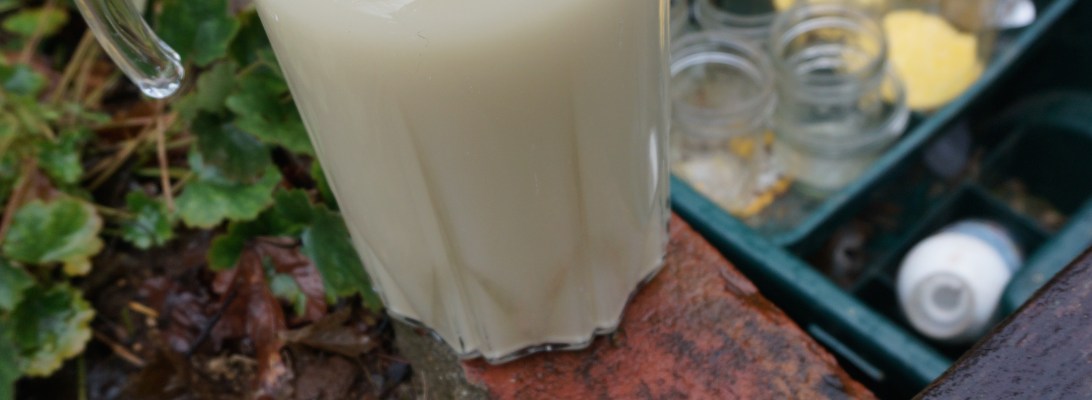
The second approach I decided on is the yeast-and-honey method. I boiled yeast and honey together, about 1/2 cup each, in a half gallon of water. I hesitated over the boiling instruction at first, since it would kill the yeast. But then I concluded that this might be a good thing; otherwise we’d have yeast bubbling all over the garden. I poured the mixture into jelly jars (I wanted to use plastic disposable cups, but we had none). Then I dug a hole in the garden near a patch of tender shoots using my nifty transplanting tool, and sunk a jar into a hole. The idea here is that the slugs will be attracted to the smell of the mixture, crawl in, and be unable to escape, drowning. I only got to place one jar, though, because it was at this point that Sofia did a face plant into a patch of mud and had to be taken inside. Ah, the hazards of gardening with babies on rainy days…
Simple ingredients: honey and yeast.
After boiling the yeast and honey.
Slug trap bait: honey and yeast in the pitcher, with cornmeal jars in the background.
Slug trap
Oops. I guess we can put out the rest of the traps tomorrow….
We shall soon see how these are working out! Already, taking Cody out for a bedtime potty venture, I noticed that a cornmeal jar near the back door had attracted two slugs. I’m hopeful that I can save my emerging blooms. To see how these methods worked out, click here.
Today a friend shared a link to an article on the Scary Mommy website, on my Facebook page. I read it with tears in my eyes. The author writes about the slow process of realizing their son had needs that weren’t being met; diagnosing him with ADHD; and, finally, reluctantly, starting medication for him. His reaction after his first day of medication was what made me tear up. This is what his mom wrote:
For the first time in … well, maybe his entire life, Colin seemed truly relaxed. But not in a stoned, disconnected way; more like a relieved way. Like someone who has finally been unburdened from the baggage that has unfairly saddled them for so long.
“I feel so much better, Mom,” he told me. “Why couldn’t we have done this from the start?”
His reaction was very much what my own feeling was, when I started ADHD medication. Relieved. Unburdened. And so much better. Why did I wait so long to admit I needed help? Pride, fear, and inability to see clearly and objectively from the haze of my condition. Medication isn’t for everyone with ADHD, but this story struck home to me. Beautiful.
We have a big rectangular garden bed with rounded ends, built up with a brick wall to make it level on a slight incline, that’s perfect for veggies. We call it the oval garden, which isn’t quite satisfactory, since it’s not oval, but of course neither is it rectangular. Anyway. This garden was planted with scattered dahlias when we moved in last spring, and there were maybe half a dozen tulips at the far end. I shifted the dahlias when they started to sprout late in the spring, interfering with my rows of peas. They were shrimpy and insignificant. I doubted they’d survive. However, they not only survived, they thrived, producing vividly colored flowers until frost killed them off in the fall. I loved them — but there were far too many of them for the veggie patch. So I determined to shift them, and the tulips.
Obviously this should have been done in the fall, as soon as the foliage died off. But the ground froze before I got to them…and then the holidays were all-consuming…and I just didn’t get to it. So last week I decided to tackle the job at last, hoping I wasn’t too late.
Three tulip sprouts had popped up already. Not too bad, I thought. There were only about half a dozen last year. A little digging, and I’ll have them all out in no time. Ha. Hahaha. Little did I know that tulips multiply! There were DOZENS of the things lurking under the soil, all with yellow-green baby sprouts. I dug…and dug…and dug. Forkful after forkful of bulbs, from barely visible babies to great big fat ones. I filled half of our little red wagon with them. Here are a few pictures of the process: [I have placed pictures here six times now. Each time, in the previewed or published post, they appear at the top of the page instead. I give up. They look prettier there, anyway. Maybe tomorrow it will reset and they’ll remember where they’re supposed to be.]
These brave babies had popped up above the surface, as you can see by their darker green color.
This is about halfway through digging. SO. MANY.
The first forkful.
I replanted as many as I could that afternoon before dark, burying them under trees and in beds all along our winding driveway. I have no idea if this was the correct solution, but since they’d already sprouted underground, putting them back into the ground seemed logical. Then I gave two dozen more to a friend. And then I spent an hour or so the next day planting even more of the things, with Niko’s help. So. Very. Many. (Yes, he’s wearing shorts. And orange-on-orange. How could I deny his need to be a pumpkin that day?)
There’s something about tulips under trees that I love.
Niko was thrilled to choose the bulbs to put into holes.
While I was planting out the tulips, I got distracted by weeds. My ADHD took over, and before I knew it I’d weeded a whole bed while the last six bulbs waited to be planted. And then I was distracted from my distraction by these lovely blooms that my weeding uncovered:
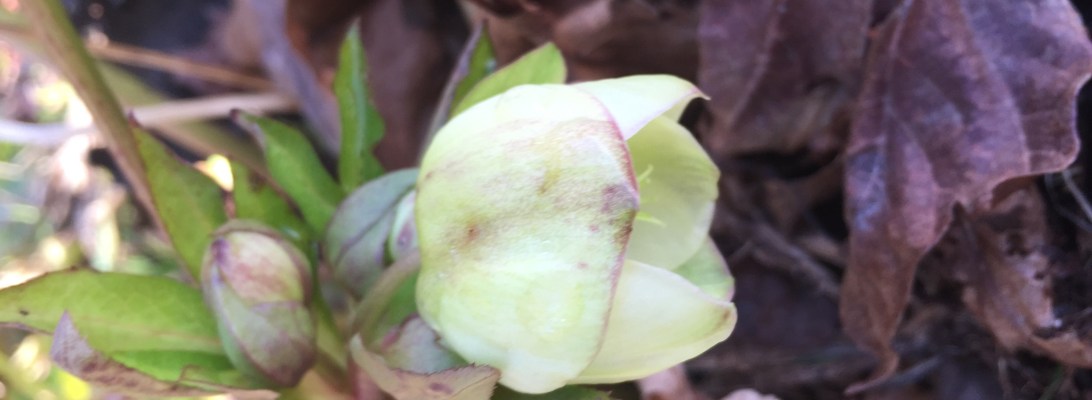
This appears to be a variety of Lenten Rose or Christmas Rose, in the Hellebore genus.
This appears to be a variety of Lenten Rose or Christmas Rose, in the Hellebore genus.
And by these shoots — young rhubarb! Exciting!
Baby rhubarb in January, thriving under leaf mulch and burlap.
Then I tackled the dahlias. These should be easy, I thought. They were so small last spring. Easy peasy. WRONG. They multiply, too! The tubers were monstrous, many-bulbed things, with each bulging root system easily eight inches across. I got as much dirt off as possible, and lay them on paper in a big feed bucket the size of a small pond. (Seriously, you could feed a whole herd of horses from that thing.) I’ll divide and plant those monsters when the frost danger is past…and no doubt I’ll have some to give away, too.
A feed bucket full of baby dahlia monsters.
Look at those tubers!
One final tidbit: Sofia sound asleep after an exhausting afternoon of riding on my back while I dug things up and buried other things.
Sound asleep. Relaxing on Mom’s back is exhausting!
Next project: a long raised bed of overcrowded gladioli to dig up, divide, replant, and (of course) share with friends. Should be easy, right?
Lately Niko has been giving me kind compliments. “I like your hair, Mommy,” he’ll say, petting me gently as if I’m a shaggy-haired dog. Sometimes he’ll tell me out of the blue, “I like you!” or ” I love you soooo much!” Or, “You smell so good!” he’ll tell me as he lays his head on my shoulder for a hug. The last time he pulled that particular one out, I hadn’t managed to get a shower for about three days and was sweaty and dusty after sweeping, mopping, and vacuuming the house, so I think he has a long way to come as far a distinguishing a good human smell from a less marvelous one. But the thought is sweet, anyway.
A couple of days ago, he announced, “I think Daddy should bring you some pretty flowers when he comes home.” (Aaron was on a business trip.)
“Really?” I asked. “Why do you think that?”
“To show you how much he loves you,” he explained. “Because he loves you lots.”
It made me think. Kids Niko’s age, while they’re working on establishing a personal identity, are still little imitators. Niko’s sweetness and kindness weren’t created in a vacuum. His outpouring of love to me is in direct imitation of his dad. And it’s dawning on me that this is, in fact, a gift to me from my amazing husband.
When I fix Niko a just-right sandwich and he says, “OH! Thank you, Mom! That is so nice of you to make me a sandwich!” I realize that he’s been paying attention to his dad, who thanks me every single time I serve a meal…even if it’s burnt. Or late. (Or both.) Even if he’d have done it better himself. Every time.
When Niko gives me those sometimes inaccurate compliments on my hair or the way I smell, it’s because he hears his dad say the same thing. “Your mom is so beautiful, isn’t she?” Aaron will say to Niko, and Niko answers, “Yes! You’re pretty, Mom!”
Or Aaron might say to Niko, “Your mom is really special. I love her a lot. Do you love her too?” And Niko says, “I love you soooo much, Mom!”
So when my son gives me these funny, adorable compliments, it’s because his dad is teaching him how to express love and admiration. His dad is teaching him that love shouldn’t be hidden away. And in doing so, my husband is giving me the gift of a quirkily loving child.









 A Bright Ray of Hope